
Daily freshly harvested salads and herbs from an automatically controlled greenhouse (‘Plantcube’) – with this concept, the Munich-based start-up Agrilution wanted to bring the idea of vertical farming into the home. Since the end of 2019, this has been happening under the umbrella of the Miele Group. Now, the Gütersloh-based household appliance company has announced that it will no longer be continuing the business with the Plantcubes due to a lack of economic prospects. This affects almost 40 salaried as well as additional student employees, who have been given notice of termination due to the closure of the business on June 30, 2023. The approximately 650 users, who also purchased their seeds (‘Seedbars’) through Agrilution, will soon receive an offer to buy back their equipment.
Experts understand ‘vertical farming’ as the space-saving supply of fresh food via large, multi-storey greenhouses. Agrilution itself was founded in 2013, but then had to file for insolvency proceedings in 2019 after a financing round could not be realised as planned. After the opening of insolvency proceedings, Miele took over the brand, the know-how and almost all employees in a so-called asset deal and transferred them to the newly founded 100% subsidiary Agrilution Systems GmbH.
Over the past few years, with intensive financial and technical support from Miele, work has been done to guide the business model, product portfolio and workforce into a sustainable marketable future. ‘Unfortunately, however, it has since become apparent that demand has fallen far short of expectations,’ says Gernot Trettenbrein, Senior Vice President New Growth Factory, amongst others responsible for new business areas at Miele. In addition, this product was marketed at over 3,000 euros due to its technical complexity.
In order to make the Plantcube attractive to broader target groups, an additional series was to be launched at a significantly lower entry price. However, this could no longer be realised due to the skyrocketing costs of materials, energy and logistics. As a result, after careful consideration of all available options, the decision was made not to pursue the plantcube business any further. In conjunction with this, Agrilution’s business operations will cease on June 30, 2023. Miele would like to thank the Agrilution team for their dedicated service and wishes all employees the success they deserve in their future careers.
The dealers who marketed Agrilution’s Plantcube as resellers have already been informed separately by Agrilution, as have all end customers and other users. Furthermore, the company has announced that it will buy back all Plantcubes that are in use or still in stock. Detailed offers will follow within the next few weeks
Tag Archives: Miele
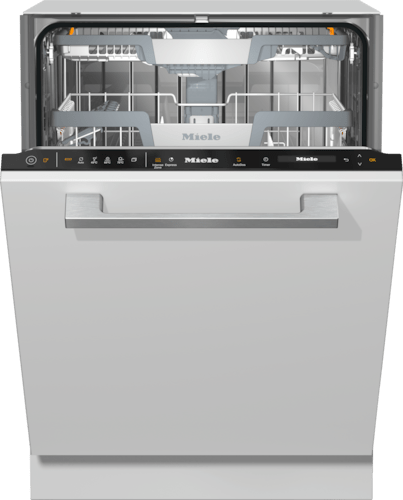
Green product award to the Miele dishwasher
Tenth edition for the Green Product Award . In the kitchen category, the award went to the fully integrated Miele model G 7465 SCVi XXL AutoDos. The international jury appreciated “In particular, the transparency of energy and water consumption through the app involves the consumer who seeks greater sustainability and makes him responsible”. This is the new consumption panel in the Miele app, which displays how often a program is used weekly, monthly or annually and how much water and electricity it actually uses. The app also compares the average values of the programs and provides ecological advice.
The awards are organized by the Green Future Club, a network of sustainable innovators and experts with a vision for a near future where all products are sustainable. The club organizes awards, exhibitions and networking events, supports young designers and publishes the annual Green Trend Book with international best practices. Nils Bader , promoter of the award, emphasizes: “ With the awards, we present existing, future and, of course, sustainable alternatives and network the players. With the exhibition and the talks we want to surprise and show what is already possible. No one should do things randomly, but plan, design and ultimately consume with a different perspective in the future .”Innovative water feed for washing with less water
In the ECO programme, water consumption is reduced to 8.9 litres. This also means that less energy is required to heat the water, and you benefit from an energy-efficient dishwasher. The water savings are achieved through the intelligent design of the supply system and a new, highly efficient filter system. Additional insulation reduces thermal losses and thus the amount of energy required to heat the water.


Miele continues to grow – and builds production plant in the USA
Miele have announced an important step for future growth: With the new plant in the USA, we will manufacture the special range cookers and ovens for the USA, Canada and Mexico in close proximity to the market. This will not only save on shipping but will also free up new capacities at our existing production sites in Arnsberg, Bünde and Oelde. Start of production planned for end of 2024 / First expansion phase with
150 employees
The decision on the specific location will follow within the coming months
In order to continue and further strengthen its growth course, the Miele Group is expanding its production capacities. The next milestone is the Gütersloh-based family group’s first plant on the American continent, where ovens are to be manufactured for the USA, Canada and Mexico. For the world’s leading manufacturer of premium domestic appliances and machines for commercial use, this is the eighth production site outside Germany, out of a total of 16 plants.
Thanks to its high-quality ovens, hobs, steam cookers, cooker hoods and other attractive products, the business unit Cooking has been one of the Miele Group’s most important growth drivers for many years – most recently generating more than € 1.1 bn in sales, representing an increase of almost 13%. “We are planning for further increases in unit sales in the coming years,” says Dr. Uwe Brunkhorst, Senior Vice President Business Unit Cooking, “and this means that our current production sites in Arnsberg, Bünde and Oelde are approaching the limits of their capacities”.
There are several good reasons behind our decision to produce in the USA in future. “Even today, the United States represent Miele’s biggest market outside Germany, with considerable growth rates recently but still plenty of potential”, says Dr. Axel Kniehl, Executive Director Marketing & Sales with the Miele Group. Manufacturing locally is therefore a logical step and sends out a strong signal to our customers there. This also dispenses with the need to ship appliances across the Atlantic: “This reduces delivery times from currently up to 10 weeks to only a few days, whilst at the same time protecting the environment”, says Dr. Stefan Breit, Executive Director Technology. In order to further reduce CO2 emissions, the majority of supplier parts will also come from the USA.
In a first step, at this new plant, Miele will manufacture 30-inch ovens and large, versatile range cookers, both designed specifically for North America. Large-format cooker hoods will be added later. Production is scheduled to start at the end of 2024; in a first step, the workforce will grow to 150 employees by the end of 2025. A decision on the precise location will be made and communicated over the coming months. What a second stage expansion might look like, with a view to further product groups and the personnel required for this, will be reviewed at a later date.
Today, production within the business unit Cooking is distributed as follows: Hobs and steam ovens as well as warmer drawers come from the Bünde plant (approx. 730 employees), cooker hoods are manufactured in Arnsberg (approx. 250 employees) and conventional ovens and dialogue ovens come from Oelde (approx. 670 employees), all situated in Germany. The particularly versatile steam ovens are produced in Bünde or Oelde, depending on the model. The Production of the large-format series to the new plant will not in any way weaken Arnsberg, Bünde or Oelde. On the contrary: “We will become more efficient through less complexity and at the same time free up the urgently needed capacities for future growth with the remaining model series”, says Uwe Brunkhorst.
Including the new plant, the Miele Group’s international production network will then comprise a total of 16 plants, eight of them in Germany and one each in Austria, China, the Czech Republic, Romania, Poland and the USA. In addition to this, there are also two plants belonging to the Italian medical technology subsidiary Steelco Group.

Miele UK electric ID Buzz
Miele UK are delighted to announce that we’re one of the first companies in the UK using the new, all electric ID Buzz of Volkswagen Commercial Vehicles UK in our service fleet!
Having the ID Buzz as part of our award winning service fleet, not only reliably brings our service technicians to our customers, but also supports us in converting our vehicle fleet to renewable energies. This is an important step towards our global goal of reducing the CO2 emissions of our fleet by at least 30%, by 2030.
The first Miele ID Buzz was handed over today at our head office in Abingdon, by Dave Smerling from Volkswagen Group Fleet International, to Miele Service Tech
Miele increase sales
In a challenging environment with overall declining markets, the Miele Group has grown once again and reports € 5.43 bn sales in 2022.
As in previous years, we produced, sold and shipped more products than ever before. An above-par contribution to this accomplishment came primarily from eastern European and Asian markets, including China, but long-standing markets such as Australia, Great Britain, the Netherlands and the USA gave a good hand, too. The contribution to turnover coming from outside Germany was 72%.
Miele green aluminium
Miele introduces green aluminium to production: After having started to deploy green steel, we are now the first company in our industry to use primary aluminium, produced exclusively using green electricity from hydropower.
As part of a pilot project, we will use profile strips in the manufacture of ovens, which as of this year will be made from around 150 tons of CO2-reduced aluminum and are 100 percent recyclable. This way, we reduce our CO2 footprint by 645 tonnes a year. In doing so, we make yet another contribution to greater sustainability in the supply chain.
“The objective is to use climate-friendly aluminium on a broad front and thereby contribute towards a future-proof economy”, says Senior Vice President Hans Krug who is in charge of Purchasing at the Miele Group. In the picture, Hans Krug (left) and Oelde plant manager Rouven Vierfuss show a profile strip made of aluminum.

Miele presents Pioneering GmbH
Miele has founded its own incubator in order to further promote the development of innovative solutions from within the ranks of the workforce and implement them faster. With Pioneering GmbH, Miele is ensuring a creative environment in which internal start-ups can bring their ideas to fruition faster, well away from established structures. Management of Pioneering GmbH is to be shared by Ina Nordsiek, Director Intrapreneurship within the business unit, and Hendrik Stegelmann, Director Digital Innovation and Products with Smart Home. Both will assume their new responsibilities alongside their existing tasks.
Particular attention will be paid to promoting business ideas which represent a strategic fit but are outside Miele’s previous core business field. «With Pioneering GmbH – Nordsiek explains – we are offering administrative freedom and elbow room and a professional and inspiring environment in which we bring together the best of the start-up and the Miele world». As Stegelmann added, «on the one hand, teams have the liberties and autonomy of a start-up whilst on the other being able to fall back on the support of a globally active family company».
In more concrete terms, ideas for innovative business models, product or process solutions from the New Growth Factory or Smart Home are transferred to the new company which, after careful evaluation by Miele, are considered promising. Once there, development of the so-called Minimum Viable Product continues through to market maturity, initial discussions with potential customers and market trials under real-life conditions. If the business case overcomes this hurdle, it is either integrated at Miele or pursued further as a separate start-up founded at that point
Miele new commercial dishwasher
New commercial dishwashers from Miele’s MasterLine series are the products of choice: The proven fresh water system takes in fresh water for each phase of the programme and uses high temperatures to remove soil and reliably deal with viruses and bacteria. In the course of everyday work, short cycles make for efficient processes. These models are ideal for kindergartens and nurseries.
Thanks to their large touch display, all models from the MasterLine series are intuitive to use, even when wearing gloves. M Touch Basic and M Touch Flex represent two sets of controls giving fast access to favourites and allowing individual adjustment to programmes – intuitive thanks to plain text, symbols and 32 languages. The M Touch Flex version with its colour display takes user convenience to the next level. For example, programme names can be changed in order to eliminate operating errors. The individual stages of operation are explained in short, informative sequences.
The new dishwashers remove 99.999% of most bacteria, even in the ‘Super Short’ programme with its cycle time of only 5 minutes. For verifiable and above-average virucidal efficacy, the Institute for Integrative Hygiene and Virology – InFluenc_H has awarded this series its Virus Seal of Approval in Gold. Security functions enable even greater safety. These include a door lock which prevents unauthorised access during a running programme.
Virus Seal of Approval in Black for particularly high standards of hygiene
In addition to this, the model PFD 407 has been awarded the Seal of Approval in Black which defines even higher standards. This model with its Vario TD programme offers thermal disinfection, otherwise only the preserve of the medical sector, removing even more than 99.99% of enveloped and non-enveloped viruses (for example Corona, Influenza and the Norovirus).
All models clean crockery thoroughly and remove stubborn food residues. Redesigned baskets improving the use of space simplify loading and offer ample space on two rack levels. To ensure that light-weight parts such as learn-to-drink cups and their lids stay put throughout the cycle, Miele offers special-purpose basket inserts. There is also a matching basket for up to 16 bottles or other items such as thermos flasks, guaranteeing thorough cleaning on the inside.
Several models feature Miele’s innovative Dry+ technology. This active drying system extends programmes by 8 minutes and dispenses with the need to use a tea-towel, reducing the workload of staff. Without the least manual intervention, plates, cups and cutlery are ready for use again in next to no time, even if they consist entirely or partly of plastics.
Order cleaning chemicals online
The new MasterLine dishwashers connect to the Miele MOVE online portal. This allows users to track how many machines are in use from the convenience of a smartphone or tablet – even listing which programmes are most frequently used. And there’s another practical feature: The simple ordering of detergents and other chemicals via a direct link to the Miele Professional Shop.
Similarly, process data vital in ensuring hygienic clean crockery, for instance temperatures and cycle times, can be saved with Miele MOVE and, if necessary, exported. This allows users to furnish proof of hygiene programmes having successfully completed.
MasterLine dishwashers can also be installed in a tall unit. These models meet all the provisions of the European Machinery Directive, which is essential if machines are to be used in a commercial environment, and they are made from durable materials. Tested for 28,000 cycles, these machines guarantee spotless crockery for many years.
Company profile: Miele is the world’s leading manufacturer of premium domestic appliances including cooking, baking and steam-cooking appliances, refrigeration products, coffee makers, dishwashers and laundry and floor care products. Their product portfolio also includes dishwashers, air purifiers, washing machines and tumble dryers for commercial use as well as washer-disinfectors and sterilisers for use in medical and laboratory applications. Founded in 1899, the company has eight production plants in Germany, one each in Austria, the Czech Republic, China, Romania and Poland as well as two production plants belonging to its Italian medical technology subsidiary Steelco. Sales in the 2021 business year amounted to around € 4.84 bn. Miele is represented with its own sales subsidiaries and via importers in almost 100 countries/regions. Throughout the world, the family-run enterprise, now in its fourth generation, employs a workforce of around 22,300, of which approx. 11,200 employees work in Germany. The company has its headquarters in Gütersloh in Westphalia.
DOWNLOAD AS PDF
DOWNLOAD INCL. MEDIA (ZIP)
Your contact
Anke Schläger
+ 49 5241 89-1949
anke.schlaeger@miele.com
Media information
Description
Hygienically clean and dry crockery, thanks to innovative technology: Installed in nurseries, a Miele fresh water dishwasher from Miele’s MasterLine series takes the workload off staff, freeing up more time for the care of little ones. (Photo: Miele)
Download
HIGH RESOLUTION JPG
Description
Thanks to their large touch display, all models from the MasterLine series are intuitive to use, and can even be operate
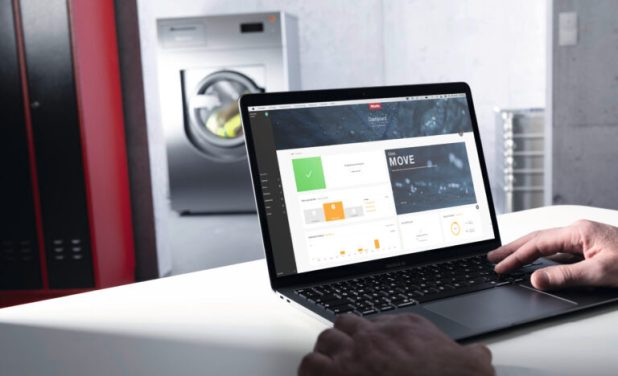
Miele MOVE portal
Miele’s MOVE portal is available for all Miele laundry machines from the Little Giants and Benchmark generation, catering for load capacities of 6 to 20 kg (washing machines) or up to 44 kg (dryers). This platform for PCs and mobile devices allow professional users to get information quickly and easily on which washing machines are running, when the dryer has finished, how high the consumption is etc. Where necessary, relevant messages are sent direct to a smartphone or tablet, for instance informing users when a washing machine or dryer can be unloaded. The direct link to the Miele Professional webshop is helpful in terms of supply management, simplifying the re-ordering of consumables such as detergents. “Miele MOVE – the company explains – also allows the monitoring of the key process data which is essential in producing hygienically clean laundry, for example temperatures and times. Programme data is also quickly exported and saved. This, for instance, allows proof to be furnished that disinfection programmes were successfully completed. In addition, further economies can be pinpointed by archiving and evaluating operating data”. Besides, error messages are sent direct by the client, consent permitting, to a designated contact in Miele Service or to a certified Miele service agent, without having to pick up the phone. Thanks to the data transmitted, the cause is immediately visible to staff, facilitating a fast and targeted remedy – either in the form of a service visit by a trained technician with the necessary parts on board or self-help instructions over the phone. The use of the basic version of Miele MOVE is free of charge. A monthly fee is only levied from the fourth machine connected onwards. The platform is now active in numerous countries: further markets to follow
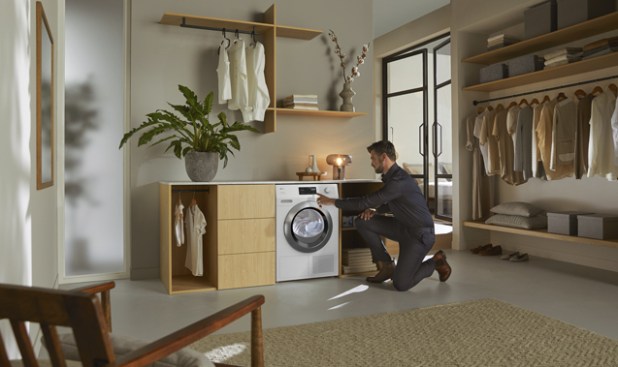
Miele heat-pump dryer
Miele heat-pump dryer save more than € 1,200* in energy costs over ten years
Hanging laundry out to dry in a heated room is not a good idea in winter – and not sustainable, either. After all, evaporating the moisture in laundry results not only in mould indoors but also in increased heating costs. Removing moisture from laundry followed by the need for airing rooms requires additional energy input. A proven and, on balance, more climate-friendly alternative during the cold season is an energy-efficient heat-pump dryer which not only uses energy sparingly but is also fast and convenient and leaves laundry soft and bouncy.
Drying laundry involves evaporating moisture, a process which requires a lot of energy. A heat-pump tumble dryer therefore represents a milestone in the quest for sustainability in laundry care as this approach recuperates the energy from the moist, warm drying air of the laundry in the drum and reintroduces it to the process via a heat pump. This, in turn, significantly reduces the energy needed to heat up more air. As a result, top Miele models equipped with a heat pump today overshoot the A+++ rating for energy efficiency by a margin of 10%, whilst conventional condenser and vented dryers only achieve, at best, a B rating. Consequently, a highly efficient heat-pump dryer from Miele cuts energy costs over a 10-year period by more than € 1,200* – compared with Miele condenser dryers without a heat pump. For this reason, these less efficient versions were entirely removed from the programme range last year.
And, what’s more, Germany’s consumer watchdog Stiftung Warentest has confirmed once again that Miele dryers are particularly energy-efficient. The Miele TEF 775 WP was the sole winner in the September 2022 issue of their ‘test’ magazine, saving up to € 174** in electricity costs over ten years. The other Miele models in the test were also the only ones to be awarded a ‘Very good’ (1.5) for their environmental properties. Moreover, the Miele dryers were the only models tested to achieve an A rating for condensation efficiency, with more than 90% of the water evaporated being recaptured. This means that heat-pump dryers from Miele are particularly tightly sealed and therefore release only extremely small amounts of moisture into the room and hence very effectively avoid problems with mould over their long life cycle.
But it is not only energy efficiency which ensures sustainability: the use of materials which go easy on resources and a long life cycle are also important contributing factors. A significant contribution to this is made by the floor module, which was developed from scratch and whose plastic is enriched with nitrogen in an innovative manufacturing process. This saves 30 percent of material – while at the same time improving stability. In addition, the climate-friendly refrigerant R290 is used. Both the new base module and R290 are also used in almost all Miele dryer models.
As the only manufacturer in its line of business, Miele tests its dryers for a life cycle of 20 years. To test this life expectancy under representative, real-life conditions, Miele performs a battery of challenging and strenuous endurance tests to simulate 5 cycles per week or a total of 5000 programme cycles.
‘DryCare 40’ gently dries even delicate fabrics
The DryCare 40 option ensures that all items of clothing washable at 40°C can be tumble-dried without the least worry – even if textiles are not approved for machine drying according to the wash-care label. This is facilitated by reducing the air temperature during the drying process to ensure that delicate fabrics are dried so gently that damage can reliably be ruled out. DryCare 40 can be selected in a whole series of programmes such as Cottons, Minimum Iron and Shirts. This subjects fibres to no more strain than necessary and guarantees that garments keep their shape and remain soft to the touch.
Further convenience is offered by the SilenceDrum, which is only available from Miele: Buttons and zips are known to be a source of annoying noises. Thanks to a special design in which the drum is partially lined on the outside with insulating felt strips, such noises are noticeably reduced by the SilenceDrum.
Unnecessary washing can be avoided by the PowerFresh feature. Garments which, for example, have been sitting around in a cupboard for a long time can be freshened up to remove any odours they may have absorbed. This approach involves the inclusion of a moisturising phase before drying commences. Steam makes for better heat transfer to the load, thereby releasing and removing odour molecules more efficiently. The PowerFresh extra unfolds its full potential in combination with the DryFresh flacon, which additionally neutralises odours and leaves behind an unobtrusive, fresh fragrance.
*Consumption according to energy label: TDA150 C: 494 kWh/year, TWF760 WP: 161 kWh/year, TCA230 WP: 208 kWh/year. / Energy costs for the next 10 years calculated with an average price of 43 cent per kWh: TDA150 C: 2.124,20 €, TWF760 WP: 1.431,90 €, TCA230 WP: 1.229,80 €.

