
When people talk about sustainability, they often picture solar panels, electric cars, or futuristic tech. But some of the biggest environmental wins are happening in the background — inside the everyday appliances we rely on without a second thought.
One of the best examples is the humble washing machine.
From 65 Litres to 46: A Generation of Progress
Back in the 1990s, a typical wash cycle used around 65 litres of water. Fast‑forward to today, and modern machines average just 46 litres per cycle — a remarkable reduction of 19 litres every single wash.
That’s not a small tweak. It’s a fundamental shift in how efficiently appliances use resources.
Scaling Up: The EU‑Wide Impact
Now imagine that improvement multiplied across Europe.
– 200 million households
– 200 wash cycles per year
– 19 litres saved per cycle
Add it up, and you get an astonishing 760 billion litres of water saved every year across the EU.
That’s the kind of impact that rarely makes headlines — but absolutely deserves to.
Sustainability That Fits Into Everyday Life
What makes this progress so powerful is its simplicity. Consumers don’t have to change their habits or buy niche eco‑products. The efficiency is built in.
Modern washing machines:
– Use less water
– Consume less energy
– Cost less to run
– Deliver better performance
– Reduce environmental impact automatically
This is sustainability at its best — practical, invisible, and woven into daily life.
Why It Matters for the Future of Home Appliances
As manufacturers continue to innovate, we’re seeing a clear trend: appliances that deliver more while using less. For households facing rising utility costs and for a continent focused on resource conservation, these improvements aren’t just welcome — they’re essential.
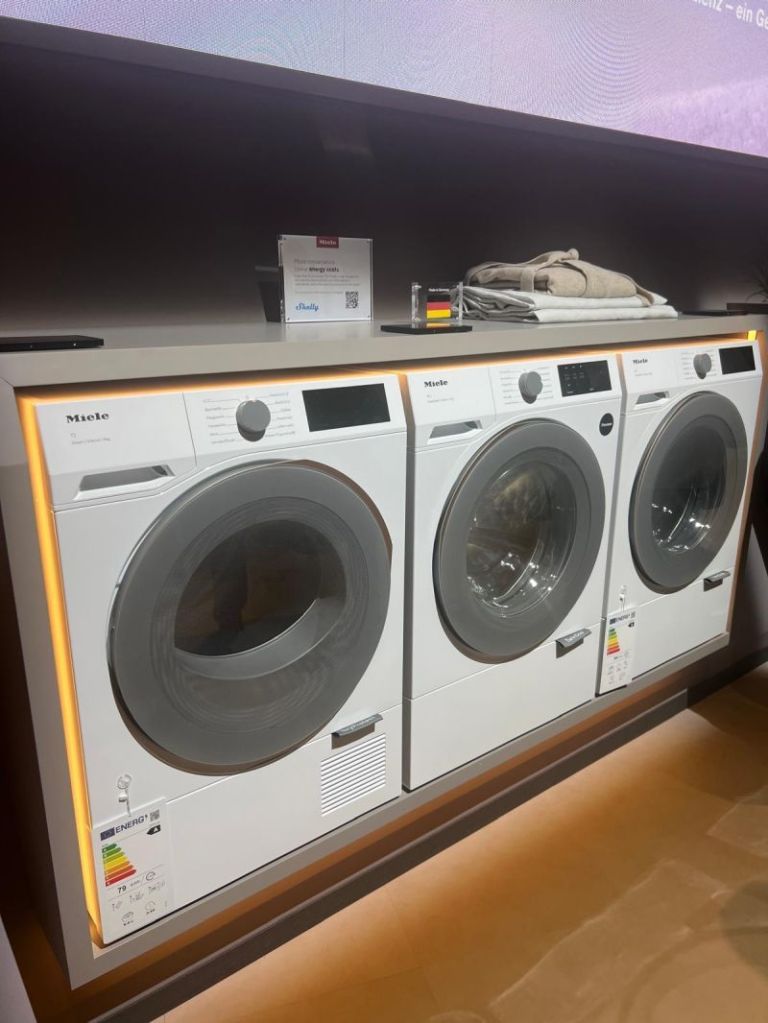
WASHING MACHINE TECHNOLOGY: THE FEATURES SHAPING TODAY’S LAUNDRY MARKET
Modern washing machines are evolving fast, with manufacturers adding smarter software, gentler drum systems, and energy‑saving technology designed for real‑world family laundry. For retailers, these innovations are now key selling points, helping customers understand not just capacity and spin speed, but the genuine performance differences between brands.
SMART CONNECTIVITY
Connected laundry is now mainstream. Wi‑Fi, Bluetooth and NFC allow customers to control their machine from a smartphone: starting or pausing cycles, receiving end‑of‑wash alerts, downloading extra programmes, and running remote diagnostics. Key platforms include Hoover One Touch, Beko and Blomberg HomeWhizz, Samsung Smart Control, and Bosch Home Connect. These ecosystems are becoming major differentiators for tech‑savvy households and premium buyers.
ECO AND INTELLIGENT DOSING TECHNOLOGY
Manufacturers are investing heavily in systems that reduce water, energy and detergent waste. LG AI DD detects fabric softness and load characteristics, adjusting drum movement for improved fabric care. Bosch i‑DOS automatically doses detergent and water based on load weight and soil level. Bosch SpeedPerfect cuts wash times by up to 65 percent while maintaining cleaning performance. Samsung EcoBubble premixes detergent with air and water to create bubbles that clean effectively at lower temperatures. These features matter to customers focused on sustainability and running costs.
ADVANCED DRUM AND WATER‑JET SYSTEMS
Drum engineering is now a battleground for premium performance. LG 6 Motion Direct Drive uses six drum movements tailored for different fabric types. Blomberg RapidJet cascades water and detergent from the top of the drum, reducing harsh mechanical action and speeding up cycles. Beko AquaTech uses water jets to deliver washes up to 50 percent faster and 50 percent gentler. These systems appeal to customers wanting faster cycles without compromising garment longevity.
QUIET, EFFICIENT BRUSHLESS MOTORS
Brushless inverter motors have become standard in mid‑to‑premium machines, offering quieter operation, reduced vibration and improved energy efficiency. Bosch EcoSilence Drive and Siemens iQdrive are key examples. Noise levels can drop as low as 47 dB, making these machines ideal for open‑plan living.
PRACTICAL EVERYDAY FEATURES
Real‑world usability remains a major selling point. AddWash and Reload doors let users add forgotten items mid‑cycle. ActiveCare stain removal systems from Hoover and Hotpoint mix water and detergent for deeper fibre penetration, tackling over 100 common stains at just 20°C. These features resonate strongly with busy families and customers who value convenience.
RETAIL TAKEAWAY
Washing‑machine innovation is accelerating, with brands competing across smart connectivity, eco‑efficiency, drum engineering and stain‑removal performance. For retailers, clearly explaining these technologies helps customers understand why certain models command a higher price and which features genuinely match their lifestyle.
Washing Machines in North America: Best-Selling Models, Smart Features and How They’re Made
Washing machines are one of the most important categories in the white-goods industry, and North America remains a highly competitive market. Consumers are looking for machines that combine large capacity, cleaning performance, energy efficiency, convenience and increasingly, smart technology.
The market is dominated by familiar names such as Whirlpool, LG, Samsung, GE Appliances and Maytag. Current retail rankings show particularly strong demand for high-efficiency top-load machines, while front-load washers continue to attract customers looking for premium features and stackable designs.
Which washing machines are selling strongly?
There is no single public sales ranking covering every retailer across North America, so the best way to identify current best sellers is to look at major retailers and consumer-satisfaction research.
At Lowe’s, current best-selling listings include the Whirlpool Deep Water Wash High Efficiency Agitator, GE High Efficiency Agitator, Whirlpool removable-agitator washer, Maytag Deep Fill washer, and several LG and Samsung models.
Best Buy’s current best-selling washer listings similarly feature Samsung, Whirlpool, LG, GE Profile and Insignia models. Its front-load best sellers are particularly concentrated around LG and Samsung machines with smart functions, steam, high efficiency and rapid-wash technologies.
Consumer satisfaction also provides an interesting picture. In J.D. Power’s 2026 U.S. Appliance Satisfaction Study, Maytag ranked highest among front-load washers, followed closely by LG and Whirlpool. For top-load washers, LG ranked first, followed by Samsung and Maytag.
Key features consumers are looking for
- High-efficiency washing
Water and energy efficiency have become central to modern washer design. High-efficiency machines use sensors and carefully controlled water levels to clean clothes without unnecessarily filling the tub.
Front-load washers can be particularly efficient because they use the tumbling action of the drum rather than requiring a large volume of water to move clothes around.
- Large-capacity drums
Large-capacity washers are popular with families because they can handle more clothing, bedding and towels in a single cycle.
Current North American models commonly range from around 4 to 5 cubic feet, with premium machines going beyond that. Retail listings show many of today’s popular machines positioned around the 4.5-cubic-foot capacity range.
- Agitators and removable agitators
The traditional top-load agitator remains popular in North America. Modern designs have evolved considerably, with manufacturers developing high-efficiency agitators and removable versions.
A removable agitator gives consumers the option of using traditional agitation for heavily soiled clothing or removing it to create more open space for larger loads.
- Faster washing
Manufacturers are competing to reduce cycle times without compromising cleaning performance. Features such as TurboWash and Super Speed Wash are examples of technologies designed to shorten washing cycles.
- Steam and specialized cycles
Steam has become a premium feature, particularly in front-load machines. Depending on the model, steam functions can be used as part of cleaning or fabric-care programs.
Modern washers also offer specialized cycles for items such as bedding, delicate fabrics, sportswear and heavily soiled clothing.
- Smart connectivity
Smart washing machines are moving beyond simple remote start. Many premium machines can connect to a smartphone application, provide cycle information and use sensors to adjust washing programs.
LG, Samsung and other manufacturers are increasingly integrating connected laundry systems into their product ranges.
- Automatic sensing
Sensors are an important part of modern washer engineering. They can help determine load size and adjust water levels or cycle settings.
The electronic control board acts as the machine’s central control system, coordinating functions such as water levels, cycle operation and other electronic components.
How is a washing machine manufactured?
Behind the finished appliance is a complex manufacturing process combining metal forming, plastics production, electronics, mechanical engineering and final assembly.
The manufacturing process can broadly be divided into fabrication, sub-assembly and final assembly.
Step 1: Producing the metal components
Washing-machine cabinets and internal structural components commonly use formed sheet metal.
Large presses shape metal sheets using dies. The resulting components may then be cut, drilled, bent or otherwise processed to achieve their final dimensions.
Metal components require accurate manufacturing because the cabinet and internal structures must fit together precisely.
Step 2: Moulding plastic components
Modern washing machines contain numerous plastic components, including covers, housings, pipes and other technical parts.
Plastic injection moulding allows manufacturers to produce large numbers of consistent components at high speed.
Step 3: Manufacturing the drum and tub
The drum is one of the most important parts of the appliance. It must withstand repeated rotation, vibration and contact with water and laundry.
A washing machine generally has an inner perforated tub or drum and an outer tub that supports it and contains the water.
Step 4: Motors, pumps and electronics
The mechanical and electrical systems are assembled into functional sub-components.
Important components include the motor, water pump, inlet valves, control electronics and drainage system. The motor provides the power needed to rotate the drum or washing mechanism, while pumps move and remove water.
Step 5: Final assembly
Once individual components and sub-assemblies are ready, they are brought together on the production line.
The outer cabinet, tub, motor, pump, wiring, electronic control board, door or lid and control panel are assembled into the finished machine.
Modern appliance factories use substantial automation, although some operations still require human workers. Quality checks are also performed on incoming materials and finished products.
Step 6: Testing
Before a washing machine reaches a retailer, manufacturers need to verify that its mechanical, electrical and water-handling systems operate correctly.
Testing can include checking controls, water filling and draining, drum movement, vibration, leaks and electrical performance.
Where is the North American market heading?
The North American washing-machine market is becoming increasingly divided between affordable high-efficiency top-loaders and more technologically advanced front-load and smart machines.
Retail rankings demonstrate that traditional top-load machines remain extremely popular, while front-load models are competing through premium features such as steam, smart connectivity, stackability and advanced wash systems.
At the wider appliance-brand level, recent U.S. market data also shows intense competition among LG, GE, Whirlpool and Samsung. In Q1 2026, LG led the overall major-appliance unit-share ranking, followed by GE, Whirlpool and Samsung, although this figure covers several appliance categories rather than washing machines alone.
Conclusion
Today’s washing machine is far more than a motor, drum and water supply. It is a sophisticated white good combining mechanical engineering, electronics, sensors, software, plastics and precision-manufactured metal components.
In North America, the strongest products combine familiar practical benefits—large capacity, effective cleaning and simple controls—with newer features such as high-efficiency operation, removable agitators, steam, faster cycles and smartphone connectivity.
For manufacturers, the challenge is to deliver these features while keeping production costs, water and energy consumption, noise and reliability under control. For consumers, that competition means an increasingly broad choice of washing machines across different price points and household requirements.
Ready to take your laundry efficiency to the next level? Share your thoughts, experiences, or questions in the comments — or explore more of our deep‑dives into innovative home appliances to keep discovering smarter ways to care for your home.

