
The European Commission Have adopted a new proposal for common rules to encourage the repair of electronic equipment. This should make it easier and cheaper to repair devices instead of replacing them, as the commission announced. Refurbed.at basically sees the move as the right signal, but the proposal in its current form unfortunately falls short of expectations, as the platform for remanufactured products says.
In recent decades, replacement of defective products has often been preferred to repair, and consumers have not been given sufficient incentives to have the goods in question repaired once the legal guarantee has expired, the EU Commission has criticized. The new proposal aims to make it easier and cheaper for consumers to have goods repaired instead of having them replaced. “In addition, higher demand will boost the repair sector and at the same time create incentives for manufacturers and sellers to develop more sustainable business models,” writes the EU Commission and continues: “The proposal will ensure
Five to ten years repairability
Customers should be able to request that manufacturing companies repair products that are technically repairable under EU law for a period of five to ten years . But of course there are no rules without exceptions at the European Commission either. This means that sellers are obliged to repair within the warranty period, “unless it is more expensive than an exchange,” it says.elektro.at HOME
EDITOR’S CHOICE
positive signal
EU Commission: Is there a right to repairs?
BACKGROUND | Stefanie Bruckbauer | 03/23/2023
The European Commission yesterday adopted a new proposal for common rules to encourage the repair of electronic equipment. This should make it easier and cheaper to repair devices instead of replacing them, as the commission announced. Refurbed.at basically sees the move as the right signal, but the proposal in its current form unfortunately falls short of expectations, as the platform for remanufactured products says.
In recent decades, replacement of defective products has often been preferred to repair, and consumers have not been given sufficient incentives to have the goods in question repaired once the legal guarantee has expired, the EU Commission has criticized. The new proposal aims to make it easier and cheaper for consumers to have goods repaired instead of having them replaced. “In addition, higher demand will boost the repair sector and at the same time create incentives for manufacturers and sellers to develop more sustainable business models,” writes the EU Commission and continues: “The proposal will ensure
Five to ten years repairability
Customers should be able to request that manufacturing companies repair products that are technically repairable under EU law for a period of five to ten years . But of course there are no rules without exceptions at the European Commission either. This means that sellers are obliged to repair within the warranty period, “unless it is more expensive than an exchange,” it says.
Companies should also provide information about which products they have to repair themselves. And: Citizens should be able to find out about repair services and points of sale for outdated goods on national mediation platforms.
The European Parliament and the EU states must now discuss the proposals and negotiate a compromise on the proposals. It may be some time before consumers really benefit from the project.
By the way: Of course, the environment should also be relieved by the project. Fewer discarded products naturally result in less waste and less material used in manufacturing. As a result, there are also fewer greenhouse gas emissions. It is estimated that 18.5 million tons of greenhouse gas emissions, 1.8 million tons of resources and 3 million tons of waste will be saved over 15 years.
Discarded products are often still usable goods that can be repaired, but are often thrown away prematurely, resulting in 35 million tonnes of waste, 30 million tonnes of wasted resources and 261 million tonnes of greenhouse gas emissions in the EU every year, according to the EU Commission. In addition, the loss consumers incur by choosing replacement over repair is estimated at nearly €12 billion per year.
Refurbed: “Basically a positive signal”
The online marketplace refurbed.at (which, according to its own statements, is committed to the development of a long-term circular economy) considers the initiative to be a “positive signal” for the development towards a sustainable circular economy.
Kilian Kaminski , co-founder of refurbed says: “The current linear model of production, consumption and waste processing is not sustainable – many of the resources we depend on are finite. Their exploitation brings us to the limits of our planet and destroys our livelihoods. To counteract this, the transition to a circular economic model, the circular economy, is necessary. The ‘right to repair’ is an essential milestone for this project. Because the repair and reuse of devices should not just be an option, but the new norm at European level. With a longer service life, fewer resources are used and fewer emissions are emitted.”Refurbed therefore calls for other elements to be considered in addition to the aspects of the proposal:
Consumers need the right information to make an informed purchasing decision. One possibility can be an EU repair score, which informs buyers whether a product can be repaired, how easy it is and what the costs are.
The repair sector is underdeveloped because it has never been a priority and this needs to change. Making repair the norm requires financial incentives that make repair affordable. This can be achieved through extended producer responsibility.
The principle of “repair before replacement” must be enshrined in law. The current proposal is not strong enough here. Products must be designed to be repairable – as long as manufacturers are allowed to replace damaged products when it is cheaper than repairing them, they will not adjust the design of their products. If repair is not possible, replacement should be made with a remanufactured item.
Monthly Archives: March 2023
New SEBO Commercial vacuum cleaner
Introducing the NEW commercial SEBO BP60 Cordless Vacuum Cleaner!
The Power has been unleashed but without compromise! The BP60 offers SEBO quality, performance and unique features in a cordless vacuum cleaner with a FULL 60 minute runtime from its powerful 308Wh battery.
Powerful, hygienic, and convenient cleaning at the flick of a switch!

New from Odul
Odul 80 LT built-in ovens, multi-functional with fan assisted, re-designed as elegant and aesthetic copper-coloured stainless steel ready to serve in you as an ideal choice for your kitchens

Arçelik, Parent Company of Dawlance, Establishes a Research Center
Arçelik has established its second R&D center in Pakistan at the National University of Science and Technology (NUST). Arçelik is the 2nd largest manufacturer in Europe, operates in 53 countries with 83 subsidiaries has 30 R&D centers around the World.
Arçelik produces leading sustainable and innovative home appliances products at its, cutting-edge technologies in nine countries. For fostering innovations in Pakistan, Arçelik established an R&D center in Karachi in 2017 just after the acquisition of Dawlance and now is making a new investment to establish an Arcelik Global Research & Development (R&D) Center, at the National University of Sciences & Technology (NUST), in Islamabad to accelerate its effort to grow in Pakistani market.
Tony Johnson joins Rangemaster
Tony Johnson has been appointed as the Regional Sales Manager for the South East by Rangemaster. With over 17 years of experience in the appliance sector, Mr. Johnson has previously worked at Electrolux Group, overseeing the AEG, Electrolux and Zanussi brands. During his tenure, he handled customer care, training, business development, and regional account management, and worked closely with builders’ merchants and kitchen studio customers.
In his new role, Mr. Johnson will collaborate with Rangemaster’s appliance division to provide support to customers such as kitchen studios, specialists, and Euronics dealers. Additionally, he will be responsible for expanding the company’s customer base in the South East region, which includes London, Essex, Kent, and Sussex.
Samsung seeks to overcome downturn with energy-efficient home appliances
Samsung Electronics on Tuesday unveiled the lineup of its new range of energy efficient Bespoke home appliances, in a move to attract Korean consumers and satisfy strict environmental regulations in Europe and elsewhere.
The tech giant said it will improve its profitability this year with upgraded products equipped with artificial intelligence (AI) technology.
“What consumers are most interested in recently are energy-related functions. So we will overcome the difficulties this year, through our eco-friendly products,” Samsung Electronics Vice Chairman Han Jong-hee said at a press conference.
Samsung Electronics Executive Vice President Choi Ick-soo also said that the company’s energy-efficient products have helped generate growth in sales, especially in the European market.
In the aftermath of the global economic recession, Samsung Electronics suffered a 60 billion won ($46 million) operating loss in its home appliance business during the fourth quarter of last year. This was the first time in seven years that the company suffered a quarterly operating loss in its home appliance business.
Although the vice chairman did not specify the timing of the turnaround, he said that the company expects better earnings during the second half of this year.
According to the company, the new Bespoke appliances use 30 percent less energy than first-class energy-efficiency products. In addition, consumers can further reduce the use of energy, thanks to AI technology, which can analyze how consumers use the products.
“Our washing machines can reduce microbeads from clothes by 60 percent,” Han said. “We will reduce the amount more significantly by launching a microbeads filter this year.”
Samsung Electronics emphasized the fact that it made some parts of its refrigerators and other home appliances with reusable plastic. It also noted that the new Bespoke products are equipped with Samsung’s SmartThings function to enhance connectivity between them.
During the press conference, Samsung Electronics reiterated that it will focus on nurturing the robotics business as one of its new growth engines.
“Engineers at Samsung Research plan to develop a Samsung robot platform,” Han said. “We are preparing to launch the EX1 robot this year, and there is the possibility of further development in our robot vacuums.”
His remarks came as Samsung Electronics’ recent acquisition of shares in Rainbow Robotics sparked expectation that the conglomerate may resume large-scale M&As this year. The vice chairman, however, remained cautious about the speculation.
Instead, he confirmed that Samsung Electronics will be more aggressive in using ChatGPT for its home appliance business.
“As more companies are using ChatGPT, I don’t deny the fact that it has become part of the mainstream,” Han said.

Haier open training centre
Haier has recently inaugurated a training center at Birchwood Park business park in the vicinity of Warrington. Named as the Haier Europe Training Activation Centre, this facility aims to provide the latest product and technology training to Haier’s engineers. The event was graced by the presence of top officials such as Haier Europe UK and RoI Chief Executive David Meyerowitz, General Manager Yan Xiaoming, and representatives from the UK and European branches
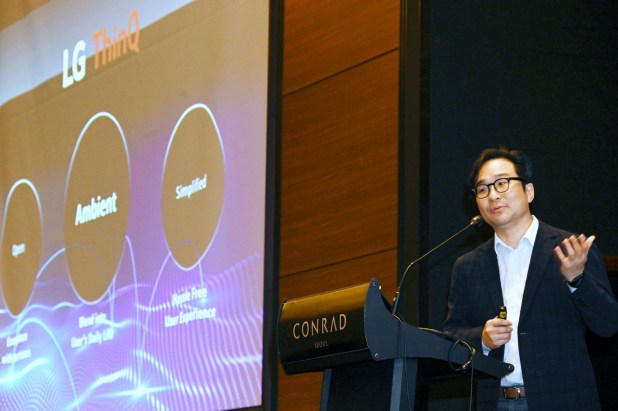
LG unveils vision for ThinQ smart home platform
LG Electronics said Monday it presented a blueprint for ThinQ, a platform brand that connects home appliances and consumer electronics with smart technology for higher efficiency, at the Connectivity Standards Alliance member meeting in Seoul.
Jung Ki-hyun, vice president of LG’s platform business center, attended the four-day event as a keynote speaker and shared the company’s vision for providing more consumer-friendly smart home services.
He outlined three core values of ThinQ: advancement, connectivity and openness.
“LG ThinQ will soon serve as a partner that enhances the lives of our consumers by creating a smart environment — whether that’s at work, home and on vacation — that is tailored to their lifestyles,” Jung said.
ThinQ users can enjoy heightened connectivity for LG home appliances by connecting ThinQ to the Internet of Things and other smart devices that enabled Matter, an Internet Protocol-based communications standard for smart home technologies.
In line with the global trend toward artificial intelligence-based service releases, LG looks to equip AI chatbot services and AI-based voice recognition technology to ThinQ.
It also hopes to propel ThinQ’s open innovation strategy by taking full advantage of the wide range of opportunities offered by AI. This includes providing support for virtual assistant software platforms such as Google Assistant and Amazon Alexa, which are gaining popularity across diverse consumer demographics.
“We are paving the way for the age of ambient computing. We will continue developing our AI technology and Internet of Things connectivity so our consumers can get the best smart home experience with ThinQ,” Jung said.
The CSA is an organization that drives collaboration in IoT by developing universal open standards that enable the connectivity and interaction of objects. It also specializes in the standardization of a protocol called Matter.
Alongside LG Electronics, this year’s event was attended by 134 members around the globe, including Apple, Amazon and Google.
BSH Egypt factory
Today BSH celebrates the groundbreaking of their first factory for cookers in Egypt – and on the African continent.
This is an important milestone for growing BSH business in Africa and the region. With range-cookers from this factory, we will improve quality of life at home for consumers in Africa and in the Middle East.
“It is a great pleasure to celebrate at this place, where ancient civilization meets modern manufacturing.” – Rudolf Klötscher, Chief Sales & Service Officer and Head of Region Emerging Markets.

Midea’s Best-Selling Microwave Receives First-Ever Intertek Green Leaf Certification
The Midea microwave oven MM720C-PM0E00 2AT has recently received the first Green Leaf Certification from Intertek for one of its globally best-selling microwave oven products, as being in accordance with the ISO 14067:2018 standard, which specifies principles and guidelines for the quantification and reporting of the carbon footprint of a product (CFP). This is the first Green Leaf Certification Intertek provided for a microwave ovenThe MM720C-PM0E00 2AT, is an eco-friendly microwave oven with outstanding performance. Its capacity of 20L is ideal for small families. The microwave’s 700W power ensures fast and efficient heating, while featuring five power levels and can easily defrost based on the time or weight of the food. With these features and the 360° heating, it can ensure even cooking without cold spots and also prevent overcooking.
“Being awarded the Green Leaf Certification from Intertek is a testament to the Midea’scommitment to environmental protection and sustainability in our products. By taking steps to reduce the carbon footprint and minimize its impact on the environment, Midea is helping to create a better future for everyone and will continue to work hard to develop products that are both high-quality and eco-friendly.” said Dr. Zhou Fuchang, R&D Director at Midea Microwave & Cleaning Appliances Division.
The Green Leaf Certification is a comprehensive certification program that helps companies validate their environmental claims. It is awarded toproducts that have been independently verified by an accredited laboratory and found to conform to specified existing environmental standards and regulations. The certification allows companies to clearly and accurately communicate their commitment to sustainability and environmental protection to consumers.
 WHITEGOODSNOW