
Tony Johnson has been appointed as the Regional Sales Manager for the South East by Rangemaster. With over 17 years of experience in the appliance sector, Mr. Johnson has previously worked at Electrolux Group, overseeing the AEG, Electrolux and Zanussi brands. During his tenure, he handled customer care, training, business development, and regional account management, and worked closely with builders’ merchants and kitchen studio customers.
In his new role, Mr. Johnson will collaborate with Rangemaster’s appliance division to provide support to customers such as kitchen studios, specialists, and Euronics dealers. Additionally, he will be responsible for expanding the company’s customer base in the South East region, which includes London, Essex, Kent, and Sussex.
Category Archives: Uncategorized
Samsung seeks to overcome downturn with energy-efficient home appliances
Samsung Electronics on Tuesday unveiled the lineup of its new range of energy efficient Bespoke home appliances, in a move to attract Korean consumers and satisfy strict environmental regulations in Europe and elsewhere.
The tech giant said it will improve its profitability this year with upgraded products equipped with artificial intelligence (AI) technology.
“What consumers are most interested in recently are energy-related functions. So we will overcome the difficulties this year, through our eco-friendly products,” Samsung Electronics Vice Chairman Han Jong-hee said at a press conference.
Samsung Electronics Executive Vice President Choi Ick-soo also said that the company’s energy-efficient products have helped generate growth in sales, especially in the European market.
In the aftermath of the global economic recession, Samsung Electronics suffered a 60 billion won ($46 million) operating loss in its home appliance business during the fourth quarter of last year. This was the first time in seven years that the company suffered a quarterly operating loss in its home appliance business.
Although the vice chairman did not specify the timing of the turnaround, he said that the company expects better earnings during the second half of this year.
According to the company, the new Bespoke appliances use 30 percent less energy than first-class energy-efficiency products. In addition, consumers can further reduce the use of energy, thanks to AI technology, which can analyze how consumers use the products.
“Our washing machines can reduce microbeads from clothes by 60 percent,” Han said. “We will reduce the amount more significantly by launching a microbeads filter this year.”
Samsung Electronics emphasized the fact that it made some parts of its refrigerators and other home appliances with reusable plastic. It also noted that the new Bespoke products are equipped with Samsung’s SmartThings function to enhance connectivity between them.
During the press conference, Samsung Electronics reiterated that it will focus on nurturing the robotics business as one of its new growth engines.
“Engineers at Samsung Research plan to develop a Samsung robot platform,” Han said. “We are preparing to launch the EX1 robot this year, and there is the possibility of further development in our robot vacuums.”
His remarks came as Samsung Electronics’ recent acquisition of shares in Rainbow Robotics sparked expectation that the conglomerate may resume large-scale M&As this year. The vice chairman, however, remained cautious about the speculation.
Instead, he confirmed that Samsung Electronics will be more aggressive in using ChatGPT for its home appliance business.
“As more companies are using ChatGPT, I don’t deny the fact that it has become part of the mainstream,” Han said.

Haier open training centre
Haier has recently inaugurated a training center at Birchwood Park business park in the vicinity of Warrington. Named as the Haier Europe Training Activation Centre, this facility aims to provide the latest product and technology training to Haier’s engineers. The event was graced by the presence of top officials such as Haier Europe UK and RoI Chief Executive David Meyerowitz, General Manager Yan Xiaoming, and representatives from the UK and European branches
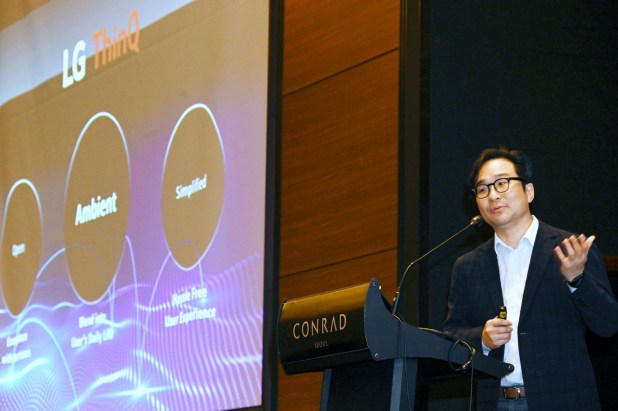
LG unveils vision for ThinQ smart home platform
LG Electronics said Monday it presented a blueprint for ThinQ, a platform brand that connects home appliances and consumer electronics with smart technology for higher efficiency, at the Connectivity Standards Alliance member meeting in Seoul.
Jung Ki-hyun, vice president of LG’s platform business center, attended the four-day event as a keynote speaker and shared the company’s vision for providing more consumer-friendly smart home services.
He outlined three core values of ThinQ: advancement, connectivity and openness.
“LG ThinQ will soon serve as a partner that enhances the lives of our consumers by creating a smart environment — whether that’s at work, home and on vacation — that is tailored to their lifestyles,” Jung said.
ThinQ users can enjoy heightened connectivity for LG home appliances by connecting ThinQ to the Internet of Things and other smart devices that enabled Matter, an Internet Protocol-based communications standard for smart home technologies.
In line with the global trend toward artificial intelligence-based service releases, LG looks to equip AI chatbot services and AI-based voice recognition technology to ThinQ.
It also hopes to propel ThinQ’s open innovation strategy by taking full advantage of the wide range of opportunities offered by AI. This includes providing support for virtual assistant software platforms such as Google Assistant and Amazon Alexa, which are gaining popularity across diverse consumer demographics.
“We are paving the way for the age of ambient computing. We will continue developing our AI technology and Internet of Things connectivity so our consumers can get the best smart home experience with ThinQ,” Jung said.
The CSA is an organization that drives collaboration in IoT by developing universal open standards that enable the connectivity and interaction of objects. It also specializes in the standardization of a protocol called Matter.
Alongside LG Electronics, this year’s event was attended by 134 members around the globe, including Apple, Amazon and Google.
Air fryer sales to rocket in Europe and US in 2023
The global market for air fryers is booming, according to recent research, with sales driven in the UK and Europe primarily by rising energy prices. While US sales have been largely driven by an increasingly health-conscious consumer.
The forecast, carried out by Future Market Insights, predicts that between 2023 and 2033, the global market will grow at a steady CAGR of 7.7% to $1.9 billion (€1.77bn) by 2033. The market is currently worth $896.5 million (€835.65m).
Broken down by region, the US holds the largest market share with absolute market growth at $233.8m. The UK ranks in second place at $89.6m followed by Germany in third position with $71.9m. China and India’s absolute market growth is recorded at $49m and $57.4m, respectively.
India is the fastest growing market, with a CAGR of 8.1% according to FMI. This fast growth rate will be supported by “rapidly growing populations, changing consumer spending patterns, a transition towards urban lifestyles and easier access to major brands”.
Germany, the dominant market in Europe, is likely to hold market share worth $147m in 2023. Its growth is being fuelled by a combination of increased health consciousness, growing online penetration, and discounts by large e-commerce retailers. FMI said that, in addition, the presence of major air fryer brands, Philips, Ninja and Prestige would also positively impact growth.
In terms of opportunities, consumers across the board are likely to opt for premium products, from trusted and well-established brands.
Challenges and restraints to growth will include counterfeit goods and an issue of potential toxic emissions with long-term use.
According to the World Customs Organisation, 7% to 9% of global trade consists of counterfeit products and the issue is especially prevalent in online sales.
In terms of toxic emissions, the FMI said that several manufacturers use plastic, non-stick coatings which can become toxic over time. In addition, it said the high heat can “ruin nutritional profiles”.
Courtesy of GFU
Over 1.5 Million air fryers sold in Germany alone in 2022 says GFU
In other air fryer news, IFA organiser the GFU has reported that for the first time in a single year, more than 1.5 million hot air fryers were sold – an increase of 25%. The increase in sales in 2022 was even 31% to almost €179 million. This is no longer a trend, but has become the standard for many consumers.
“In addition to the selection of the food, the preparation of the food also plays a large part in this. Low-calorie cooking, baking or frying with a hot air fryer, a so-called air fryer, helps,” the company said.
Electrolux says costs cuts on track at North America plants
Electrolux, Europe’s biggest appliances maker, said on Monday it was on track to slash costs at underperforming plants in North America as part of its ongoing efficiency programme in the region.
“Cost per unit in the Anderson and Springfield factories will significantly improve near-term, reaching competitive cost levels,” the Swedish group said in a statement ahead of presentations to investors later in the day.
“Another key earnings contributor for business area North America is commercial growth in higher value categories, which the investments in new and innovative modular product architectures enable,” it said
Electrolux has invested heavily in its North American plants in recent years, but the pandemic and component shortages have delayed the ramp-up of local production.
The group ahead of the capital markets day in Stockholm reiterated a business and market outlook given in February, and its financial targets.
It last month predicted lower sales volumes in 2023 due to weaker consumer confidence and demand across Europe, North America and Latin America and said it may not be able to fully pass on higher energy and labour costs.
The rival to Whirlpool repeated it had “a clear path to reach” a target that the aftermarket segment will account for 10% of group sales in 2025.
Haier builds 1st plant in Egypt
China’s home appliance giant Haier held a groundbreaking ceremony on Wednesday for its first Egyptian factory, aiming to boost the manufacturing industry and provide local jobs in the North African country.
Haier Egypt Ecological Park, invested by Haier Group’s subsidiary Haier Smart Home with a total of 160 million U.S. dollars, will cover an area of 200,000 square meters in the 10th of Ramadan City of northeastern Sharqia Province.
Speaking at the ceremony, Hossam Heiba, the CEO of the General Authority for Investment and Free Zones of Egypt, hailed the strong economic ties between Egypt and China, saying that the Egyptian government attaches great importance to the cooperation with China and is ready to attract more Chinese investment, especially in technology and engineering industries as well as home appliances, which will help the Egyptian economy to move up the value chain.
Haier Egypt Ecological Park is an important project as it will facilitate the transfer of home appliance manufacturing technology and create about 2,000 jobs in Egypt,
Teka manufactures all its products with 100% renewable energy in Spain
Since 2020, the entire manufacturing process of Teka products at the Zaragoza and Santander plants is carried out with 100% renewable energy. Likewise, Teka’s offices and warehouses in Spain also use green energy. Thanks to this initiative, the supply consumed avoids the emission of CO 2 (TCO 2 eq) into the atmosphere due to power generation.
Teka’s environmental commitment focuses on the correct management of all processes, from the manufacture of its products to the optimization of resources and waste. In this way, a more sustainable product is offered without losing its quality and essence.
Teka and the planet
Teka has been working for years on the transformation of the sector, introducing sustainability criteria in the design and production of its electrical appliances. For this reason, the ISO 14001 certification endorses and recognizes Teka’s responsibility with the planet.
This is demonstrated by the company’s CSR policy, which follows three clear lines of action. On the one hand, the use of recycled materials when manufacturing its electrical appliances, while introducing recycled glass in its production process. The second pillar is the reuse of plastic: Teka washing machines, dishwashers and refrigerators are made with reused plastic waste that has been transformed to partially incorporate the plastic-based components of these products, consequently reducing carbon dioxide emissions into the atmosphere. during the manufacturing process. Finally, it is worth noting the German brand’s commitment to durability. Teka has had products with the LifeTime Warranty seal for years,
Faber, digital factory
What are the challenges for Faber , Franke ‘s air specialist , on the production side? In the short term, the company with its plant in Sassoferrato aims to adopt new production technologies , integrating them with the most tested ones. In the medium-long term, on the other hand, the number one objective is digitalisation , implementing new business models, to respond more effectively to a constantly evolving demand, including through the latest generation of production plants. The last great goal is particularly felt: to remain competitive by maintaining a 100% Italian production .
Human capital, safe
Since its inception in 1989, Sassoferrato has always been a site (over an area of more than 60,000 square meters ) capable of standing out for its policies towards employees. To date, the factory has the support of over 350 highly specialized technicians, with a figure of 35% of women’s shares and an average age of 39 years . It holds important records, including the longest accident-free plant in Italy and in Europe: it is no coincidence that the best prevention plant technologies are used , increasingly accurate procedural bodies are adopted and, at the same time, integrated HSE management systems(Health, Safety & Environment) certificates. Personnel training is also a fundamental aspect: in 2022 alone, more than 1,500 hours of training were provided for employees at the Sassoferrato plant.
Green innovation and commitment
For Faber, constant technological innovation is essential : at the Sassoferrato site, for example, numerous processes have been digitalised, production has been verticalised and the skills of the employees are continuously updated. Two practical examples? A new latest generation laser and a system that uses artificial intelligence have recently been introduced to speed up processes and make them safer. Innovation, for Faber, also passes through sustainability: the green steps taken in recent years are important and include the new photovoltaic systemmade up of 2600 panels, which already today ensures the factory 30% of the available energy and allows for savings of up to 305 tons of CO2 per year and the change of all halogen lamps to LEDs, for further savings on emissions.
Artisan expertise and efficiency
“ Our factory is unique in the world because Faber’s know-how is enclosed here. Which are the technologies, of course, but also and above all the expertise of our craftsmen. We constantly invest in the most innovative technologies on the market and work tirelessly on people’s skills, motivating them and involving them in our business project with a ‘people first’ perspective, seeking continuous improvement – comments Giorgio Rossi, Operation Director of Faber ‘s Sassoferrato factory -.We work flexibly, focusing on quality and service to create value for both our company and our customers, pursuing sustainability in terms of being close to the external environment and making production costs more efficient
Electrolux: over half of Group’s factories certified “Zero Waste to Landfill”
As reported by Electrolux Group, almost 98% of the total waste produced at its manufacturing sites was either recycled or recovered in 2022 and 55% of the factories are now “Zero Waste to Landfill” certified, moving the Group toward the target of certifying all manufacturing sites by 2025. When an Electrolux Group factory is third-party certified to the Zero Waste to Landfill program, it means that it sends less than 1% of its total waste to landfill and less than 3% for waste to energy. “We reduced the percentage of waste sent to landfill by 20% in 2022 compared with the previous year, which is an amazing result – says Claudia Mazzon, Electrolux Group Operations Sustainability Specialist and global coordinator of the Zero Waste to Landfill program –. I am so proud of the great job done by our colleagues around the world who are proactively working to reduce waste and find recycling opportunities”. During 2022, seven additional Electrolux Group factories were certified to the Zero Waste to Landfill program (Santiago, Chile; Zarow, Poland; Forlì, Italy; Cairo Delta, Egypt; Juarez Fabric Care and Stamping, Mexico; Kinston, United States; Swidnica, Poland). The countries that now have at least one Electrolux Group factory certified are Argentina, Australia, Brazil, Chile, Egypt, Italy, Mexico, Poland and the United States.
 WHITEGOODSNOW