Manchester United ‘close to £70m-a-year shirt deal with Chinese firm Haier’

Manchester United will reportedly secure a new shirt deal worth £70m with Chinese firm Haier ahead of next season.
Senior representatives of the Chinese corporation, whose brand value is said to stand at around £12.6bn, have held talks with United over the last few weeks.

United’s current shirt sponsorship deal is with American car company Chevrolet, who agreed a seven-year deal with the club in 2014.

China’s three leading home-appliance giants Midea Group, Gree Electric, and Haier Electronics all reported third-quarter profit rises

China’s three leading home-appliance giants Midea Group, Gree Electric, and Haier Electronics all reported third-quarter profit rises in a series of Thursday stock filings, but the results present a mixed picture as the country’s economic slowdown exerts downward pressure on the domestic market.Shenzhen-listed Midea reported net profits of 6.04 billion yuan ($858.5 million) in the three months through September, representing a 23.5% increase year-on-year. Its revenue hit 67 billion yuan in the three months through September, 6.4% higher than last year.Over at Gree, whose business mainly focuses on air conditioners, growth was more sluggish. The Shenzhen-listed company posted 8 billion yuan in net profit — a rise of 0.66% year-on-year — and generated 57 billion yuan in revenue, a rise of just 0.03%.Meanwhile, Shanghai-listed Haier, which is staking its future on developing “smart home” technologies, turned a net profit of 2.6 billion yuan, more than double the equivalent figure from last year, and also reported a 7.7% rise in revenue to 148 billion yuan. The figures come after Haier jettisoned its logistics arm — bringing 4.6% revenue growth, according to the company — and earned 144 billion yuan from a stock selloff.Domestic sales of home appliances hit 174.5 billion yuan in the third quarter, a year-on-year increase of 4.2%, according to the China Testing & Inspection Institute for Household Electric Appliances, an organization affiliated to the country’s State Council.

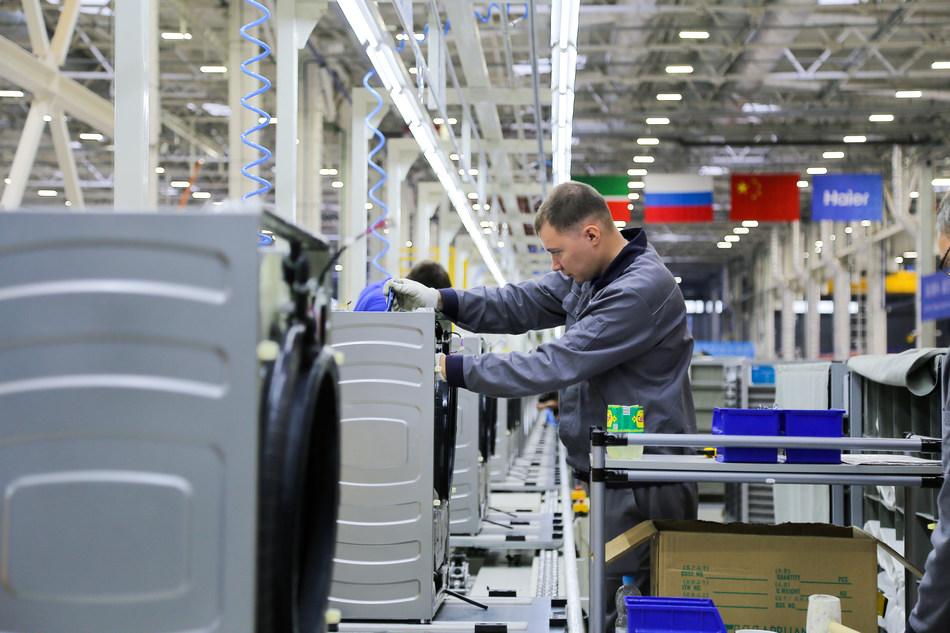
Haier Russian Laundry factory

Haier, China’s largest consumer electronics and home appliance producer, announces the launch of production at the Haier Russian Industrial Park and Laundry Appliances Plant in Naberezhnye Chelny, Russia. The new Haier plant, connecting the customer to the factory throughout the manufacturing process, is estimated to be able to produce laundry appliances for up to 200 million users across Russia and other countries in Central Asia and Europe.
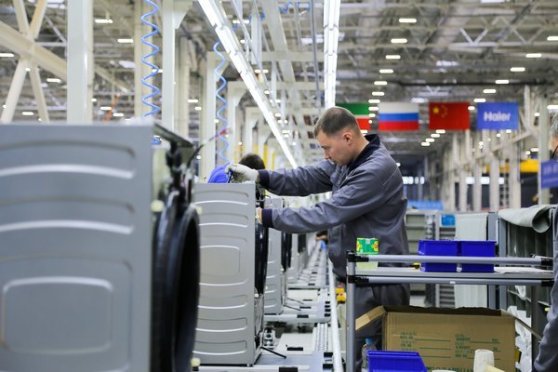
“The laundry appliance plant is the first of its kind, as no other Chinese firm has established such a plant in Europe before. We are proud to be the pioneer firm,” Guiwei Sun, General Manager of Russian Laundry Appliance Interconnected Plant, said. “We hope this plant can enhance the supply capacity and meet the increasing demands for laundry appliances in the Russian market.”

Haier to Develop Complete Industry Chain, Aiming to Further Drive Russian Home Appliance Market

Along with the already-existent refrigerator manufacturing plant, the new laundry appliances plant can drive synergistic effects, as Haier is also planning production lines for its other appliances, including air-conditioners and water heaters, in the area. This will eventually culminate in the establishment of an integrated ecological production chain.

“The synergistic effects will benefit not only the local area but also Haier, in that it will reduce cost disadvantages greatly thanks to local production and increased efficiency of distribution,” added Sun.

“Trinity” Localization Model with Focus on Russian Market Requirements and Expectations

The new laundry appliances plant follows Haier’s regional model of international growth. Haier calls this model the “Trinity” localization model of R&D, manufacturing and marketing.

With such a strategy, Haier aims to develop a complete product supply chain when expanding the local market. In this case, Haier has hired local R&D researchers to provide insights of Russian users, including their habits and customs. All these efforts enable Haier to better adapt to the local market and create advantages. Furthermore, the regional economy and employment rate can be boosted with the further development of Haier’s localization.

One of the primary reasons that Haier’s laundry machines are popular amongst Russian users is that Haier can tailor their products to meet the practical needs of local users.

The launch of Haier’s laundry appliances plant in the region also brings confidence to local Haier sales personnel. With the plant, Haier will grow into a long-term, stable strategic partner that local sales personnel can depend on.

In the future, eight Haier manufacturing plants in different categories will be launched in the Russian Industry Park. At that time, this integrated industry park that incorporates home appliance production lines and accommodation, medical, logistics and cultural centers will bring comprehensive benefits to the locals.

Designed using Haier’s innovative 5+7+N concept, the Haier Smart Cloud Solution links seven (7) home solutions in air, water, security, clothes care, entertainment, health and information across five (5) living scenarios — the smart living room, smart kitchen, smart bathroom, smart laundry room and smart bedroom — with customizations based on variable user needs (N) for a comprehensive and intuitive smart home ecosystem.

Haier Group’s Aqua launches laundry shops in Mainland China

Haier Group subsidiary Aqua Co is launching a chain of laundry shops in Mainland China to raise awareness of its washing machines and tap demand from double-income families for time-saving convenience.

The first Aqua Laundry Shop opened at Haier Cloud Park in the Laoshan district of Qingdao City, Shandong Province, China, earlier this month. Aqua now plans to create a “Japanese-style coin laundry market” in China.

According to its own data, Aqua holds the leading share of the Japanese coin-operated laundry market in unit volume. Now the Aqua Laundry Shop in Qingdao will set out to promote the “coin-laundry culture” in China, where coin-operated laundry facilities have not been widely used yet. The company will conduct market research, provide user experiences and share business models with prospective operators.

Haier Launches Production of the First Chinese Real-time Manufacturing Facility in Europe

Haier China’s largest consumer electronics and home appliance producer, today announces the launch of production of the Haier Russian Industrial Park and Laundry Appliances Plant in Naberezhnye Chelny, Russia. The new Haier plant, connecting the customer to the factory throughout the manufacturing process, is estimated to be able to produce laundry appliances for up to 200 million users across Russia and other countries in Central Asia and Europe.

“The laundry appliance plant is the first of its kind, as no other Chinese firm has established such a plant in Europe before. We are proud to be the pioneer firm,” Guiwei Sun, General Manager of Russian Laundry Appliance Interconnected Plant, said. “We hope this plant can enhance the supply capacity and meet the increasing demands for laundry appliances in the Russian market.”

Haier to Develop Complete Industry Chain, Aiming to Further Drive Russian Home Appliance Market

Along with the already-existent refrigerator manufacturing plant, the new laundry appliances plant can drive synergistic effects, as Haier is also planning production lines for its other appliances, including air-conditioners and water heaters, in the area. This will eventually culminate in the establishment of an integrated ecological production chain.

“The synergistic effects will benefit not only the local area but also Haier, in that it will reduce cost disadvantages greatly thanks to local production and increased efficiency of distribution,” added Sun.

“Trinity” Localization Model with Focus on Russian Market Requirements and Expectations

The new laundry appliances plant follows Haier’s regional model of international growth. Haier calls this model the “Trinity” localization model of R&D, manufacturing and marketing.

With such a strategy, Haier aims to develop a complete product supply chain when expanding the local market. In this case, Haier has hired local R&D researchers to provide insights of Russian users, including their habits and customs. All these efforts enable Haier to better adapt to the local market and create advantages. Furthermore, the regional economy and employment rate can be boosted with the further development of Haier’s localization.

One of the primary reasons that Haier’s laundry machines are popular amongst Russian users is that Haier can tailor their products to meet the practical needs of local users.

The launch of Haier’s laundry appliances plant in the region also brings confidence to local Haier sales personnel. With the plant, Haier will grow into a long-term, stable strategic partner that local sales personnel can depend on.

In the future, eight Haier manufacturing plants in different categories will be launched in the Russian Industry Park. At that time, this integrated industry park that incorporates home appliance production lines and accommodation, medical, logistics and cultural centers will bring comprehensive benefits to the locals.

Designed using Haier’s innovative 5+7+N concept, the Haier Smart Cloud Solution links seven (7) home solutions in air, water, security, clothes care, entertainment, health and information across five (5) living scenarios — the smart living room, smart kitchen, smart bathroom, smart laundry room and smart bedroom — with customizations based on variable user needs (N) for a comprehensive and intuitive smart home ecosystem.

LG Licenses Advanced Refrigerator Technologies To GE Appliances LG Grants Use of Door-Ice Making Patents for Premium Refrigerators

LG Electronics (LG) is licensing its patented refrigerator door-ice making technology for use in refrigerators sold by GE Appliances, which Haier acquired in 2016. Terms were not disclosed.

The license agreement follows months of negotiations over GE Appliances’ use of LG’s patented technologies. The agreement underscores the value of LG’s patent portfolio and the company’s leadership in home appliances with more than 400 patents related to door-ice making technology.

LG’s patented door-ice making technology allows for slim and sleek profile designs that maximize usable space inside the refrigerator.
This door-ice making technology takes up less room than a conventional refrigerator ice maker and frees up more space for food storage in the refrigeration compartment.
LG’s patented door-ice making technology allows for slim and sleek profile designs that maximize usable space inside the refrigerator. This door-ice making technology takes up less room than a conventional refrigerator ice maker and frees up more space for food storage in the refrigeration compartment.

“Our desire to deliver more convenience and functionality to customers drives us to develop innovative new core technologies such as our door-ice making inventions,” said Dan Song, president of LG Electronics Home Appliance & Air Solution Company. “At the same time, as seen in this major patent licensing agreement, LG is committed to actively protecting our intellectual property.”

About LG Electronics Home Appliance & Air Solution Company
The LG Home Appliance & Air Solution Company is a global leader in home appliances, smart home solutions, air quality systems as well as visionary products featuring artificial intelligence. The company is creating total solutions for the home with its industry leading core technologies and is committed to making life better for consumers around the world by developing thoughtfully designed kitchen appliances, living appliances and air solution products. Together, these products deliver enhanced convenience, superb performance, efficient operation and compelling health benefits. For more information, visit http://www.LG.com.

SOURCE LG Electronics USA

Haier , Hoover and Candy brands ,Haier Europe reveals its innovations and commercial strategy

Haier Europe has recently gathered its clients at the Príncipe Pío Grand Theater in Madrid to present their latest releases of the Haier , Hoover and Candy brands , as well as to share the company’s commercial and communication strategy.

Regarding novelties, two star products of Haier stand out: on the one hand, the side by side model HB25FSNAAA, one meter wide, equipped with technologies such as Fresher Techs and with Iconic Black finish; on the other, stands out the Super Drum washer HWD100-BD1499U1, with capacity of 10 kg of washing + 6 kg of drying, wi-fi connection, i-Refresh, Smart Duo Spray and ABT antibacterial treatment. Both models offer a lifetime guarantee.

For its part, Hoover has presented the folding broom H-Free 500, with autonomy of up to 40 min. and only 70 cm in height.

Candy is still betting on connectivity in all its appliances, from the kitchen with its new wifi oven, going through the cold and even washing, where the range of Rapido washing machines and Brava dishwashers stand out.

The company has also announced the new spot of the Haier brand that focuses on clearly conveying the main benefit of Fresher Techs technology. For Candy and Hoover, the group is committed to a 12-month campaign of visibility in the press, digital media, radio and outdoor. It has also announced the opening of the new commercial office of Haier Europe in the Paseo de la Castellana in Madrid, the sponsorship of Candy in the cooking school “Apetit’Oh!” And the start of a road show that will go to several cities Spanish

Toshiba

Toshiba domestic appliances a money-loser in 2016 is now showing signs of a comeback under Midea Group as it leverages its new Chinese parent’s sales channels across Asia.

The Toshiba appliance business “is an important component in the globalization of Midea. We want to grow it into a world-leading appliance maker,” said Fang Hongbo, chairman and president of Midea.

Toshiba appliances disappeared from Chinese shelves in 2015 due to sluggish sales. They returned a year later via the retail network of Midea, which acquired Toshiba’s appliance business, Toshiba Lifestyle Products & Services.

“This is a popular product that uses Toshiba’s advanced technology,” says a saleswoman at a Midea appliance shop in the southern Chinese city of Guangzhou. Amid the shelves of Midea products stand Toshiba-brand microwaves, of which the most expensive costs 12,999 yuan ($1,922) — around twice the price of its Midea equivalent.

The multifunctional Toshiba microwave can be used to make a variety of dishes, such as employing high-temperature steam to broil fish. “It’s also very durable,” the saleswoman said. “Those who enjoy cooking hold it in high regard.”

Midea is a big presence in the appliance market, generating sales of around 240 billion yuan in fiscal 2017. But its core lineup consists of inexpensive products limited to basic features. The company is working to move upmarket and has positioned the Toshiba brand as its top of the line.

Under Midea, Toshiba Lifestyle is accelerating its overseas expansion. Midea plans to open a new plant in western India as early as 2020 and will locally produce and market such Toshiba-brand products as washing machines and microwave ovens, marking the brand’s return to the market after a 2012 exit. Depending on demand, other items like refrigerators may be added to the mix. Investment of more than $1.8 billion is expected over the next five years.

Toshiba Lifestyle is also cultivating the entire Southeast Asian market, including places like Cambodia and Myanmar. Besides using its own factories in Thailand and China, Toshiba Lifestyle is procuring products from Midea under an original equipment manufacturer arrangement.

In the second half of 2018, Toshiba put more than 30 new items on sale in Thailand, including refrigerators where the freezer is on one side, a type little seen in Japan.

When Toshiba Lifestyle was under Toshiba, it was never more than one division of a larger engineering company. When earnings faltered at the parent, it did not receive sufficient money for product development, falling into a cycle where it became less competitive.

But after it was bought by Midea, Toshiba Lifestyle began receiving enough funds to develop products that met the needs of the marketplace, company executives say. The goal now is to use Midea’s marketing network to increase the portion of overseas sales at Toshiba Lifestyle to 50% from the current level of around 30% by 2020.

Earnings are recovering as Toshiba Lifestyle’s revenue jumped more than 50% from fiscal 2015 to 250 billion yen ($2.3 billion) in calendar 2017. The company probably moved back into the black last year even without restructuring measures like layoffs. Cost-cutting moves such as production at Midea’s Chinese plants and joint parts procurement seem to have had a positive impact.

Other Japanese brands revived under Chinese parents include the white goods business of Sanyo Electric, which returned to profitability several years after being sold to Haier Group in 2012.

Haier

Chinese home electronics and appliances manufacturer Haier Group announced that it will lay off around 10,000 workers this year, after cutting 16,000 jobs last year, as part of its adjustment in relation to the changing market in China.