South Korean companies resuming op

Samsung Electronics, LG Electronics and other Korean companies are sche-duled to restart their plants in China as businesses resume work after mandatory closures due to the deadly outbreak of Covid-19.

Automakers such as Hyundai, Kia, SsangYong and Renault Samsung, which had stopped their assembly lines in Korea due to a shortage of China-sourced auto parts, will also restart their operations.

However, The Korea Times said Korean businesses had only “partially” restarted and were unsure if operations would fully resume as the virus continues to spread.

Samsung’s home appliance manufacturing plants in Suzhou, China resumed work last Monday, while its Tianjin factory is set to reopen next week.

“Our business could have been disrupted if the Suzhou plant remained suspended,” a Samsung official said.

Although the Tianjin plant will restart its operations later than the Suzhou plant, any potentially negative consequences will be minimised as the plant is producing products only for consumers in the domestic Chinese market.

Miele increases turnover by 3.2%

In the second half of 2019, the Miele Group achieved a turnover of € 2.24 bn – 3.2% more than in the previous year. ’This is once again evidence that we are well positioned with our products and services to increase turnover and gain market shares under challenging conditions and intense competition in the marketplace’, according to the Executive Board of the world’s leading manufacturer of premium domestic appliances. During the current year, this course for growth will be further consolidated – for example with kitchen appliances from the new Generation 7000 series, which will set standards in the market with numerous exclusive innovations. On December 31, 2019, Miele employed a workforce worldwide of 20,478 – more than ever before.

This publication of half-time figures is due to the fact that the Miele Group has changed its business year to coincide with the calendar year (instead of running from July 1 to June 30). This results in a one-off stub year. In particular, large European markets such as Austria, Switzerland, the Netherlands, Italy and, after a long Brexit-related dry spell, Great Britain, contributed to this positive development. In the highly contested German market, Miele achieved turnover growth of 2.7%. In contrast, business in Hong Kong is suffering from political unrest. In China, state intervention has resulted in a subdued real estate market – also impacting business with high-quality kitchen equipment.

Amongst the product groups, above all washing machines, tumble dryers and vacuum cleaners contributed most to sales growth. In laundry care, numerous detail improvements ensure increased user convenience: These include shorter programme cycles, the ability to add forgotten items of laundry at any time throughout the cycle and even the energy-efficient washing of individual garments. In the booming sector of rechargeable handsticks, the Triflex HX1 has got off to a very successful market start. Across all product groups, campaign models marking 120 years of Miele (Series 120) resulted in significant additional impetus. With its built-in appliances from the new Generation 7000, Miele is reasserting its leading role in the fields of innovation, design and lifestyle pleasures in the kitchen. With 3,000 model versions spanning 15 product groups worldwide, now off to a very promising start in almost all countries, this amounts to the biggest product launch in the history of the company.

Above-average growth during the reporting period was recorded by Miele Professional with machines and services for commercial operations, medical facilities and laboratories, and its Italian medical technology subsidiary Steelco. Steelco is in charge of the aspiring hospital project business within the Miele Group. Compact commercial washing machines and dryers for small businesses (Little Giants), which have been on the market since last year with a completely new model series, represent a further growth driver. In total, Professional turnover grew by more than 4%.

New impetus for growth and innovation

In order to exploit further sustainable growth potential, Miele has, as reported last October, undergone reorganisation – for example with 8 independent business units, remapped sales territories and a new location devoted to digital marketing which is currently being set up in Amsterdam (Digital Hub). The new production plant for washing machines, built by Miele in the Polish town of Ksawerów, has commenced operations on schedule. Miele Venture Capital GmbH, which brings together Miele’s stakes in promising start-ups, has further expanded its activities.

During the period under review alone, two new 100% subsidiaries were added to the portfolio: With the takeover of the business operations of Agrilution GmbH, Miele entered the future field of vertical farming – with stacked and digitally connected Plantcubes sporting an elegant design for private homes. With a minimum of effort, these offer the ideal growing conditions for, say, greens and herbs. Miele Operations & Payment Solutions GmbH offers a unique, app-based solution covering the furbishing, organisation, servicing and billing in shared laundry facilities (appWash). This can even go as far as assuming responsibility for the entire operation. This is aimed for example at student hostels, housing associations, multi-unit dwellings, campsites and launderettes. With these and other activities, Miele is pursuing its strategic goal of continuing to expand its portfolio and grow with innovative products and digital services which meaningfully complement its core business.

As per December 31, the Miele Group had 20,478 employees on its payroll. This amounted to 163 employees, or 0.8%, more than in the previous year. In Germany, Miele employs a workforce of 11,061, down 209 on the previous year.

Arçelik filed lawsuit against LG for patent infringement

Arçelik A.S, Turkey’s leading brand of white goods as well as smaller household electronics, filed a lawsuit against LG Electronics and its subsidiaries for patent infringement concerning its “direct drive” technology in LG’s washing machines, said Finance Yahoo.

Arçelik is also the second biggest brand of electronic goods in Europe, selling its products abroad under the Beko brand. It had a turnover of 31.9 billion TL in 2019 and receives 70 percent of its revenue from their international markets. Their BEKO products make up one-in-five home appliances sold in Britain.

“Direct drive” is an Arçelik-developed technology which prevents damage to clothes. Arçelik was granted a patent which was filed in 1997, and claims that LG is using this technology without a license.

LG Electronics showed no effort to resolve these infringement issues even after Arçelik’s warning, leaving Arçelik with no choice but to file a lawsuit,

Virus angst spills over to Korean manufacturers

The new coronavirus-triggered angst appears to be spilling over to the Korean corporate realm as the global supply chain is feared to face some disruptions amid the rapid spread of the novel coronavirus in China, industry watchers said Sunday.

With the new coronavirus killing more than 300 people in China so far, Beijing has recently decided to extend its Lunar New Year’s holiday in some areas of the country in what could be a move that can disturb the normal operation of South Korean firms with manufacturing bases there.

The extension of the holiday that originally started Jan. 25 was earlier announced only in Hubei Province in central China, where Wuhan, the epicenter of the new virus, is located but was later expanded to other areas as the number of patients skyrocketed at an alarming pace.
South Korea’s finance ministry earlier said its economy has not yet faced direct fallout from the spread of the virus, but the country’s exports are poised to face a setback should the spread of the virus not be contained soon, industry watchers said, as local firms with production facilities in China have been suspending or scaling back their operations in the world’s No. 2 economy.

South Korea’s top tech giant Samsung Electronics Co. decided to shut down the operations of its home appliances production line in Suzhou, eastern China, until next week in tune with the extended holiday.

LG Electronics Inc. and SK Innovation Co. also plan to put off the reopening of their Chinese production line until the end of next week.

LG Chem Ltd. said it has sharply lowered the operational level of its battery line in China as well.

Korean chipmakers and display makers, on the other hand, have been maintaining the routine operation over the holiday, although LG Display Co. said it is considering closing down its facilities depending on the development of the issue.

“We already secured enough inventory in preparation for the Chinese New Year’s holiday, but it is inevitable for us to face troubles if the situation is drawn out over a long period,” a SK Innovation official said.

No. 2 chipmaker SK hynix Inc. said South Korean firms will eventually face some disruptions in their operations and production if the issue is protracted.

Industry watchers said the rapid spread of the new coronavirus has already prodded South Korean carmakers to scale down their production as the supply of some auto parts has been disrupted by the spread of the new virus.

SsangYong Motor Co. earlier said it will suspend the production of its plant in South Korea through Feb. 12 amid a delay in the supply of wiring harnesses, a part used to supply power in an automobile.

South Korean carmakers depend heavily on China for the supply of the part.

“As many auto parts makers have relocated to China to cut costs, it will not be easy for them to return home,” said Lee Hang-koo, a researcher at the Korea Institute for Industrial Economics & Trade.

Numerous South Korean firms, including Samsung Electronics, have kicked off task force teams, but the companies are likely to continue to face uncertainties as the new coronavirus situation is changing every minute, industry watchers added.

Haier Leads Euromonitors Major Appliances Global Brand Rankings for 11th Consecutive Year

Haier the world’s leading home appliance producer, has emerged as the top major appliances brand worldwide for the 11th year running, according to Euromonitor International’s 2020 Global Major Appliances Brand Rankings. The accolade follows Haier’s ongoing efforts to gain a global foothold by consolidating world-leading brands into its portfolio while accelerating its revolutionary IoT ecosystem.
Compiled annually by Euromonitor International, a leading global provider of business intelligence, the report ranks the world’s appliance brands by retail sales value. In addition to listing first for major global appliances, Haier ranked first for Refrigerators for 12 consecutive years, first in Washing Machines for nine years, first in Freezers for ten years and first in Electric Wine Coolers for 11 years.
“We are honored to again be the world’s top major appliances brand for the 11th year in a row. Haier is constantly striving to listen to consumers’ changing needs and adapt to them, while simultaneously harnessing cutting-edge technology to stand out in the market,” said Wang Ye, Vice President and General Manager of Smart Home of Haier Home Appliance Industry Group.
Haier’s dominance in home appliances is a result of an ongoing commitment to R&D, and its ability to adapt its business model to the latest technology and consumer trends. Over the past decade, the home appliance industry has radically transformed with the rise of the internet, IoT, AI and 5G. Rather than ride the trends, Haier has defined them with revolutionary products, from the Clean-Free washing machines to refrigerators with fresh storage boxes.
This is set to continue in the future: during its 35th anniversary, Haier revealed its next stage of development, which puts customization, globalization and its IoT ecosystem brand at the core of its strategy.
Always in pursuit of new ways to engage with consumers, Haier has also implemented its “RenDanHeYi” 10+N R&D model in the past decade — an open entrepreneurship platform that integrates quality global resources to meet the diverse needs of users.
In recent years, Haier’s desire to reimagine the future has only strengthened its position as the world’s leading significant appliances company. In the Industry 4.0 era, a new Haier has emerged to meet the increasingly sophisticated experiences demanded by consumers in the age of connected smart homes. Instead of manufacturing smart appliances, Haier engineered a smart home ecosystem that harnesses IoT and smart appliances to enhance the quality of life. In a company first, Haier launched its official Haier Smart Home app in 2019, which allows users to infinitely customize their smart home experience based on user scenarios, rather than products. A live stream video accompanied the app launch — within one day, Haier received over 31,337 orders for over 2,440 different home designs.

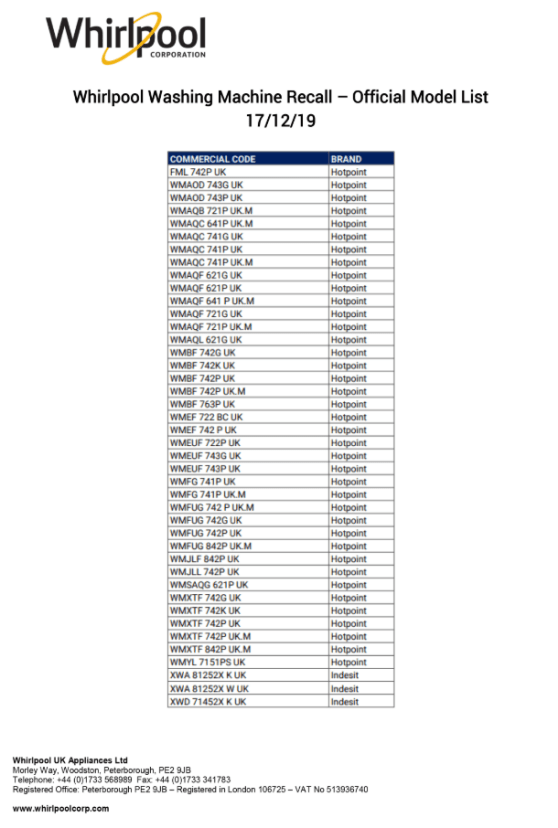
Hotpoint and Indesit washing machines are being recalled over a potential fire hazard

Half a million Hotpoint and Indesit washing machines are being recalled over a potential fire hazard, manufacturer Whirlpool has said.

Half a million Hotpoint and Indesit washing machines are being recalled over a potential fire hazard, manufacturer Whirlpool has said.

As many as 519,000 of the machines sold in the UK between October 2014 and February 2018 may be affected by a fault with the door-locking system that could cause them to overheat and catch fire.

Owners who bought a Hotpoint or Indesit appliance during that window are urged to contact Whirlpool to find out if they are affected – and should unplug and stop using them immediately

Panasonic to build new consumer electronics plant in China

Panasonic will build its first consumer electronics plant in the country in 16 years, people familiar with the matter said Friday, bucking the trend of manufacturers leaving China to avoid the U.S.-China trade war.

The 4.5 billion yen ($41 million) plant will make kitchen appliances such as microwave ovens and rice cookers, and is scheduled to begin production in 2021. Panasonic decided to build the new factory in Jiaxing, Zhejiang Province, anticipating medium- to long-term growth in China.

Hisense has sold Gorenje Tiki, a Serbian producer of water heaters and heat pumps

Chinese home appliances maker Hisense has sold Gorenje Tiki, a Serbian producer of water heaters and heat pumps, to Swedish heating technology firm NIBE Industrier AB NIBeb.ST.

Hisense’s Slovenian unit, Gorenje, said on Tuesday the sale was part of Gorenje’s drive to focus “on the core activity of manufacturing and marketing domestic appliances.”

Gaggenau and Raymond Blanc renew their partnership

Raymond Blanc has renewed his partnership with Gaggenau to upgrade the kitchen in the Raymond Blanc Cookery School with new appliances. Raymond handpicked cooktops and ovens from the company 400 series. Set in a picturesque 15th century manor in rural England, Le Manoir aux Quat’Saisons has become a culinary destination for gourmands the world over, with diners at the restaurant also having the option to stay in one of the manors 32 individually designed hotel rooms. Raymond Blanc opened the restaurant 35 years ago, earned two Michelin stars upon opening and has retained them ever since. He also created the Raymond Blanc Cookery School and Gardening School, with the cookery school located just across the corridor from the bustling restaurant kitchen.
“Similarly to us – Gaggenau explays in a press realise – Raymond Blanc promotes sustainable produce and ethical farming. He ensures that these methods are used to create dishes which enrich the palate of every diner. This has meant that the menu at Le Manoir celebrates a field to fork ethos, with much of the organic produce on the menu being harvested daily from the beautiful kitchen gardens. This ethos is also carried through to the Raymond Blanc Cookery School, where guests on the course are shown how to make the most of every ingredient, lowering the chance of waste.” Raymond makes a conscious effort to stay abreast of trends in the culinary world, especially ones which make an impact on the environment. When Le Manoir initially opened 35 years ago, Raymond offered a five and seven course vegetarian menu, which at the time was not popular amongst the restaurant patrons. However, as diners are now considering how the planet is affected by what is on their plate, the demand for vegetarian menus at Le Manoir has risen dramatically.