Electrolux presents vacuum cleaner made of 100% recycled and reused materials

Electrolux takes a new important step on the journey towards circularity with a prototype for change. Together with Stena Recycling, Electrolux has developed a vacuum cleaner made of 100 percent recycled and reused materials. The plastic and components originate from consumers electronic products, such as used hairdryers, vacuum cleaners and computers. The project addresses some of today’s key recycling challenges while exploring circularity in household appliances.

More than 400 million metric tons of plastic are produced globally every year, but less than 12% of this comes from recycled materials. Therefore manufacturers have difficulty finding enough safe and consistently high-quality recycled material. As a pioneer, Electrolux was first in the industry in 2010 to raise awareness about the global shortage of recycled plastics through the Vac from the Sea project. The volume of products containing recycled material has since increased across the industry but remain at low levels.

To step up the pace, Electrolux is partnering with Stena Recycling in the collaboration Circular Initiative. The goal is to learn more about how to make the market for recycled plastics function as well as for virgin materials. The first concrete result is a visionary vacuum cleaner made of 100 percent recycled plastic and reused components from electronic consumer products. The prototype is developed to explore circularity in household appliances.

“We at Electrolux have a strong commitment to reduce our climate impact by 2030 and circularity is a key dimension of this. The partnership with Stena Recycling is one of the important initiatives we engage in to push ourselves and the industry forward through knowledge sharing and innovation. We want to support consumers in making sustainable choices, and to succeed we need a solid approach to circularity”, says Jonas Samuelson, CEO at Electrolux.

Henrik Sundström, Head of Sustainability at Electrolux, adds: “This project has highlighted many of the considerations we take into account as we seek to become more circular. From product design and material use to new business models, there are regulatory requirements as well as quality and safety questions that need to be addressed. We have to strike a good balance in increasing the amount of reused and recycled materials when making products that are optimized for further recycling at the end of life”.

The material from used products such as hair dryers, vacuum cleaners and computers originates from Nordic households. The focus on consumer products has enabled the project to study the lifespan of the recycled products and components to gain insights about consumer recycling behaviors and attitudes.

“The Swedish industry has all the right conditions to become a pioneer in circular flows. We have the know-how, we have the technically advanced processing plants needed, and we have companies willing to take the lead in circular production. I’m proud of what we have achieved together in the partnership with Electrolux. It’s a crucial step towards a future where circular materials will play a significant role in manufacturing. Through the Circular Initiative we provide our expertise when collaborating with our partners to create world leading circular solutions”, says Kristofer Sundsgård, CEO at Stena Recycling.

By 2030 all Electrolux product ranges will contain at least 50% recycled materials. On the journey towards circularity, the learnings from developing the prototype will provide important knowledge for Electrolux future innovation.

Stena Recycling collects discarded electronic consumer products and breaks them down into raw materials for new products or for energy recovery. Read more about the Circular Initiative here.

The prototype vacuum cleaner is an action within the Electrolux Better Living Program, a plan to enable better and more sustainable living for consumers around the world through 2030.
Beko’s first-of-its kind household product line eliminates more than 99% of bacteria and viruses

Today saw Beko launch its new HygieneShield™ range at a global virtual press conference. A ground-breaking portfolio of household products created in response to emerging needs in the post-lockdown era.

The new portfolio includes seven appliances with in-built disinfection programmes and functions to disinfect packaged food and belongings to help people adjust to the ‘new normal’ at home. Developed as a result of in-depth global consumer research and with innovative new technology, the HygieneShield™ product line has the power to kill more than 99% of bacteria and viruses (including coronavirus), providing a level of reassurance unrivalled in the market place.

Beko research, across 31 countries revealed that one of the primary concerns is hygiene. Many of us are disinfecting supermarket purchases when we get home, worrying about handling mobile phones and keys, or not bringing coats into the house. People have increased the amount of cleaning and laundry in their homes, with some disinfecting bedding for the first time. 75% of people are cleaning the house more often, 64% are doing more laundry and 68% are paying more attention to the cleanliness of the packaging on purchased products.

The new HygieneShield™ range takes inspiration from nature and uses methods such as steam and heat to enable you to achieve excellent hygiene results at home. It will be available to buy from December 2020.

Hisense Plans To Open Washing Machine Factory in Africa

Hisense has made public its plans to open a washing machine manufacturing plant in South Africa by February 2021.

This will be the company’s second manufacturing plant in the continent, following the opening of a KES 2.2 Billion plant back in 2013 that is used to produce TVs and fridges. In 2019, Hisense added an additional production line that saw it start assembling smartphones in the Atlantis factory.

“Since launching washing machines in the country three years ago, Hisense has achieved a 12% market share in that segment,” the group said.

The new factory, which will also be in Atlantis, north of Cape Town in South Africa, will add an additional 200 jobs into the country’s economy. Hisense says that they currently employ more than 800 people and reach over 3000 people through their outreach programmes that train and uplift the wellbeing of people in communities around South Africa.

In 2019, Hisense managed to put out more than 530,000 TVs and 331,000 fridges from their factory in the country. “In 2019, one in four TVs or fridges sold in South Africa was a Hisense,” said the company.

Hisense has also made significant inroads in Africa, with products also being exported to 13 other African countries, including Kenya, South Africa, Namibia, Mozambique, Zimbabwe, Malawi, Zambia, Botswana and Lesotho.

Midea overcomes COVID-19 challenge to continue overseas expansion

Despite the challenges posed by the COVID-19 pandemic, Midea Group, a Chinese home appliance maker, will expand its global footprint this year, strengthen the layout of its supply chain, and increase its investment in Thailand, Egypt and Brazil.

Although overseas orders increased by 10 percent year-on-year in the first half of this year, that was not enough to avoid declines in both revenue and net profit.

First-half net profit was 13.90 billion yuan ($2 billion), down 8.29 percent, on a revenue of 139.70 billion yuan, down 9.47 percent. More than 40 percent of its revenue came from overseas markets as Midea added more than 11,000 sales outlets abroad.

The company underlined its e-commerce business. Its products now cover major online retail websites in Italy, the United Kingdom and France.

“We are more willing to build joint ventures in overseas markets, especially countries and regions taking part in the Belt and Road Initiative,” said Fang Hongbo, chairman and president of Midea.

Fang noted that growing market demand in emerging countries and regions, along with an improving domestic demand for smart home appliances, will help boost sales in the years ahead.

“We need to rethink the layout of overseas manufacturing bases,” Wang Jianguo, vice-president of Midea, said.

The company will also look for suitable places to establish a manufacturing base in North America.

Established in 1968, the Foshan, Guangdong province-based Midea makes air conditioners, refrigerators, laundry appliances, kitchen appliances and various small home appliances. It has 28 research and development centers and 34 major production bases around the world.

Its orders from overseas markets rose by 26 percent on a yearly basis in the first quarter. Wang has strong confidence that the company’s performance in the second half of this year will improve despite COVID-related changes and uncertainties.

The company will strengthen its global supply chains and increase investment in Thailand, Egypt and Brazil. In April, Midea began to build an air conditioner factory in Thailand. It is also preparing to build a manufacturing base in Egypt, its 18th overseas.

First-half retail sales of home appliances in China were worth 369 billion yuan, down 14 percent year-on-year, due to COVID-19, said a report released by the China Center for Information Industry Development, which is part of the Ministry of Industry and Information Technology.

The CCIID report also said the market for most of home appliances has shrunk and sales fell in the first half of the year.

“The growth rate of the domestic home appliance market is dropping, so major players should accelerate steps to expand in overseas markets such as North America, South America, Africa and Europe as they continue to show huge growth potential in low, medium and high-end products,” said Liang Zhenpeng, a consumer electronics analyst.

Liang noted in the past most of the Chinese enterprises adopted the original equipment manufacturer or OEM model, but nowadays they tend to build their own brands to be competitive globally.

Midea’s more than 150,000 staff members man its 17 production bases in overseas markets, with its products sold in more than 200 countries and regions. Midea has set up overseas 18 R&D centers in the United States, Japan, Italy, Germany, Singapore, Austria, Israel and other countries.

Since the establishment of its first overseas plant in Vietnam in 2007, Midea has efficiently expanded its operations. The company has stepped up its go-global push in recent years through mergers and acquisitions.

Midea acquired a 32.5 percent stake in Egypt-listed air conditioner manufacturer Miraco. It took a majority stake in German industrial robotics manufacturer Kuka in 2016, marking another important step in the company’s bid to expand into automation and smart manufacturing.

In 2017, it purchased more than a 50 percent stake in Israeli motion solution provider Servotronix Motion Control. Midea also acquired an 80 percent stake in Italian air conditioner maker Clivet SpA and bought the white home appliance products business of Japanese home appliance manufacturer Toshiba Corp in 2016.

The traditional home appliance market is almost saturated and companies need to seek new growth points, said Dong Min, an independent researcher of the home appliances sector.

“Expansion into overseas markets could not only relieve the pressure of high inventory in the domestic market but increase the international influence of Chinese home appliance companies.”

Midea announced in 2018 it would invest 13.5 billion Indian rupees over the next five years to set up a science and technology park in India. Covering an area of roughly 270,000 square meters, the project is estimated to generate direct and indirect employment opportunities for more than 2,000 people.

The park will produce 500,000 refrigerators, washing machines, water purifiers and water heaters respectively, 1.5 million household air conditioners, 250,000 commercial air conditioners, and 4.5 million air conditioner compressors annually.

Hisense and Gorenje committed to protect their staff from the virus

Hisense Europe Group (HEG) management and representatives of trade unions at the plants in Slovenia (Velenje), Serbia (Valjevo) and the Czech Republic (Mariánské údolí) are united and committed to their intention to protect the health of all employees across Europe during the coronavirus pandemic. HEG management and representatives of trade unions at plants in Slovenia, Serbia and the Czech Republic have urged their employees to strictly abide by the preventive measures against spreading of COVID-19 that were imposed to benefit each individual employee as well as the entire company. HEG continues to work closely with healthcare authorities in all countries it operates in, strictly following all the measures imposed by local authorities.

«Our common response to the current pandemic – reads the statement signed by the HEG management and trade unions in all three countries – is the zero-tolerance approach to the violation of prescribed measures. Behaving responsibly is the only way that can help us maintain our health during the pandemic, which is a major challenge the entire world is facing. We have been investing all our efforts in making sure our employees are well-educated about the importance of strict implementation of all measures, both in the plants and outside them. Together, we urge all employees to practice discipline, physical and social distancing even outside the plants, and thus help contain the spreading of the virus.»
The Group ensures that “HEG plants, as well as all other organizational units throughout Europe, have been following strict preventive measures since day one of the pandemic: physical distancing, mandatory use of disinfection barriers, regular disinfecting of hands and work areas, measuring body temperature at the entrance, and wearing protective masks provided by the company. Protective barriers have been installed in all our plants; they prevent physical contact wherever possible, premises are regularly disinfected, and meetings are held online or with mandatory proper physical distancing.”

Samsung tipped to log strong Q3 earnings on solid chip biz, mobile sales recovery

Samsung Electronics Co. is expected to report strong third-quarter earnings, analysts here said Monday, as its mainstay semiconductor business remained solid despite a decline in memory prices, while its mobile and home appliance sales soared on pent-up demand amid the pandemic.

Samsung was projected to log 63.95 trillion won (US$54.5 billion) in sales in the July-September period, up 3.1 percent from a year earlier, while operating profit was estimated to surge 33.7 percent on-year to 10.4 trillion won over the period, according to Yonhap Infomax, the financial news arm of Yonhap News Agency, which compiled data from 17 brokerage houses.

Should Samsung meet the consensus, the tech giant will post its best quarterly performance since the fourth quarter of 2018, when it logged an operating profit of 10.8 trillion won.

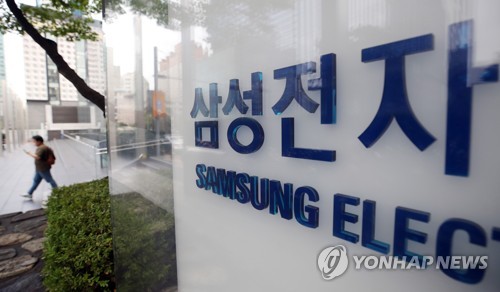
An outdoor sign of Samsung Electronics Co. at the company's office building in Seoul (Yonhap)
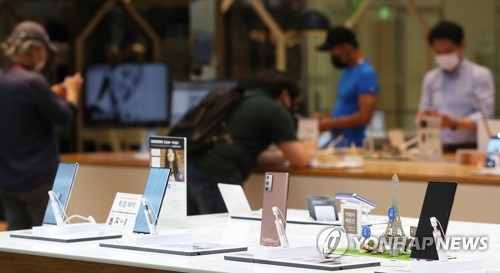
This file photo taken Aug. 7, 2020, shows Samsung Electronics Co.'s Galaxy Note 20 smartphones displayed at a store in Seoul. (Yonhap)
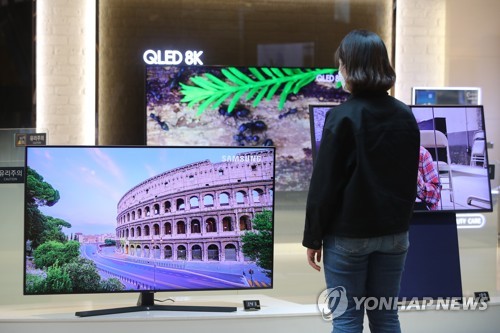
This file photo taken April 29, 2020, shows a customer looking at Samsung Electronics Co.'s QLED TVs at a store in Seoul. (Yonhap)

An outdoor sign of Samsung Electronics Co. at the company’s office building in Seoul (Yonhap)1 of 4hide caption

Compared with the previous quarter, the estimated figure suggests Samsung seeing a 20.7 percent increase in sales and a 27.6 percent jump in operating profit.

Samsung, the world’s leading memory chip and smartphone producer, is expected to announce its third-quarter earnings guidance next week.

Analysts have been raising their earnings outlook for Samsung in recent weeks after they assessed that its chip business is not likely to suffer a big drop in sales despite a decline in memory prices prompted by an excess in inventory.

Server DRAM products in the third quarter were projected to suffer a 10-15 percent price drop in the third quarter, according to market researcher TrendForce, which also estimated that prices for mobile DRAM and consumer DRAM chips to see up to an 8 percent and maximum 10 percent decline, respectively.

However, rush orders from Huawei Technologies Co., the world’s top telecom equipment maker and No. 2 smartphone producer, apparently helped Samsung’s chip business to stay afloat.

Analysts predicted Samsung’s chip business to post an operating profit of around 5 trillion won in the third quarter of the year.

Huawei, one of Samsung’s five largest customers, has been aggressively procuring semiconductors ahead of the U.S. export restrictions that have been in place since Sept. 15.

“Bit growth for DRAM and NAND flash is expected to mark 3 percent and 12 percent quarter-on-quarter increases, respectively, better than its previous guidance,” said Kim Kyung-min, an analyst at Hana Financial Investment.

“Rush orders from its Chinese client, along with a better yield rate and increased wafer input from the expansion of its Xian plant, pushed up the growth,” she said.

Analysts also predicted that Samsung’s foundry business logged growth in the third quarter. The company reportedly secured orders from Qualcomm and Nvidia to manufacture their latest chips.

Samsung’s mobile business was tipped to see a big improvement in its earnings with increased smartphone sales and reduced marketing costs.

Many analysts here predicted that Samsung’s mobile business logged 4 trillion won in operating profit in the third quarter, more than double its second-quarter operating profit of 1.95 trillion won.

Samsung’s Galaxy smartphone sales were estimated to be around 80 million units in the third quarter, about a 50 percent increase from the previous quarter, while that of tablets reached 10 million units, roughly 45 percent higher than the second quarter, analysts added.

“It appears that Samsung has performed well amid Huawei’s struggle and Apple’s new iPhone launch delay, while its tablet sales benefited from a stay-at-home trend,” said Song Myung-sub, an analyst at Hi Investment & Securities. “With decreased marketing costs amid the pandemic, the mobile business unit’s operating margin is expected to be around 10.5 percent in the third quarter.”

Samsung’s home appliance business was also tipped to get a boost from pent-up demand amid the pandemic-driven stay-at-home economy with a sharp increase in its TV sales.

Some analysts even predicted the company’s consumer electronics unit to post over 1 trillion won in operating profit in the third quarter, its best quarterly performance since the second quarter of 2016.

“Considering TV shipments in July and August, it appears that Samsung’s third-quarter TV shipments have posted a better growth than the company’s earlier estimate of a 40 percent increase from the previous quarter,” said Lee Seung-woo, an analyst at Eugene Securities.

According to a recent report from market tracker Omdia, the global QLED TV market, led by Samsung, was projected to grow to 2.44 million units in the third quarter, up 83.9 percent from a year earlier.

Samsung’s display business was projected to post mediocre earnings in the third quarter due to the delayed launch of Apple’s new iPhone 12 series.

Big growth for small domestic appliances

According to GfK data, small and major appliances faced the pandemic situation without significand drop. The Small Domestic Appliances (SDA) market grew by a solid +8.6 percent while the Major Domestic Appliances (MDA) market (including Air Conditioners) experienced limited losses of -8.6 percent in value terms. Excluding Air Conditioners the revenue loss was only -3.7 percent.
«Although the pandemic had a significant negative impact on sales due to retail shutdowns – GfK experts explains – the increased focus on the at-home experiences drove a sales recovery in May and June. Sales of appliances addressing the new challenges generated by the enforced need to “eat at home”, “clean at home” and “groom at home” soared. This includes microwave ovens, vacuum cleaners, dishwashers, beard trimmers and multi-grooming kits. However, for some categories, entire seasons were lost due to COVID-19 – for example, Air conditioners. Overall, MDA (excluding Air Conditioners) only lost -3.7 percent in value terms – even less than the total -5.8 percent for the tech & durables (TCG) market. Whatever the appliance, the overall trends driving choice for consumers of performance, simplification, health hygiene and borderless shopping have become more relevant than ever.»

Looking at the regions, in the first half year of 2020 (H1 2020), the SDA market experienced a solid performance in the developed world. Europe (including CIS) grew by +9 percent. The MDA market was almost stable at -2 percent here. Developed Asian countries also saw a strong uptake of MDA products at an +2.7 percent uptick. While affluent countries were able to invest in appliances to makes their life easier in lockdown, this was less feasible in emerging economies due to the immediate impact of the pandemic on income and willingness to spend money. Consequently, the emerging Asian countries (including China) experienced a double-digit decline in value, weakening MDA market growth. However, the low price point of SDA products and the urgent need for cooking and cleaning products supported a rapid revival of SDA in emerging Asian countries (including China). Here SDA grew by +10.9 percent. Fortunately, in June total appliances growth recovered with double digit sales growth both in China and the rest of the world.

The Label 2020 project helps the transition to the new labelling

The old labelling concept involving A+++ to D efficiency classes has become cumbersome and less transparent for stakeholders so that EU has decided to come back to the original A–G class concept which for the future shall involve rescaling of label classes depending on technology and market development.
To help in the smooth market transition towards the new energy labels, the Austrian Energy Agency coordinates the Label 2020 project, taking place in 16 EU member states.
The project has received funding from the European Union’s Horizon 2020 research and innovation programme and will last until January 2023, with the objective to support: consumers and professional buyers by means of effective information campaigns, services and tools; retailers in the correct, efficient and effective implementation of the new label at the point of sale and in online sales channels; manufacturers in the provision of correct labelling and product information; policy makers, multipliers and other stakeholders in the use and promotion of the new label within national programs, initiatives and schemes.
Among the most important news of the new regulation, we remember that there will be one common scale for all products including only class A to G. There will be no extension to A+ classes anymore.
The label will be linked to a new EU product database via a QR-Code, that provides additional product information for all labelled products for buyers, retailers as well as for market surveillance. In 2021 new labels will be implemented in physical stores and on-line shops for 5 product groups: household refrigerators and freezers, washing machines and washer-dryers, dishwashers, TVs and displays, light sources.
For other labelled product groups like air conditioners, tumble dryers, vacuum cleaners, water heaters etc. the new labels will be implemented as soon as the relevant EU regulations will be in force

LG SIGNATURE Partners With Global Style Icon and Fashion Entrepreneur Olivia Palermo

LG SIGNATURE has partnered with international style icon Olivia Palermo for a new digital campaign showcasing the brand’s sophisticated products in line with the premium brand’s philosophy, “Art Inspires Technology, Technology Completes Art.” Through its collaboration with Palermo, LG SIGNATURE will actively engage millennial consumers worldwide, sharing its message of sophisticated luxury with the digital generation.

LG SIGNATURE partners with international style icon, Olivia Palermo

The digital campaign features Palermo sharing how her philosophies of luxurious lifestyle, personal mission, and achievements coincide perfectly with LG SIGNATURE. Just as LG SIGNATURE does with its innovative and artistically inspired appliances, the international style authority and entrepreneur strives for perfection in everything she does, whether it’s styling an outfit for a fashion event or creating a new collection of clothing.

Olivia Palermo has cultivated a global community of fans and followers, engaging them with her warmth, wit and inimitable style. A Lifestyle Endorser for LG SIGNATURE, her participation in the digital campaign will highlight the brand’s value and authenticity to millennials, who are rapidly emerging as the world’s largest and most influential group of consumers.

A fashion creative director, model, entrepreneur and style icon, New York-based Olivia Palermo is the founder and Chief Creative Officer of the Olivia Palermo Group. With her finely-honed ability to curate and harmonize diverse elements, Palermo will curate how art and technology affects her lifestyle, defining herself as an intuitionist, curator, expressionist, and multi-tasker. Synonymous with premium living at its best, Olivia Palermo is a perfect match for LG SIGNATURE.

“I am thrilled with the honor of working with LG SIGNATURE,” said Palermo. “A premium lifestyle is one where you can always feel like the best version of yourself. It’s a feeling of luxuriousness found in the appreciation of simplicity and efficiency, that technology makes a possibility – and LG SIGNATURE seamlessly enables all of that without having to sacrifice beauty.”

“We are delighted to be partnering with Olivia Palermo, as she represents exactly what LG SIGNATURE stands for. Her elegant style and drive to bring perfection to everything she does makes her a wonderful ambassador for the brand,” said Kim Jin-hong, head of LG’s Global Marketing Center. “Working with such an influential fashion-world icon once again highlights how we are bringing art and technology together.”

LG SIGNATURE offers a diverse and growing lineup that includes new 88- and 77-inch 8K OLED TVs, the Wine Cellar, InstaView Door-in-Door™ refrigerator, TWINWash™ washing machine, and more. Uncompromising quality and a focus on the essentials are built into every one of the brand’s innovative products. To learn more about LG SIGNATURE, please visit www.LGSIGNATURE.com.