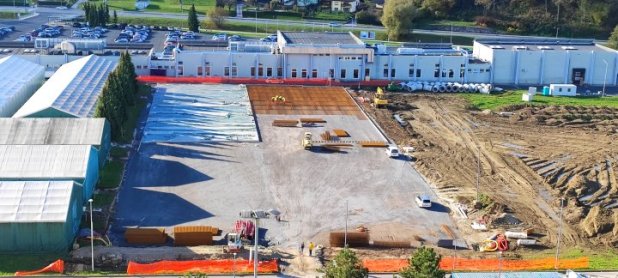
After the successful test transports that wad carried out in June this year, in mid-October together with the carrier Cosco, hisense established a regular Trieste-Velenje railway line, along which a special Hisense container train delivers raw materials and components for production, which arrive in the port of Trieste on Cosco ships. Hisense are already building a new container terminal in the Velenje industrial park, which is a condition for increasing the capacity of container transport as planned in the future. Strategic partners Cosco and Hisense will strive to build on this form of cooperation in logistics to create a win-win situation for mutual benefit and in the future increase the capacity of the block train to Velenje. It has been running regularly since mid-October, once a week, bringing 32 containers of raw materials and components from the port of Trieste directly to the Velenje industrial park each time.
Global reorganization that the Electrolux group announced in recent days provides for 4 thousand redundancies, a situation that is affected by the context characterized by both the growth of inflation and the drop in consumption that also affects household appliances. The Italian management of the company met with the trade unions to decline the impact in our country where, according to a note from Fim, Fiom and Uilm, the redundancies will be 300. Half of the workers, half of the white-collar staff and managers.
However, the reduction in costs will go hand in hand with investments and the reorganization of production which will concern in particular the Solaro site, where an innovative dishwasher platform should be built. Precisely this appliance is considered increasingly strategic, since “not yet relegated to a market of mere replacement and therefore potentially growing,” the company explained to the trade unions. The intention is therefore to produce a new product in the Italian factory, which will focus on low consumption and high performance and which will require a very important investment. In fact, the site needs an intense reorganization in the now obsolete technology department, in the packaging plant and in the assembly lines, with an amount of investments in the period 2023-2026 of 102 million euros. The new production platform should allow us to reach from the current 780 thousand pieces to 960 thousand in 2024, to 1,140 thousand in 2025 and to 1,329 in 2026.However, Electrolux’s investment plan is linked to reaching an agreement with the trade unions both on redundancies and on increasing productivity. In particular, the company asks to switch from the current production revenue, equal to 90 pieces per hour, in two years to a revenue of 118 pieces per hour, for a daily production of 5,970 pieces. The major pieces would be linked to an ergonomic improvement of the workstations and to the strengthening of the staff, which however has not yet been quantified. For the trade unions it is «an extremely ambitious project, not predictable in its outcome, which greatly affects the organization of work. A comparison is now starting that will have to try to combine the sustainability needs of investments with the indispensable ones of health and safety in the workplace, as well as with the need to stabilize precarious workers and to be able to carry out a generational change
Electrolux, with a newly-expanded plant in Anderson County, announced thousands of layoffs that will affect workers across the globe.
Last week the company said it is implementing a cost reduction and restructuring program to increase earnings.
Electrolux says between 3,500 and 4,000 positions companywide will be impacted by the program in the last quarter of 2022.
“Regarding business area North America, I am obviously very disappointed with our performance,” said CEO Jonas Samuelson. “The production transformation with the two new facilities Anderson and Springfield including several new product platforms, in combination with the particularly challenging supply chain conditions, require additional measures to return to stability and profitability.”
Samuelson said stabilizing and improving operational planning in Anderson is part of the North American turnaround plan.
Beko, one of the leading home appliances brands in Europe*, is delighted to announce its integration with Youreko, an energy efficiency tool that helps consumers choose sustainably and understand the financial running costs when choosing new appliancesThe integration of the Youreko tool on Beko’s website, displays information to consumers on how energy efficient Beko’s appliances are when compared with traditional models and how much money the consumers could save in the long run with manufacturer’s appliances. The tool supplements the listings of Beko’s washing machines, washer dryers, tumble dryers, dishwashers, refrigerators and freezers.Currently operational on the Beko UK website, the Youreko partnership will be further implemented on Beko’s websites in Romania and Poland, helping consumers across Europe to calculate their cost saving potential.
Resource efficiency is a key priority for Beko, particularly in the current economical and climate-conscious environment. This integration with Youreko is an extension of the brand’s ongoing commitment to providing products for their consumers to encourage sustainable living.
The tool helps consumers on Beko’s websites by providing more information on the energy consumption and financial cost of running a particular appliance. Utilising an easy-to-read gold, silver or bronze tiered rating system, the tool signals where money and energy can be conserved most, helping consumers make more informed buying decisions.
By integrating Youreko into its products, Beko is also able to make a smart-recommendation to the consumers based on a product’s energy efficiency rating. This calculation is based upon a comparison against a more traditional, like-for-like model of the applianc
The CEO of Arcelik, one of the world’s biggest home appliance makers, told Xinhua recently that China is a bright spot for business amid global recession fears and an increasingly gloomy market outlook.
Speaking of the present headwinds against the world economy, Hakan Bulgurlu said, “we will have to go through a lot of pain before it gets better.”
China, however, is “a little bit of a different picture,” he said in a video interview with Xinhua.
Established in 1955, Arcelik is a Turkish multinational household appliances manufacturer headquartered in Istanbul. With 45,000 employees, its global operations include subsidiaries in 53 countries, 30 production facilities in nine countries.
Arcelik’s domestic sales in China have grown by roughly 80 percent in 2022.
“I find China one of the more promising places to be in the future. It has always been the factory of the world, and I think it will continue to be the factory of the world,” said Bulgurlu.
“The world economy has significantly slowed down, and we are facing a recession on many fronts,” said the Turkish businessman, who had lived in Hong Kong for 13 years.
Calling himself “a big fan” of China and Asia, Bulgurlu said he is optimistic about the business performance in the future Chinese market. “I think demand for appliances continues. We want to continue investing in China to actually bring our brands in.”According to Bulgurlu, four product groups, namely heating and cooling, refrigeration, lighting and electric motors, consume about 40 percent of all power. Many current technologies have made these production much more efficient.
“We need global regulations to make us use the best available technologies in all of these product groups to reduce power consumption,” he said.
Regarding the upcoming COP27 meeting, he said “I hope to make some progress and talk not only with policymakers but other CEOs as well.”
“I actually admire China in the sense that when China makes a decision, it follows through very, very fast,” Bulgurlu said.
The South Korean company for the production of equipment LG may close a plant in the Moscow region (produces refrigerators, washing machines and televisions) and move production to Uzbekistan or Kazakhstan. Told “Kommersant” a source in the household appliances market.
LG is negotiating in Uzbekistan with Artel, which produces Samsung appliances. The company has not been operating a factory in Kazakhstan since 1998.According to experts, it would be more profitable to move production to Uzbekistan. According to one of the sources, part of the top management has already been relocated to Tashkent. Another source says that LG is negotiating with the authorities of Kazakhstan. After the start of a full-scale invasion of Ukraine in f In February, manufacturers of electronics and household appliances began to stop deliveries of products to Russia.
LG suspended deliveries of products to Russia in March.
whirlpool are taking the most drastic steps in the shifting business by slashing production of its refrigerators, dish washers and other home appliances by more than a third to shrink inventories.
The company is among dozens of U.S.-based multinational companies confronting weakening consumer demand amid higher costs. Whirlpool says cutting production volume by 35% last quarter reduced inventories by $300 million.
The moves are among the many steps companies are taking to adjust to increasingly volatile consumer spending patterns. Household staples supplier Procter & Gamble is diversifying its production assortment to keep cash-crunched shoppers from switching to cheaper brands.
In its most recent quarter, higher commodity, materials and freight costs reduced P&G’s gross profit margin by 5.5 percentage points, which was fully offset by cost cuts and price increases.
In the conference call with analysts, the CEO does not reveal the names of the possible buyers of Whirlpool Emea and fails to stop the collapse of the stock after the disappointing results announced the previous day.
The things are clear to the 15,000 Whirlpool employees in Europe (especially Italy and Poland), Africa and the Middle East, to the related industries of the 10 factories (5 of which in Italy) and to the trade, in short, to those who try to understand what the destiny of Whirlpool EMEA. The little information shared by Whirlpool Corporation in presenting the data for the third quarter allows us to establish some fixed points 10 financial and industrial groups have proposed to acquire (it is not known whether in part or in whole) the assets of Whirlpool Emea. Two of these groups, both industrial, remained ‘in the running’ and their offers are being evaluated.
The choice between one of the two offers and an internal solution will be submitted to a meeting of the Board of Whirlpool Corporation, probably before the end of the year, based on an analysis of the various market segments in which Whirlpool Emea operates.The markets in which the group intends to invest both to produce and to sell are other: obviously the USA and Canada, Brazil and Mexico and India.
Globally, Whirlpool Corp closed a bad third quarter disappointing analysts’ expectations. Whirlpool’s sales fell by 12.8%, in the third quarter by 7% net of the strengthening of the dollar. During the year, Whirlpool transferred $ 2.6 billion in dividends and buy backs to its shareholders
Whirlpool Corp is set to inaugurate a new factory in Buenos Aires after a $52 million investment, with plans to export more than 70% of the local production, Joao Carlos Brega, the firm’s Latin America chief, said.
The plant, which will employ some 400 workers, will produce 300,000 washing machines each year and export $50 million worth of products around Latin America, mainly to Brazil.
Arçelik’s washing machine factory in Ulmi, Romania, ranked among the most advanced in the world in terms of environmental sustainability. Indeed, Arçelik, a global appliance manufacturer and subsidiary of Turkey’s largest industrial conglomerate, Koç Holding, has been awarded Sustainability Lighthouse status by the World Economic Forum (WEF) for its manufacturing plant . ‘Ulmi, Romania. A recognition that rewards effective measures in terms of energy performance applied on the site. This follows the already existing statusArçelik as a Global Lighthouse awarded by WEF to its Ulmi plant in 2019 and Eskişehir plant in 2021 for the successful adoption of Fourth Industrial Revolution (4IR) technologies to improve productivity and performances.
Sustainability Lighthouse
The World Economic Forum’s Global Lighthouse Network (GLN) seeks to promote 4IR technologies to transform production facilities, value chains and business models. In 2021, GLN introduced Sustainability Lighthouse as a new designation to recognize manufacturers who apply innovative 4IR transformations to boost productivity while preserving the environment.
Arçelik shows the way
Arçelik’s washing machine factory in Ulmi, Romania, leads the way in efficient and sustainable manufacturing and uses state-of-the-art technologies for improved energy and water efficiency. The Ulmi plant is now designated as one of the Global Lighthouse Network’s ten sustainability flagship sites. A new recognition that Hakan Bulgurlu, CEO of Arçelik, commented saying: “ We are proud to be recognized as a pioneer in sustainable development by the World Economic Forum. This is a reflection of our deep commitment to environmental protection throughout our organization. We have ambitious environmental goals and we believe that theWe aim to achieve net zero emissions for all of our operations by 2050 through green investments in renewable energy, as well as energy efficiency in products and production. Our plant in Ulmi acts as a Sensitivity: Public laboratory and serves as an example for the entire Arçelik ecosystem. We set out to build not only an efficient Industrial 4.0 site in terms of production, but also a unit that reflects our commitment to contributing to a better future. And this recognition is well deserved, thanks to investments in advanced technologies and green production applications. I am proud of all my colleagues who have worked hard and with dynamism to achieve this. »
As a world leader in sustainability, the Arçelik washing machine factory in Ulmi stands out for the following achievements :
The factory is the first and only production unit in Romania to hold LEED Platinum certification.
The factory uses 100% green electricity. It has renewable energy systems for heating and cooling, such as rooftop solar (PV) panels (930 kWp) and concentrated solar power (700 kWth) and plans to increase the yield of the panels 160% solar power by the first half of 2023.
The factory’s “digital twin” model automatically adjusts lighting and optimizes cooling and heating systems. The building management system uses an algorithm that leverages approximately 15,000 real-time data points from more than 650 energy-measuring devices and sensors.
The lighting system uses 62.9% less electricity than a non-automated system , and the need for natural gas boilers is reduced by 34.5% for the preparation of domestic hot water.
Due to the high level of water stress around the plant, an advanced treatment plant was installed, treating 100% of domestic and industrial wastewater, and recycling and reusing 68% of its water intake.
All these efforts have resulted in a 17% energy saving per product, a 25% reduction in water consumption per product and a 22% reduction in scope 1 and 2 GHG emissions per product in production in one year , in accordance with company objectives.
Since its commissioning, the plant has avoided the emission of 684 tons of CO2.
The factory uses 100% green electricity. It has renewable energy systems for heating and cooling, such as rooftop solar (PV) panels (930 kWp) and concentrated solar power (700 kWth) and plans to increase the yield of the panels 160% solar power by the first half of 2023.