
Large household appliances will have to be transported almost entirely using reuseable packaging by 2030, according to the European Commission’s proposed packaging waste law, a move widely questioned by players in the supply chain.
The EU’s Packaging and Packaging Waste Regulation (PPWR), tabled in November last year, aims to slash unnecessary boxes and wrappings while promoting recycling as well as reuse.
The proposal, which is currently being examined by the European Parliament and EU member states before eventual adoption, has caused anxiety in the retail and logistics sector, which is still in the process of analysing the implications of the Commission’s proposed reuse targets.
But the white goods sector is confronted with headaches of their own.
Under the Commission’s proposal, 90% of packaging used for large household appliances must be “made available in reusable transport packaging” by 2030 when they are placed on the EU market for the first time.
The mandate is contained in Article 26.1 of the draft regulation, which lays down re-use targets for packaging used in the transport of “large household appliances” such as refrigerators, washing machines, tumble dryers, electric fans or air conditioners.
Whether that objective makes sense is open for debate, though.
The provision “is a significant source of concern for our sector”, said Paolo Falcioni, director general of APPLiA, a trade association representing the home appliance industry in Europe.
According to APPLiA, packaging for large household appliances must be functional and protective, to ensure the product is not damaged physically or by humidity during its journey from the manufacturer to the retailer and eventually to the consumer.
Packaging typically used for this purpose include pallets, plastic straps, carboard boxes, and pallet wrappings, some of which “cannot be reused due to technical constraints”, APPLiA said.
“For example, pallet wrapping may become damaged or contaminated with materials that cannot be adequately cleaned, rendering them unusable for future shipments. In other cases, reuse may be possible, but the cost and complexity of returning the packaging to the manufacturer can make it impractical,”
Category Archives: Environmental
SMEG sustainability report
SMEG annual sustainability report is now published and available to download At Smeg, they are committed to designing beautiful, functional products, caring for people and planet. You can download it here https://www.smeguk.com/company/sustainability

AMDEA BOSS HIGHLIGHTS THE ENERGY-SAVING BENEFITS OF MICROWAVES
AMDEA CEO Paul Hide was quoted in a recent online news story published by the i national newspaper.
The piece, which appeared this month, ahead of AMDEA’s Parliamentary Reception, (May 24) at which it called on the Government to encourage consumers to use energy efficient home appliances, focused on how microwave ovens could have an important role to play in net zero homes and easing the cost of living crisis.
At a time when families are cash-strapped and time-stretched, the microwave is due a renaissance, suggested the article.
Speaking to Serina Sandhu, senior reporter at the i, Mr Hide said: “Microwave ovens have been a staple of UK kitchens for more than 40 years. Particularly with the current focus on energy bills, UK consumers hold these energy efficient and versatile cooking appliances in high regard, purchasing some three million every year. These appliances are not only capable of cooking nutritious and tasty meals, they can save you money too.”
The AMDEA-organised event called on the Government to support households in becoming net zero through making smarter choices about all their kitchen appliances, not just microwaves.
Jennipher Marshall-Jenkinson, chair of the UK Microwave Technologies Association, told the i: “I can honestly say to you that microwaves are the safest, the most convenient, the most nutritious and energy efficient way to cook food in this 21st century,” adding that she hopes to give everybody “peace of mind” about using microwaves to cook meals.
She added: “There is no need to have saucepans anymore but getting people to move away from their habits of a lifetime is very difficult.”https://inews.co.uk/news/consumer/microwaves-secret-net-zero-homes-2352362
Arçelik recycles 192m plastic bottles
In the period prior to the day of the Word Environment on June 5, the Giant of the Arçelik appliances has revealed that it has recycled 192 million PET bottles and has used more than 13,207 tons of recycled plastic in its production only in 2022.
The 192 million PET bottles were recycled between 2017 and 2022 and were used for the production of bathtubs in their washing machines and dryers. Arçelik has also implemented a robust circular model for its Beko and Grundig brands and recycled a wider range of plastics, including industrial fishing nets and lines. These materials are recycled and used in the production of plastic components in ovens, dishwashers and washing machines. Since 2022, the company has used 26 tons of recycled fishing nets and 563 tons of recycled industrial yarns for these products.
founder of Midea, creates US$428 million science fund
Chinese billionaire entrepreneur He Xiangjian, founder and largest shareholder of home appliances giant Midea Group, on Sunday unveiled an eponymous 3 billion yuan (US$428 million) science fund to boost artificial intelligence (AI) and climate research in the country.
Asko receives the EcoVadis 2023 Silver Medal for its commitment to sustainability
Asko has been awarded this prestigious business rating for promoting practices that minimize its environmental impact and encourage social responsibility.
Since its beginnings in Sweden in the late 1950s, Asko has been dedicated to designing innovative products with the aim of moving society towards a better future.
In this endeavor, Asko pays attention not only to the products it makes, but also attaches great importance to how it makes them
Midea’s Revenue in 2022
In 2022, Midea ranked first in China in terms of market share for several categories of products both online and offline.headquartered in Foshan, Guangdong Province, recently released its 2022 annual report and 2023 quarterly report. In 2022, the company’s total revenue reached CNY 345.7 billion (USD 50 billion), an increase of 0.7% year-on-year, with a net profit of CNY 29.6 billion, 3.4% higher than in the previous year. In the first quarter of 2023, Midea achieved total revenue of CNY 96.6 billion, up 6.3% year-on-year, and achieved net profit attributable to its parent of CNY 8 billion, an increase of 12.0% from the same period last year.
Founded in 1968, Midea is one of the leading companies in the electrical appliance industry. Its five business segments are smart home, building technology, electro-mechanical, robotics & automation, and digital innovation. It has spent nearly CNY 50 billion on research and development in the past five years and provides services to over 400 million users worldwide each year. Up until now, Midea has about 200 subsidiaries, 35 R&D centers and 35 major production bases worldwide, with operations in more than 200 countries and regions.
In the overseas market, which accounts for up to 41% of its overall revenue, Midea’s 2022 overseas sales revenue reached CNY 142.65 billion, up 3.63% year-on-year. Midea ranked first in China in terms of market share for several categories of products both online and offline, including air conditioners, countertop microwaves, countertop ovens, electric heaters, induction cookers, electric kettles, etc. Among them, Midea’s offline share of air conditioners reached 33.7% of the total market share and its online share reached 33.6%.
Based on current industry trends, Tan Xiguang, chairman of Midea, believes that the electrical appliance industry is heading to a more intelligent, more efficient and greener future. In February 2023, Midea was listed among the “2022 Forbes China Top 50 Sustainable Development Industrial Enterprises”. Besides, Midea is increasing investment in R&D, constantly launching innovative products, and cooperating with technology companies to jointly explore new trends in the home appliance industry.
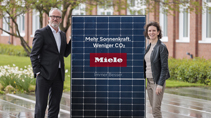
Miele harvests the sun’s power from Gütersloh roofs
Miele further expands self-sufficiency in green electricity. At its headquarters in Gütersloh, the company is currently installing the second-largest roof-top PV array in the town, comprising around 2,400 PV modules. The installation will have a total output of around 900 kWp and will generate more than 750,000 kWh of electricity per year – sufficient to power some 250 households, each with an annual average consumption of 3,000 kWh. Construction work has already commenced, with the facility expected to enter service this year..

New Electrolux Group study: Europe turns to 30° wash, driving down CO2 emissions
35 million European households have made the switch to washing at 30°C since 2020. That’s just one of the highlights from our latest pan-European report ‘The Truth About Laundry 2023’ which focuses on resource efficiency, and in particular energy usage.The Truth About Laundry report 2021
To help people create more sustainable habits in laundry care, we need to understand current attitudes and behaviors when it comes to how people care for their clothes, and to what extent people consider the environment. In 2021, we commissioned our first The Truth About Laundry report to give us powerful insights to drive change.Read the report here https://admin.betterlivingprogram.com/wp-content/uploads/2021/02/Electrolux_TheTruthAboutLaundry_TheReport-1.pdf


Microplastic Consortium
Microplastic Consortium presents key findings to IEC toward a standardised measurement method
Today, world’s leading standardisation body International Electrotechnical Committee (IEC) met in Tokyo to discuss the key findings of the joint study conducted by APPLiA-led Microplastic Consortium to assess the release of microplastic particles and fibres in household washing processes.
Brussels, 21 April 2023 – Today, world’s leading standardisation body International Electrotechnical Committee (IEC) met in Tokyo to discuss the key findings of the joint study conducted by APPLiA-led Microplastic Consortium to assess the release of microplastic particles and fibres in household washing processes. This meeting marks a landmark step toward the development of a reliable, repeatable, and reproducible measurement method for household washing machines.
The Consortium on microplastics release during household washing processes which concluded its roughly 2-year-work in March 2023, brought together 21 signatories ranging from washing machines, detergent and filter manufacturers to test institutes and facilities, with an eye to establish basic elements towards a harmonised test method to measure the behaviour of washing machines and the release of microplastics during a real household washing cycle.
One of the main findings of the study was that intentionally added plastic particles and synthetic fibres to the washing machines only partially find their way to the drain. Analyses show a big variability of results even in a laboratory-controlled environment. While the study attempted to bridge the gap between lab and real life, the Consortium faced several challenges in developing a fully repeatable, reproducible, and consumer-relevant protocol. “There are still many parameters of influence and open points to be studied and analysed,” explained IEC Convenor and BSH Senior Expert Gundula Czyzewski addressing IEC technical experts. These include the problem of non-synthetic fibre fragments such as wool and cotton, the use of powder detergent and washing machine load amount among others, “that could possibly affect filter clogging and remain an open issue to a comprehensive analysis.” Therefore, from the measurements done in the Consortium, it was possible to only calculate a few individual performance factors, triggering the need for further investigation. In this sense, workshop participants convened that standardisation bodies are the right place to continue the discussion for the development of an accurate test procedure that could verify the performance of any solution.
Setting minimum performance requirements on microplastics filters without a repeatable and reproducible method would result in a non-verifiable, ineffective legislation. Concern about the potential impact of microplastics has gathered momentum during the past few years. The number of scientific investigations has increased, along with public interest and pressure on stakeholders. “Understanding the magnitude of the issue is key to ensuring an effective solution,” said APPLiA Energy & Environment Policy Manager Giulia Zilla, who was responsible for the coordination of the Consortium activities on behalf of the Association, and contributed to the draft of the final report. The issue of microplastic pollution has escalated the EU political agenda to translate into a number of different regulations currently being discussed at national and international level. There, the study plays a key role in substantiating the need for the adoption of “a lifecycle-based approach to identify the most cost-effective solution to a global issue.” In this sense, the deployment of washing machine filters into European homes has been identified by some countries as a possible mitigation strategy to microfiber emissions. “While filters can contribute to halting the journey of microplastics before they reach the environment, a more comprehensive and long-term solution, reconsidering the very use of plastics, is needed,” commented Zilla. Mandating the equipping of all household washing machines with a filter does not seem to represent a conclusive solution to tackle the microplastics issue, as fibres will always find their way into the environment, if present in textile products themselves. Before setting any legislative requirements on washing machines, a number of technical considerations must be addressed. Among others, the filter can cause clogging of the machine but what is more, the burden of maintenance to keep the machine running would fall on consumers, from cleaning to replacement and disposal, in order to prevent the rinsing off of fibres in the sink. Even in the case of integrated filters, it would be very problematic to deal with the maintenance of the filter itself while ensuring the best performance of the machine. Research is currently ongoing to evaluate the benefits of EU-wide legislation. A proposal is expected later this year.
While it is difficult to estimate a timeline by when a measurement method could be available to use for the verification of the requirements, the role of policymakers remains crucial to follow standardisation activities and set measurable targets in the law. As a next step, the joint study conducted by the Consortium will be reviewed in detail by IEC and used as a starting point to the development of a standardised measurement methodology.
 WHITEGOODSNOW