
China’s leading home appliance manufacturer Midea Group saw its revenue rise 24.98 percent year on year in the first half of 2021, following strong sales growth.
Its revenue reached 173.8 billion yuan (about 26.9 billion U.S. dollars) in the January-June period, the Fortune 500 company said in an interim financial report filed with the Shenzhen Stock Exchange on Tuesday.
Over the period, the company chalked up 15 billion yuan in net profit, up 7.76 percent year on year, according to the report.
Midea said its major home appliance products expanded their shares in online and offline domestic markets in the first six months of this year. The company was the top seller of household air conditioners in both markets during the period

LG reports steady appliance recycling activity
LG Electronics says it is continuing to invest in what it calls a state-of-the-art recycling facility in Hamyang County, South Korea. The LG Chilseo Recycling Center, says the firm, collects a broad range of discarded household appliances and then undertakes disassembling, crushing and screening to create secondary commodities that can be reused in new LG appliances, “beginning their life cycle again.”
Every year, the center recycles up to 550,000 appliances, including refrigerators, washing machines and air conditioners. LG says the process starts with skilled technicians and includes “tried-and-true” processes and specialized equipment that helps harvest aluminum, copper, steel and plastic, destined for end markets tied to the manufacturing of new LG home appliances.
Offering an overview of the plant, LG says the plant’s initial stage includes disassembly, shredding and sorting. Once the appliances have been collected at the Chilseo Recycling Center, workers manually remove both mechanical and detachable plastic components such as compressors, drawers and shelving. Any remaining refrigerant is safely extracted using a gas recovery device, adds the firm.
Appliance frames are then shredded and sorted into steel, copper, plastic, aluminum and any other fractions “through a variety of methods using vibration, gravity, magnets and air.”
Shredded plastics are moved to another facility and sorted another time using water before being melted, cooled and cut into small pellets of uniform size. “With their consistent shape, scale and composition, the pellets are perfect for use in the manufacturing of plastic parts and goods, offering dual benefits of reducing both waste and effort required to create new products,” states LG.
From the plastics facility, the pellets are transferred to another site where they are melted down, poured into molds and transformed into plastic components for new LG refrigerator models.
Those plastic components are then moved to LG’s plant in Changwon, South Korea, the company’s “main home appliance manufacturing facility” 30 kilometers (nearly 19 miles. There, the components become part of a new LG refrigerator as shrouds, ducts and handles, among other components.
The appliance maker states, “One of the best ways to preserve the Earth’s resources and reduce our footprint is through creating a virtuous cycle where we recycle, reuse and repurpose what we already have. From eco-conscious manufacturing and product design to responsible recycling and waste management and development of sustainable technologies, LG continues its journey to ensure a better tomorrow.”

Electrolux Celebrates 1,000th Tree Donation To The Nature Conservancy
Electrolux announced today that it has donated its 1,000th tree to The Nature Conservancy.
Through a partnership with The Nature Conservancy’s Plant a Billion Trees campaign, Electrolux North America is helping plant a tree on behalf of every consumer who registers their new Electrolux appliance before June 30, 2022. The company reached the 1,000th tree in the campaign’s first three months. The campaign is a major forest restoration effort with the goal of planting a billion trees across the planet.
Electrolux is committed to a sustainable future, both in its manufacturing operations and in consumers’ homes.
Electrolux is planting a tree on behalf of every U.S. consumer who registers their new Electrolux appliance.
“We are deeply committed to sustainability and are proud to support The Nature Conservancy,” said Nolan Pike, head of Electrolux North America. “Many thanks to our consumers for helping us make a big difference and reach the one-thousandth tree donation mark so quickly. Together, we are planting the seeds to shape a better future for our planet – the home we all share.”
Electrolux U.S. consumers who want to register their new product can do so here. After registering a product, consumers will receive a welcome email with a link to select a tree to be planted in one of four important North American forests.
“Planting the right trees in the right places is a rewarding way to foster clean and abundant waters, enhance wildlife habitats, cool our cities, improve our health, and help mitigate carbon emissions to stabilize our climate,” said Rachel Holmes Urban Forest Strategist at The Nature Conservancy. “We appreciate partners like Electrolux for contributing to our efforts to plant one billion trees.”
Haier smart in Milan design week
Haier has chosen Milan Design Week 2021 to present and materialize its idea of Smart Home, an immersive experience that will allow visitors to be active participants in a story that will unfold according to their choices and preferences, hand in hand with technological innovation. , premium design and personalized brand solutions.
From September 4 to 10, the Superstudio Più will host ‘Haier – Connect to the extraordinary’. Visitors, in small groups, will have the opportunity to experience, in a space of 400 square meters, the simulation of a fully interconnected home with a complete ecosystem of appliances and connected solutions to deal with typical problems and situations of everyday life. .

The simulation, designed by Bonsai Ninja and connected with the hOn app (the software developed by Haier to manage, control and improve the functions of all the brand’s electrical appliances), will propose to visitors to prepare an interactive dinner for friends in a completely ‘ remote ‘due to an unforeseen event. “For this, Artificial Intelligence and the unique characteristics of Haier’s ecosystem solutions and the experimental world of the Smart Home will come into play, such as the new range of cooking appliances, connected refrigerators and wine cellars with exclusive conservation functions, innovative air conditioning solutions or promising washing results “ , they point out from the brand.
“Following the unmistakable approach to bespoke solutions that characterizes each of Haier’s products and features, the experience presented at Milan Design Week conveys the brand’s philosophy of zero distance from the consumer through products. premium, unique, at the forefront of technology and with an exclusive design, as well as the possibilities of interaction and personalization offered by Artificial Intelligence and connectivity “ , they point out from Haier.
The Hoover Proposal: Performance and Attention to Well-Being

“For its part, Hoover will present in the same space the first H-ABITAT Home Wellness Ecosystem, a set with three interconnected products that care about the health and well-being of the family,” they say from the company. The installation, called ‘Performance and Connectivity for a healthier lifestyle’, will feature the smart home appliances H-SCANNER, H-PURIFIER and H-GO, which, connected through the hOn application, allow the collection of quality data of both indoor and outdoor air, purify the home and clean home surfaces independently.
Likewise, Hoover will have a second interactive stage oriented to washing and starring the new connected range H-WASH 550, a washing machine focused on the well-being, performance and disinfection of garments through steam. Visitors will discover the many benefits and comforts that connected appliances offer through the multiple functions of the hOn app, such as ‘Scan To Care’, which, with just a photograph, suggests to the user the most suitable washing program for each laundry .
Candy’s’ Snap & Do ‘experience to simplify consumers’ day to day

The Italian brand will also land at Milan Design Week with the aim of responding to consumer needs in a simple and intuitive way. Using the latest technologies applied to household appliances and continuing with its commitment to offer smart and accessible products and solutions year after year, Candy will present in its space ‘Snap & Do – Connections that make a difference’ the functionalities for washing clothes and dishes (Snap & Wash ), drying clothes (Snap & Dry), preserving food (Snap & Cool), cooking (Snap & Cook) and choosing the right wine (Snap & Wine).“It is an experience inspired by connectivity to simplify everyday life, which allows unprecedented interaction with connected appliances thanks to the hOn app. With this, Candy shows its DNA, impregnated with intelligence and a strong link with the connectivity, and its commitment to simplify the user’s daily life “ , stand out from the company.
LG Electronics applied for the largest number of patents
The Korea Intellectual Property Office said on Aug. 26 that its analysis of U.S. patent applications related to washing machines and refrigerators has found that Samsung Electronics and LG Electronics excel their competitors.
From 2011 to 2020, LG Electronics applied for the largest number of patents in the U.S. with 1,102 applications in the washing machine sector. Samsung Electronics and WINIA Electronics came in fourth and sixth with 493 and 184 applications, respectively. During the same period, LG Electronics topped the list with 764 applications for refrigerator patents. Samsung Electronics ranked second with 355 applications
Analysts say that Korean companies’ technology development for the past 10 years led to their high market shares. Samsung Electronics (21 percent) and LG Electronics (19 percent) ranked first and second in the U.S. electric home appliance market in the first quarter of this year, said North American market research company Trackline. Whirlpool, a U.S. company, accounted for 16.5 percent. In particular, LG Electronics’ sales reached 13.5 trillion won in the first half of this year, surpassing its archrival Whirlpool’s 11.9 trillion won.
However, patent applications by Chinese home appliance companies has recently surged, posing a threat to Korean makers. Chinese home appliance manufacturers ranked first and second in patent application rankings in the five major countries of Korea, the United States, Europe, China and Japan. In fact, China’s leading home appliance companies, Haier Group and Midea, are sweeping first place in patent applications in the electric home appliance sector in the top five IP countries between 2011 and 2020. Haier stood first in patent applications in the washing machine category. Midea claimed the No. 1 spots in the refrigerator and air conditioner sector
.
Beko targets South Africa
Arçelik, the consumer durables and electronics manufacturer is expanding its brand southern Africa by adding Beko, a freestanding home appliances name to its local portfolio.
Beko is available in 20 African countries including Nigeria, Kenya, Rwanda, and Mauritius.
Arçelik which holds brands Defy, Grundig and Beko under its umbrella has launched Beko in South Africa at stand-alone stores in Johannesburg and Durban.
In South Africa, Arçelik currently employs more than 2700 staff with two manufacturing facilities, and is the largest manufacturer of major domestic appliances in sub-Saharan Africa.
Faber new Pantheon hood
Brand new to 2021 is the stunning Pantheon by Faber, featuring innovative technology in a sophisticated design.
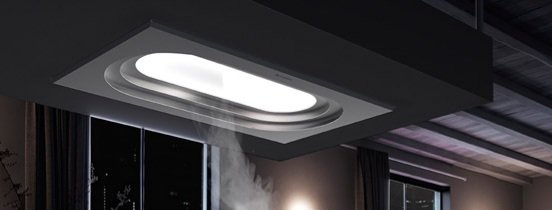

The most distinctive feature of the Pantheon is the unique turnable light transforming your ceiling hood into a distinctive décor element.
With its striking and iconic style, this extractor is available in white matt or stainless steel with an LED panel; perfect for a sleek, modern kitchen style.
Control the Pantheon with the push button or handy remote control.
This ceiling cooker hood features three power settings with an additional intensive speed function, as well as impressive perimeter aspiration. Not only does this feature accelerate air flow, but it also helps to reduce noise.
The Pantheon is available in White Matt or Stainless Steel.

Whirlpool making real, positive differences in communities.
Whirlpool making real, positive differences in communities. Brought to light in this compelling video, which recently won the Platinum Award from Hermes Creative Awards, you’ll hear straight from those impacted by #CSR efforts with Habitat for Humanity International.
To learn more about Whirlpool’s new House + Home corporate social responsibility strategy visit,

KBB Trade show returns
Kbb Birmingham returns to NEC in 2022
Kitchen, bedroom and bathroom trade exhibition kbb Birmingham, is set to return to the NEC from March 6-9, 2022.
Businesses given more time to apply new product safety marking
The UK Government has confirmed businesses will have an extra year to start using the new UKCA product safety marking.
Applicable for most products placed on the market in England, Scotland and Wales, the UK Conformity Assessed (UKCA) marking allows the UK to have control over its goods regulations, maintaining the high product safety standards expected in the UK.
Recognising the impact of the pandemic on businesses, the Government will extend the deadline to January 1 2023 to apply UKCA marks for certain products to demonstrate compliance with product safety regulations, rather than January 1 2022.
The UKCA marking replaces the product safety labelling the UK previously used while a member of the EU, such as the CE mark

