
White goods buyers and manufacturers are watching copper markets closely. Recent price movements point to higher costs for induction hobs and other home appliances heading into the final quarter of 2026 and early 2027.
Continue readingTag Archives: induction hobs
From Nokia to the Future Kitchen: Why Standing Still Is the Biggest Risk
Nokia was once untouchable.
A global icon. A market leader. A brand that defined an era.
But when smartphones arrived, the world shifted faster than anyone expected. Nokia didn’t fail because it lacked technology — it failed because the market moved toward a new user experience, a new ecosystem and a new way of thinking.
Today, the kitchen appliance industry is facing its own version of that moment.
The First Shift: From Gas to Induction
Gas hobs are giving way to induction. Not simply because induction is cleaner, safer and more energy‑efficient, but because the kitchen itself is evolving into a more intelligent, connected and adaptive environment.
And just like the jump from feature phones to smartphones, the next transformation is already underway.
The Second Shift: From Fixed Zones to Full‑Surface Freedom
Traditional induction hobs still rely on fixed cooking zones — one circle, one function, one limitation.
Future kitchens won’t accept that.
No‑zone and full‑surface flexible induction will allow cookware to be placed anywhere, creating a more intuitive, more responsive cooking experience. As smartphones replaced button phones, flexible induction platforms will replace traditional segmented heating units.
But that’s only the beginning.
The Third Shift: The Hob as an Energy Base Station
The induction hob is no longer just a cooking appliance.
It is becoming the energy hub of the future kitchen.
With emerging wireless power technologies, the hob surface could supply energy not only to cookware, but to coffee machines, blenders, kettles, food processors and modular accessories. Cables disappear. Countertops stay clean. The kitchen becomes flexible, modular and intelligent.
This isn’t a product upgrade.
It’s a platform revolution.
The Real Question for the Industry
For appliance brands, kitchen manufacturers and technology partners, the question is no longer if this shift will happen.
The question is:
Are we preparing early enough?
At Novanest, they see the future of cooking converging around three pillars:
- Flexible induction
- Wireless kitchen power
- Intelligent platform integration
The next‑generation kitchen won’t be defined by gas flames or fixed heating zones.
It will be defined by freedom, intelligence and a new energy ecosystem.Novanest Global is a specialist engineering provider of induction hob technology, delivering PCBA modules, core components, and complete SKD/CKD cooktop solutions to OEM and ODM brands worldwide. With a strong R&D base, certified manufacturing, and a portfolio spanning induction hobs, heating elements, and integrated kitchen systems, the company positions itself as a one‑stop technical partner for modern, energy‑efficient cooking appliances.
Novanest Global is a specialist engineering provider of induction hob technology, delivering PCBA modules, core components, and complete SKD/CKD cooktop solutions to OEM and ODM brands worldwide. With a strong R&D base, certified manufacturing, and a portfolio spanning induction hobs, heating elements, and integrated kitchen systems, the company positions itself as a one‑stop technical partner for modern, energy‑efficient cooking appliances.
Miele EuroCucina
Miele used Milan Design Week and EuroCucina 2026 to unveil Designed to Move with You — a holistic vision for a flexible, connected and emotionally intelligent kitchen.
Across both the EuroCucina booth and the redesigned Miele Experience Center in Brera, the brand demonstrated how appliances, architecture and user behaviour can work as one.
Key Highlights
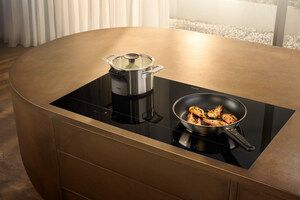
– KM 8000 induction hobs + M Sense cookware: smart temperature control with up to three sensors to prevent burning or boiling over.
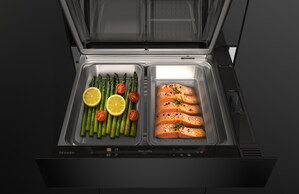
– New 14 cm steam drawer: a compact 3‑in‑1 cooking solution when paired with a 45 cm compact oven with microwave. Launching March 2027.
– CulinaryCoach AI assistant: personalised cooking guidance with direct transfer of settings to connected appliances.
– Compact Living design study (with Hettich): high‑functionality kitchen solutions for small urban spaces.
Miele’s concept positions the kitchen as a dynamic ecosystem that adapts to modern lifestyles — blending technology, design and space efficiency in new ways

BSH Spain Celebrates 23 Million Induction Hobs and 35 Years of Innovation in Zaragoza
BSH Home Appliances Spain, S.A. has reached a major production milestone—over 23 million induction hobs manufactured at its Zaragoza facility, the company’s global headquarters. This achievement marks 35 years of continuous innovation in a product that has transformed kitchens worldwide, making them safer, more efficient, and more sustainable.
A trailblazer in industry-academic collaboration, BSH was one of the first companies to partner with the University of Zaragoza, fostering a culture of research and development that continues to drive progress today. The Montañana plant, home to 1,500 employees—including 150 dedicated to R&D—is widely regarded as the crown jewel of BSH’s operations in Spain.
New Bertazzoni induction hobs, with Metal Frames
Attention to detail, colors and finishes are key elements in Bertazzoni products. This not only allows the brand to offer solutions with a refined design but also to offer appliances that can be customized according to the user’s taste. On the occasion of Design Week 2025, the company is launching new induction hobs, including those with Metal Frames. They are frames available in 78 cm and 90 cm options. The end users can choose between different finishes (gold, carbon and stainless steel) and these variations allow them to find the solution that best suits their style and decor. They also guarantee aesthetic continuity with other Bertazzoni appliances.Bertazzoni has expanded its induction hob range with new Premium (60, 78, 90 cm) and Super Premium (78, 90 cm) models, offering advanced design and technology that enhance their existing lineup. These hobs feature minimalist aesthetics with hidden controls that disappear when off, ensuring a seamless integration into modern kitchens. User-friendly controls, especially the 7” full-color TFT display on select models, provide intuitive power adjustment and real-time heat monitoring.
Key features include Bertazzoni Assistant, a smart system with five automatic cooking programs: Keep Warm, Boil Water (with auto shut-off and water level alert for steaming), Steam Cooking, Pasta Cooking (managing temperature and timing), and Frying (maintaining optimal oil temperature). Additional technologies like Automatic Pan Recognition and Pot Transfer simplify cooking. Safety features include a safety lock, Pause & Resume mode, and an end-of-cooking timer.
Furthermore, Half-Bridge technology ensures even heat distribution for low-temperature cooking, while the 3.7 kW Boost function allows for rapid boiling. A low power mode (0.3 kW) maintains stable temperatures for extended cooking.


Condensation in induction hobs: causes, remedies and solutions
The advantages of induction hobs are many, but anybody who owns one and prepares food often will understand that one big disadvantage is the condensation created. Faber S.P.A., are absolutely aware of this issue and offer solutions to overcome it.
Condensation is created due to the higher efficiency and heating rate of induction hobs. This can lead to damage of the cooker hood and also of the furniture in the kitchen. There are some remedies that you can follow to reduce the impact of condensation in the kitchen, while Faber’s Zero Drip hood range will ensure that it is no longer an issue.
To learn more about the simple steps you can take to handle condensation, and to learn more about Faber’s Zero Drip range of hoods, take a look at Fabers blog article.https://www.faberspa.com/en-en/blogs/en/condensation-in-induction-hobs-causes-remedies-and-solutions

 WHITEGOODSNOW