
BSH Home Appliances Group closed the 2025 fiscal year with €15.0 billion in sales. Adjusted for currency effects, this reflects a slight 1.6% dip, though local‑currency growth reached 2.8%. The company saw positive momentum in North America, Europe, and Emerging Markets, while Greater China remained challenging.
Regional Highlights
North America delivered strong results, with over 5% growth in local currency and continued market‑share gains. Premium brands Gaggenau and Thermador, along with built‑in refrigeration and gas cooktops, drove performance. BSH also strengthened the Bosch brand and its overall competitiveness in the region.
In Europe, sales rose 1.2% despite ongoing price pressure. Built‑in appliances grew 4%, supported by solid demand in Germany, the UK, Spain, the Netherlands, and Italy.
The Emerging Markets region posted 2.3% growth—and an impressive 24% in local currency—across Turkey, Eastern Europe, the Middle East, India, and Africa. BSH also advanced its footprint with a new factory in Cairo. India will become an autonomous region in 2026 due to its scale and strategic importance.
Only Greater China declined, with sales down 7.1% amid persistent market weakness, though BSH maintained its leading position among non‑Chinese manufacturers.
Product Category Trends
Most categories showed resilience in 2025:
– Cooking appliances returned to growth: ovens up 2.0%, hobs and extractor hoods up 2.6%, with rising demand for hobs with integrated ventilation.
– Dishwashers grew 2.1%.
– Small appliances held steady at +0.1%.
– Customer Service revenue edged up 0.3%, reinforcing BSH’s focus on product longevity and customer satisfaction.
Cooling (–4.0%) and laundry (–1.0%) declined, largely due to intense competition in Greater China.
Currys announced the departure of its chief executive
More than £160m was wiped off the value of Currys after the electrical goods giant announced the departure of its chief executive
Alex Baldock will leave after eight years running the retailer, having spearheaded a successful turnaround and fended off two takeover attempts from foreign suitors.
Confirmation of his exit led to shares in Currys falling by more than 11pc on Thursday, the biggest drop in two years.
Sabaf Group Reports Solid 2025 Results Amid Deep Sadness for the Loss of CEO Pietro Iotti
Sabaf Group has released its 2025 financial results, but this year’s numbers arrive under the shadow of profound loss. The sudden passing of CEO Pietro Iotti has left the entire organisation grieving, with emotions far outweighing the satisfaction of a positive—though complex—financial performance.
A Year of Stability and Selective Growth
Despite a challenging macroeconomic environment, Sabaf closed 2025 with revenues up 0.8%, reaching €279 million. Profitability also showed resilience:
– EBITDA rose 2.4% to €41 million, representing nearly 15% of total revenues.
– Net profit, however, declined from €16 million to €13 million, reflecting higher costs and a more cautious market.
Even with the dip in net profit, the Board of Directors expressed confidence in the company’s financial health. They intend to maintain the dividend at €0.58 per share, a signal of stability to shareholders and stakeholders alike.
Leadership Transition During a Difficult Moment
In the wake of Iotti’s passing, Sabaf has moved swiftly to ensure continuity and steady governance.
– Gianluca Beschi, previously Chief Financial Officer, will step into the role of CEO.
– Andrea Bonfadelli, Technical Director of the Gas Division and Director of the Supply Chain, has been appointed General Manager.
Both leaders are long-standing figures within the Ospitaletto-based company, and their appointments reflect Sabaf’s commitment to internal expertise and strategic continuity.
Looking Ahead
While the financial results demonstrate resilience, 2025 will be remembered as a year marked by loss. Yet Sabaf’s leadership, operational strength, and long-term vision position the company to move forward with stability and respect for the legacy of Pietro Iotti.
Midea Outlines Strategic Role for Küppersbusch in Its European Expansion
Midea has offered fresh clarity on how Küppersbusch—its German premium appliance brand acquired last year—will fit into the group’s broader European strategy. According to Ralph Kobsik, Managing Director of Midea Europe GmbH, the company intends to keep Küppersbusch operating as an independent, premium‑focused entity.
The move signals Midea’s ambition to strengthen its presence in the high‑end appliance market, an area where Küppersbusch has long held strong brand equity. Rather than folding the brand into Midea’s mainstream portfolio, the company plans to preserve its distinctive identity, design language, and market positioning.
Kobsik confirmed that the initial strategic focus will be on refrigeration and built‑in appliances, two categories where Küppersbusch has historically excelled. New product designs will remain aligned with the brand’s established aesthetic, ensuring continuity for loyal customers and retail partners.
However, one major shift is already underway: production will not return to the former Essen facility, which has now closed. While manufacturing will be relocated, Midea emphasises that the brand’s design DNA and premium positioning will remain intact.
This clarification offers a clearer picture of how Midea plans to balance scale with exclusivity—leveraging Küppersbusch’s heritage while integrating it into a broader European growth strategy.
WhiteGoodsNow will continue tracking developments as Midea refines its premium‑market ambitions.
Elica Appoints Luca Barboni as New CEO Following Leadership Transition
Elica SpA, a global leader in kitchen ventilation and home cooking technologies, has announced a significant change at the top of its leadership team. The Board of Directors has appointed Luca Barboni—formerly Managing Director of the company’s Cooking Business Unit—as the new Chief Executive Officer.
The decision was made through co‑option, in line with Elica’s established succession plan and following the recommendation of the Nomination and Compensation Committee. The appointment also received the full support of the company’s independent directors, underscoring a unified strategic direction for the brand’s next chapter.
Barboni steps into the role with deep operational experience and a strong track record within Elica’s core business. His leadership of the Cooking BU positioned him at the centre of product innovation, market strategy, and the company’s evolving approach to premium home appliances—making him a natural fit to guide Elica through its next phase of growth.
This transition follows the resignation of Giulio Cocci, who has served as CEO since March 2021. Cocci and the Board mutually agreed that the time was right for a leadership change, with his resignation taking effect immediately. During his tenure, Cocci oversaw a period of strategic consolidation and operational strengthening, navigating the company through a challenging global landscape.
Elica’s leadership shift signals a renewed focus on innovation, operational excellence, and competitive positioning within the global home appliance market. With Barboni at the helm, the company appears poised to accelerate its momentum in both product development and international expansion.
WhiteGoodsNow will continue to follow updates from Elica as the new CEO begins shaping the company’s strategic direction.
Cafom Group buyer of the brands belonging to the Brandt Group.
The Nanterre Commercial Court has selected the Cafom Group as the buyer of the brands belonging to the Brandt Group. The deal, valued at €18.6 million, covers four well-known appliance brands—Brandt, Sauter, De Dietrich, and Vedette—along with their associated patents and existing inventory.
Following the acquisition, Cafom has already restarted distribution of these brands in both the French and international markets. The group has also outlined plans to progressively reindustrialize production, with a clear intention to maintain manufacturing activities in France 🇫🇷.
To support this strategy, Cafom has partnered with Arpa, an Alsatian company specializing in cooking appliances. Arpa will notably take charge of induction cooktop production and is expected to create over 50 jobs in the short term, rising to around 130 positions in the longer term as part of a new oven production and assembly line.
At the same time, EverEver, a start-up based in Brittany that had previously submitted its own bid for the brands, has been approached to help develop a new range of washing machines scheduled for launch in the coming months.
Cafom says the project represents a major step in strengthening the French appliance industry.
“We are proud to launch this ambitious project, which will create jobs in France, preserve national industrial heritage, and protect the purchasing power of French consumers,” the group stated. “This initiative also reinforces our position as a leading player in the distribution of home furnishings and household equipment.”
Through this acquisition and its industrial partnerships, Cafom aims to revitalize historic French appliance brands while rebuilding local manufacturing capacity—a move that could bring both economic and industrial benefits in the years ahead.
Hoover reintroduced to Australia, New Zealand and the Pacific Islands.
Tempo and Techtronic Industries (TTi) have entered a new distribution partnership that will see Hoover whitegoods reintroduced to Australia, New Zealand and the Pacific Islands.
Under the agreement, a refreshed Hoover range of major domestic appliances—including laundry, refrigeration and dishwashing—will roll out later this year. The move marks a significant expansion opportunity for the brand, which carries more than a century of heritage in home appliances.
By leveraging Tempo’s established market presence and TTi’s distribution strength, Hoover is set to broaden its footprint across the region and become accessible to a wider base of customers.
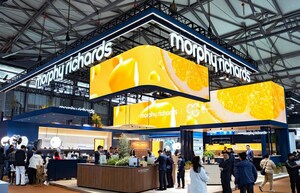
Morphy Richards Celebrates 90 Years of Innovation at AWE 2026
Under the theme “Time Forged, Vision Forward,” Morphy Richards marked its 90th anniversary at AWE 2026 with major product debuts and an AWE Innovation Award for the Kitchen Master 2‑in‑1 Mixing Fryer.
The brand showcased three flagship launches:
– the Fully Automatic Coffee Machine with hot‑and‑cold dual extraction,
– the InfuseChill Flavoured Ice Maker, introducing customizable multi‑flavour ice,
– and the Fully Automatic High‑Speed Blender, offering one‑touch heating, blending, dispensing, and sanitizing.
The award‑winning Kitchen Master impressed with its spatial‑folding design, integrating mixing and frying into a compact, streamlined workflow tailored for modern, space‑conscious kitchens.
Celebrating nine decades of engineering heritage and global growth, Morphy Richards reaffirmed its commitment to More Stylish, Higher Quality, Smarter innovation—continuing to shape the future of everyday living.
AWE2026 Sets New Global Benchmark as AI-Powered Smart Living Takes Center Stage
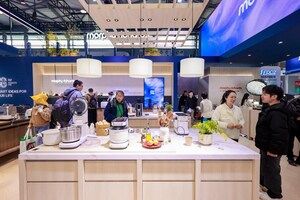
The Appliance & Electronics World Expo 2026 (AWE2026) wrapped up after four high‑energy days, uniting more than 1,200 global brands and innovators to showcase the next era of AI‑driven smart living. Early data from AWE confirms a 30%+ surge in attendance year-on-year, cementing its position as the world’s largest consumer technology exhibition.
This year’s main venue—the Shanghai New International Expo Centre—spanned over 140,000 square meters, drawing hundreds of thousands of visitors into immersive, hands-on demonstrations. Meanwhile, the Shanghai Eastern Hub International Business Cooperation Zone offered streamlined access for international attendees, with pre-registration and visa‑free entry enabling a smooth arrival-to-show experience.
AI Takes the Spotlight: “Smart AI, Smarter Future”
Under the theme “Smart AI, Smarter Future,” AWE2026 highlighted how artificial intelligence is reshaping every corner of modern living—from home appliances and robotics to mobile computing and energy ecosystems.
Two brands dominated the show floor:
Haier: AI Eye 2.0 and L4 Intelligent Appliances
Haier unveiled its upgraded AI Eye 2.0 system and introduced the Seeker series of L4-level intelligent appliances. The lineup includes three categories of home service robots designed for:
– Cleaning
– Companionship
– Domestic assistance
Haier’s expansive booth—exceeding 10,000 square meters—positioned the brand as a leader in AI‑native home ecosystems.
Dreame: A Full-Stack Smart Living Ecosystem
Dreame matched Haier with an equally massive exhibition, presenting a cross‑category ecosystem spanning:
– Smart home appliances
– Smartphones
– Vehicles
– Aerospace exploration
– Energy management
– Computing power
Flagship debuts included:
– A clothes‑folding robot
– The self‑developed “Chixiao 01” mobile processor
– The Nebula NEXT 01X platform
Smart Home Evolution: From Passive to Proactive
Major brands—Haier, Huawei, Hisense, Siemens, Panasonic, and others—showcased deeply integrated AI solutions that move appliances beyond simple automation. The shift is clear: devices are becoming active participants in home management, capable of anticipating needs and delivering personalized services.
Home Robotics Steal the Show
One of the strongest trends at AWE2026 was the rapid rise of home service robotics. Companies including Haier, Hisense, TCL, Fotile, Roborock, MOVA, Ecovacs, and Dreame unveiled next‑generation concepts such as:
– Companion robots
– Fully robotic kitchens
– Wheeled cleaning robots
– Flying cleaning devices
These innovations signal a future where hands‑free living becomes the norm, not the exception
Panasonic’s First Rice Cooker: The Small Innovation That Changed Home Cooking
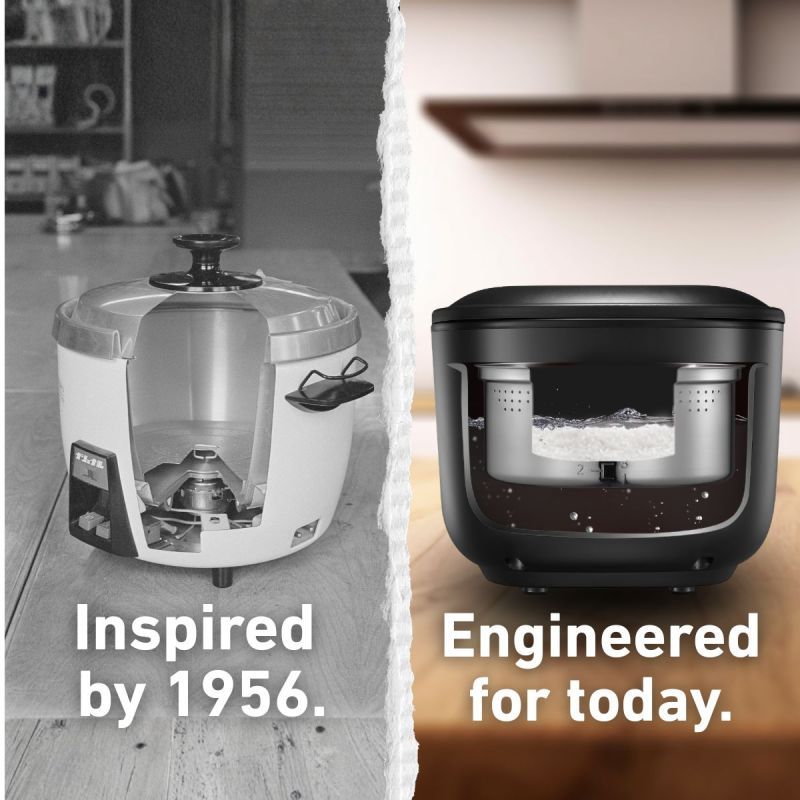
When Panasonic launched its first automatic electric rice cooker in 1956, it quietly reshaped everyday life. By pairing a heating element with a thermostat, the company turned a time‑intensive task into a hands‑off routine—so successfully that 1957 became Japan’s “rice cooker boom.”
Through the early 1960s, Panasonic kept refining the design with keep‑warm modes and timers, features that soon became essential in households across Japan.
These early steps reveal a pattern that still defines the brand today: innovation built not on flashy breakthroughs, but on steady, thoughtful improvements that make daily living easier
 WHITEGOODSNOW