
Rising material costs and high energy prices are posing significant challenges for EU manufacturers in maintaining global competitiveness.
Electricity prices in Europe are currently 2-3 times higher than in the US, resulting in increased investment costs for EU manufacturers compared to their global counterparts.
Additionally, the global supply of critical raw materials is concentrated in a few regions, making the EU vulnerable to price fluctuations, supply chain disruptions, and potential geopolitical leverage. This underscores the urgent need for diversified supply chains and the establishment of new and existing trade relationships to boost critical raw material extraction and recycling within the region and beyond.
We advocate for a stronger alignment of policies with decarbonisation goals to enable Europe to lead the #techrace, ensuring a competitive and sustainable future for European manufacturers.
Category Archives: Manufacturing
Samsung Wants Screens on Every Appliance by 2025
Samsung Electronics is set to revolutionize home appliances with its advanced display technology, embodying its vision of ‘Screens Everywhere’.
This year, Samsung is transforming the kitchen experience with a refrigerator featuring a new 9” AI Home screen and incorporating the 7” AI Home into the Wall Oven. The laundry category isn’t left behind, with the 7” AI Home integrated into the Bespoke AI Laundry Combo™, now included in the new Bespoke AI™ Washer and Dryer Set. These innovative products will debut at CES 2025.
### Bespoke Refrigerators Get New Compact Screen and Improved Functionality
By offering a range of products with varying screen sizes, Samsung enhances user accessibility and brings the smart home closer to reality. With Bixby voice control, Samsung home appliance screens provide essential activity information like internal temperatures or wash cycle details in a user-friendly format. The Map View feature stands out, allowing these screens to act as convenient control hubs, enabling users to monitor and control connected appliances from a single screen. Additionally, the screens offer various entertainment features via Internet connectivity, broadening the role of home appliances within the home environment.
Stalemate in Negotiations Between Italian Government and Beko Europe Over Factory Closures
Negotiations between the Italian Government and Beko Europe have hit a substantial deadlock regarding the planned closure of several factories and production lines acquired from Whirlpool in Italy. During a hearing before the Chamber of Deputies’ Productive Activities Committee, Maurizio David Sberna, Beko Europe’s head of external and institutional relations, expressed the company’s commitment to evaluate all potential industrial operations. He emphasized that any actions taken to mitigate the impact of these closures would only proceed if they do not alter the economic impact of the current plan, which aims to halt unsustainable financial losses.
The factories in Siena, Comunanza (Ascoli Piceno), and Cassinetta (Varese) are particularly affected, with each incurring over €50 million in annual losses. This situation is exacerbated by the overall decline in demand for household appliances in Europe and increased competition from Chinese manufacturers. Beko Europe estimates a loss of €224 million in the large household appliances sector in Europe for 2024 alone.
Beko Europe also reiterated that their plan complies with the requirements notified under the Golden Power regulations. Consequently, there are no grounds for government intervention to alter Beko Europe’s actions, with the government’s role limited to monitoring the implementation methods.
Midea inaugurates its first wholly owned factory in Brazil
Chinese home appliance giant Midea Group has announced the opening of its new Brazilian factory in Pouso Alegre, a city in the southeastern state of Minas Gerais. The official inauguration was held on 9 December, reports Brazilian outlet Diário do Comércio.
The sprawling factory covers an area of 73,000 square metres and has the capacity to produce 700,000 refrigerators and 600,000 washing machines annually. Midea Carrier CEO Felipe Costa told reporters that the company aims to reach maximum production potential in two years.
While the factory will be employing 700 employees initially, Midea expects to increase this to 1,000 jobs by December 2025. Mayor Coronel Dimas said he believes the factory could transform the municipality into a hub for the home appliances, as the investment has already triggered conversations about similar manufacturers coming to Pouso Alegre.
The new factory will be Midea’s third in Brazil, following the Manaus (Amazonas) site, which produces household air conditioners and microwaves, and the Canoas (Rio Grande do Sul) site, which makes commercial air conditioners. While the previous two are operated in partnership with Carrier, Pouso Alegre
Gree Electric has developed its own chips,
Chinese home appliance manufacturer Gree Electric has developed its own chips, Chinese local media reported on Monday citing its chairwoman, six years after the firm embarked on efforts to do so.
Dong Mingzhu, told news portal Sina.com that the company had achieved capabilities in chip research, design, and manufacturing, all without funding support from the Chinese government. She did not detail what kind of chips Gree was now able to make.
In 2018, Gree set up a subsidiary to design chips for air conditioners and the company announced that it wanted to move into making more smart home products. At the time, Dong said that Gree spent 4 billion yuan ($549.45 million) a year on buying chips for its air conditioners.
Arçelik to close factories
Arçelik, which has now decided to close its 3 factories in Italy after Poland, is increasing its production volumes in Turkey while investing in Egypt.In a recent statement regarding the €110 million investment plan in Italy, it was mentioned that “As outlined in our company’s special situation statement dated November 7, 2024, negotiations are ongoing with the Italian Ministry of Companies and Made in Italy (Ministero delle Imprese e del Made in Italy) and other relevant authorities, national and regional unions, and employee representatives to evaluate the long-term sustainable transformation plan for our Italian operations.”
The statement further elaborated:
“Our goal to establish Italy as a strategic hub for industrial design and the cooking appliances category remains steadfast. We plan to invest €110 million in our Italian operations in the coming periods. Carinaro is expected to continue as the center for spare parts and renovation. To enhance profitability and efficiency, we aim to rescale some production operations related to the laundry and cooling categories in Cassinetta, Siena, and Comunanza. Additionally, we will initiate industrial transformation processes in certain areas and evaluate all strategic options, including potential disposals. Regardless, production in these factories will continue until the end of 2025.
The Ministry and union representatives have expressed their views on safeguarding local employment and have requested a re-evaluation of the submitted proposals. Negotiations will continue with unions and employee representatives for the approximately 2,000 employees expected to be impacted by this process across all our operations in Italy.”
Hisense job cut rumours
According to Chinese media outlet Lanjinger News, several individuals claiming to be Hisense employees have taken to social media to allege that Hisense Group is undergoing significant layoffs. Reports suggest that the company’s workforce is being reduced from 110,000 to 80,000, with an estimated layoff rate of 20 to 30 percent. One verified employee of Hisense Home Appliances mentioned that the layoffs would occur in two phases, before and after the Lunar New Year, with an overall reduction of 30 percent.
Lanjinger News contacted multiple Hisense employees, who confirmed awareness of the rumors but were unclear about the specific plans or scale. An employee from Qingdao Hisense Network Technology Co. noted that many employees had already been informed. Another employee suggested that online reports might be exaggerated and that the actual number of layoffs could be lower, although demand and orders this year were significantly weaker compared to previous years.
When Lanjinger News reached out to Hisense Home Appliances Group and Hisense Visual Technology as investors, a representative from Hisense Home Appliances indicated that large-scale layoffs were unlikely but not yet confirmed, advising investors to make their own judgments while noting that the circulating information was inaccurate. A representative from Hisense Visual Technology stated that no related notices had been received.
Attempts to verify the information with Hisense Group’s public relations department went unanswered at the time of publication.
The report also recalled similar rumors from early 2020, when Hisense faced allegations of a large-scale layoff involving 10,000 employees. At that time, the company acknowledged workforce reductions as part of a performance optimization strategy but denied the scale of the layoffs being as high as reported.
Beko Europe Shifts Production: A Predictable Move
Beko Europe has announced the closure of some European operations, relocating production elsewhere. This decision aligns with the Turkish manufacturer’s long-standing aggressive pricing strategy. A quick online search reveals washing machines priced as low as €270. Given that raw material costs are consistent globally, and Italy faces some of the highest energy costs in the world, it’s no surprise that Beko would choose to produce in Turkey, where labor costs are a fifth of those in Italy.
Beko’s move is a logical step in maintaining its competitive edge. The real oversight lies with those who now invoke goldenpower to keep unprofitable factories running. Political leaders should have steered the sale of Whirlpool’s assets towards companies with different market strategies. Instead, they are now attempting to rectify a situation that has been deteriorating for years.
In the Fabriano area, some are calling for drastic measures, but such actions are futile. What is truly needed are rational and forward-thinking industrial policies.
Otter controls new CEO
Otter controls announce the appointment of Alex Nijhoff as the new CEO of the Otter Group. Our relationship with Alex spans many years, beginning when he collaborated with our engineering teams as a Senior Development Engineer at Philips in the Netherlands.Otter Controls is a UK-based engineering and manufacturing company that specializes in a variety of products, including:
Kettle controls: Otter Controls is an expert in 360° kettle controls, including the A12, A8, A11, and X6.
Bimetallic safety cut-outs: Otter Controls has been producing bimetal safety cut-outs for over 70 years.
Motor protectors: Otter Controls offers a range of motor protectors for the automotive industry, including the PK series.
Thermostats: Otter Controls offers a variety of thermostats, including the G-series, V series, and Y1 series.
Electrical connectors and couplers: Otter Controls offers a selection of electrical connectors and couplers, including wash proof options
Miele USA factory opens
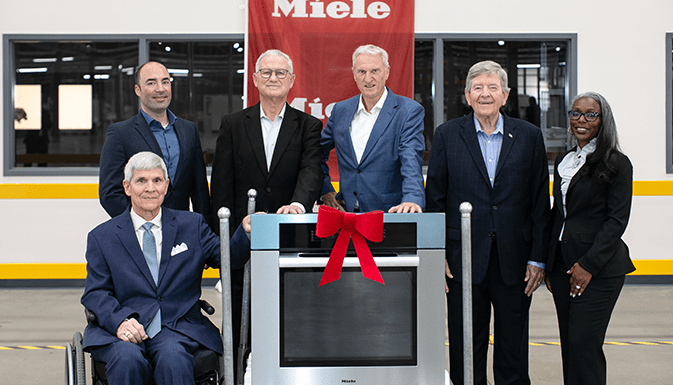
Miele, the world’s leading manufacturer of premium domestic home appliances, has officially commenced production at its first-ever US-based production plant. Located in Opelika, Alabama, the facility has begun producing its Generation 7000 built-in ovens, designed specifically for the North American market.
This Opelika facility will produce appliances for the neighboring US, Canada and Mexico markets, which will greatly reduce the delivery time from weeks to just a few days, while also lowering the impact on the environment. This much improved turnaround time is important as the US market continues to be a key growth market for Miele.
“The facility is up and running as part of the first phase of development,” said Uwe Brunkhorst, Senior Vice President of the Business Unit Cooking at Miele. “We are especially pleased that despite the tight timeline, the team has achieved their goal and production has started ahead of schedule – the first oven has officially come off the assembly line.”
“Collaboration between the production sites in both Germany and the US together with the newly hired and thoroughly trained staff played a crucial role in this success,” said Ulf M. Kranz, Managing Director of the Opelika production plant in the United States.
The first American employees were trained at the Oelde plant in Germany, and those members of the team are now taking on both assembly tasks as well as the training of new colleagues in Opelika. The thirty-five person on-site team is growing exponentially and in the first phase, the plant is slated to employ up to 150 people.
 WHITEGOODSNOW