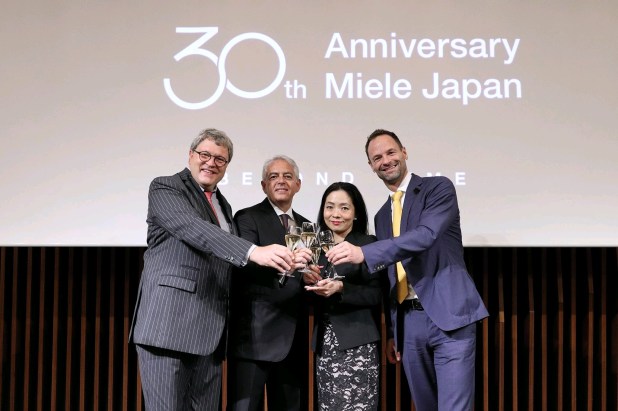
Miele Japan celebrates its 30th anniversary! When it was founded in 1992, it was the first subsidiary in Asia and the 21st in total. Starting with a small team, the local Miele team today numbers more than 110 employees.
To mark this anniversary, Dr. Axel Kniehl and Dr. Reinhard Zinkann travelled to Japan to offer their personal congratulations
As kitchens increasingly merge with dining and living areas, Miele proposes its dishwashers with FrontFit, a technology available with immediate effect ex works on selected models from the G 7000 series. With its new FrontFit feature, Miele has developed intelligent technology to affix cabinet fronts, suitable for all installation configurations.
Thanks to an integrated mechanical system, the cabinet front slides upwards slightly as the dishwasher door opens. This requires less space for the door swing arc below the dishwasher – hence requiring a gap of only a few millimetres and a particularly low plinth height.
«lThe ultimate in user convenience – the company explains – results from a combination of this feature with Miele’s tried-and-tested ComfortClose: a dishwasher with FrontFit is incredibly easy to open and close and the door remains stationary at any opening angle. As vertical door shift is less than 2 cm, machine controls remain easily accessible
Miele are committed to make sustainability happening every step. Make appliances that won’t leave a mark. End waste by giving our appliances new life. At IFA 2022, we’re showcasing their ambition and responsibility on sustainability. And this doesn’t end at the factory gate. Visit Miele at the trade fair in Berlin from September 1-6 or find out more here: https://www.miele.com/c/sustainability-3359.htm
Sustainability and climate protection will dominate the presentation of the world’s leading manufacturer of premium domestic appliances at the IFA in Berlin. A keen focus will be on the new technologies and features with which Miele aims to protect the environment and support users in acting more responsibly. These will feature alongside clever innovations for creative cooking and lifestyle which are only available from Miele. The family-owned company will present More than 400 appliances at a their booth in Building 2.1, accompanied by inspirational live events and starred chefs-de-cuisine offering food to sample. Trade fair motto: ‘Discover quality ahead of its time. For a better tomorrow’.
A contribution towards reducing food waste comes for example in the form of new free-standing refrigerators from the K 4000 series with their innovative PerfectFresh Active system in which the combination of a temperature of around zero degrees with humidity and a fine mist of water keeps vegetables and fruit crisp and attractive for up to five times longer. In addition, further improved smart cooking assistants and recipe apps as well as intelligent energy management, ensure more sustainability in the household. And more new products at the IFA trade fair mainly focus on the kitchen, starting with a well-known, particularly tasty, nutritious, and healthy preparation method: steam cooking.
In this field, Miele is expanding a model range which is already more than impressive by adding further models both at the top and the bottom ends of the lineup. In concrete terms, these are steam ovens which combine an oven or wall oven with first-class specifications with a fully-fledged steam cooker. Firstly, Miele will be presenting new models with top features, such as improved cleaning convenience. Secondly, there will be a new entry-line model series which will reduce the starting price in this sought-after product category by around one-third, making cooking with steam more accessible to a larger target audience. Miele will also be presenting a new entry-level series of ovens, with a new design, significantly more features and offering better value for money. And, in the booming market for induction hobs with an integrated downdraught extractor, there will be new models at IFA which guarantee more efficient extraction than their predecessors – whilst at the same time being noticeably quieter. All models have been tested to last 20 years. For that reason alone, a decision for Miele is a contribution towards everyday sustainability.
Miele arrived in Kraków! After an intense period of construction, furbishment, training and polishing, Miele Experience Center in Unity Center is officialy open.
UK Trade distributor PJH has signed a deal to add the full range of Miele built-in and freestanding appliances to its appliance offering.PJH already supply Elica, Neff, Bosch, Whirlpool, Hotpoint, Indesit, AEG. Electrolux and Zanussi, as well as its own brand Prima.
After four years of reconstruction, the future of the site is sustainably secured
Eight million euros invested in state-of-the-art production and logistics
Position as supplier of high-quality stainless steel components further strengthened
The Miele plant in Bürmoos near Salzburg has completely repositioned itself over the past four years – as a supplier of high-quality stainless steel components for almost all appliance plants in the Miele Group as well as for the Italian subsidiary Steelco Group. In addition, the new Miele subsidiary Otto Wilde Grillers has recently had its most established product range produced in Bürmoos. “Hardly a stone has been left unturned in our production halls,” says plant manager Dr. Hendrik Wermers. The necessary investments were made, for example, in a new cutting centre with laser processing and a fully automated high-bay warehouse, as well as in state-of-the-art production technology for surface processing When Miele set up its plant in Bürmoos in 1962, it was the first production site outside Germany. This step was originally intended to give Miele access to the EFTA free trade zone, which at the time existed parallel to the EU’s predecessor organisation, the EEC, and to which Austria also belonged. Initially, small-room washing machines, spin dryers, and waste compactors were produced, before the factory specialised more and more in the processing of stainless steel sheets and wires. From 2012 onwards, the production of sterilisers and so-called container washing systems was added, in which, for example, instrument trolleys or entire hospital beds are disinfected.
The next turning point followed in 2017, when Miele acquired a majority stake in the Italian medical technology specialist Steelco Group and bundled its entire hospital project business there. This was done to strengthen competitiveness in what was then, as now, a fiercely competitive market worldwide – and it also affected the manufacturing of the appliances produced in Bürmoos. Now the challenge was to compensate for this and at the same time further improve the cost structures. “A time frame of four years was defined for this, which our team used with great commitment and, above all, successfully,” says Hendrik Wermers. In the process, production on the 40,000 square metre site was largely dismantled and rebuilt, and the processes were completely restructured. What has remained is the focus on high-quality stainless steel components, which are now distributed among these three product segments:
Fascias and panels for washing machines, dryers and dishwashers, for example, as well for other built-in kitchen appliances from Miele (domestic and commercial),
baskets and inserts used in washer-disinfectors, disinfectors and sterilisers for medical facilities and laboratories
as well as complex assemblies for medical and laboratory technology, which are supplied in particular as large-scale appliance accessories to Miele’s subsidiary Steelco. In the past four years alone, Miele has invested eight million euros in Bürmoos, for example in a high-bay warehouse for the fully automated supply of production with sheet metal blanks as well as for the storage of finished parts which were previously cut or punched by laser. Another major investment concerns the production of front panels for Miele appliances, which the Bürmoos plant now produces more than twice as fast as before. This is ensured by a highly efficient automatic front panel machine, which brings together the stainless steel and plastic components and finally also applies the model- and country-specific printing.completely new manufacturing process for Miele in Bürmoos is surface treatment by means of so-called electropolishing. This refers to a multi-stage electrochemical process for the best possible smoothing of the surface to prevent the adhesion of viruses and bacteria. This is particularly important for baskets and inserts and other components for use in medical and laboratory technology.
“Unfortunately, about 80 jobs had to be eliminated in the course of the realignment,” reports plant manager Wermers, “but all colleagues who were affected at the time have for the most part found new jobs seamlessly, not least thanks to our good contacts with other companies.” In the meantime, Miele is expanding again in Bürmoos and currently employs around 220 people. “They have all done a great job over the past few years, for which I would like to sincerely thank each and every one of them,” says Hendrik Wermers, “and I would also like to thank the experts at the Miele Professional plants in Bielefeld and Lehrte, which are connected to us, for their support.”
The latest addition to Miele’s product portfolio in Bürmoos is the O.F.B. range from Miele’s new subsidiary Otto Wilde Grillers in Düsseldorf. This is a top-heat grill which, depending on the model, is heated with gas or electricity, operates at very high temperatures, and is largely made of high-quality stainless steel. This is why Hendrik Wermers had initially wanted to bring his factory into the game as a supplier of components, but then also won the final assembly for Bürmoos. “We have the expertise, the capacities and the flexibility for that.” A deal was quickly reached with the new customer: “We are counting on a long-term partnership, because the Bürmoos plant helps us to take the next steps in quality, scalability and further product optimisation, even for our most established product,” says Otto Wilde production manager Dr. Achim Schade. Furthermore, despite enormous cost pressures, the company is pleased to have found a partner in Bürmoos in the heart of Europe.
Miele has opened a major store in Solihull’s Touchwood shopping centre. Known for its premium and sustainable home appliances, Miele has picked the town for its latest ‘experience centre.’
The experience centre will be a dedicated retail unit in Touchwood, but will also provide customers the chance to try out its products. Expert sales staff will also be on hand to provide customers with the opportunity to fully explore Miele appliances live
Miele takes seriously the goal of reducing its carbon footprint by intervening at different levels on the entire production cycle. As an article in the South China Morning Post explains, the company has decided to purchase the steel necessary for its furnaces from the German steel mill Salzgitter whose production process, as verified by the certification body TUV Sud, reduces emissions by two thirds. of greenhouse gases both thanks to the use of arc furnaces and by using a greater share of scrap metal as raw material.
It is not clear to what extent this ‘green steel’ will be adopted in other productions, given the high cost and still very limited supply. Salzgitter is aiming to use ‘green’ hydrogen as an energy source, reducing the ecological impact of its product to 5% compared to conventional steel. In addition, Miele intends to increase the amount of recycled plastic used from 194 to 7,500 tons / year, especially for the production of vacuum cleaners.
The Gütersloh-based company has been offsetting the greenhouse gases generated by its plants since last year, financing reforestation projects in Mississippi, Uganda and Nicaragua, as well as solar energy plants in India and biogas in Nepal.
In 2021, honey sales rose by 7.5% to 4.8 billion euros and should easily exceed 5 billion in 2022 to reach 8 billion in 2030.



 WHITEGOODSNOW