
The world’s leading home appliance brand and smart home ecosystem builder, Haier Smart Home (“Haier”, Shanghai: 600690), is introducing upgraded products and next-generation smart home solutions integrated with IoT to global customers at the 128th virtual Canton Fair that started on October 15.
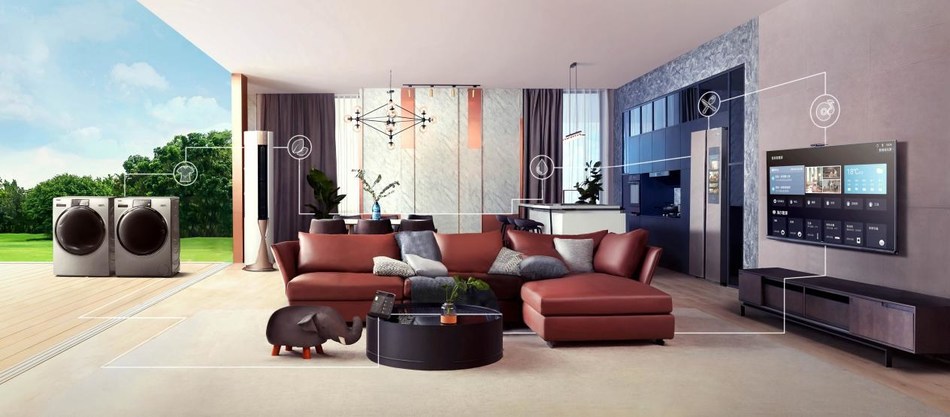
Haier’s virtual exhibition adopted VR, cloud computing, big data and AI technologies to bring an experience as close to visiting the actual fair booth as possible. Haier is hosting several virtual showrooms, presenting new products and services while giving global buyers opportunities to virtually interact and find out more.
Global visitors are invited to experience Haier’s smart home solutions and how they meet the users’ needs comprehensively in the areas of cooking, living, clothing and entertainment.
A highlight of Haier’s virtual exhibition is the food IoT ecosystem covering kitchen-related scenarios. The integration of appliances, grocery supply, logistics, training and more will provide users with a richer experience of smart cooking and dining. By working with Haier’s partners within its smart home ecosystem, the users’ daily needs of shopping, food storage, cooking, cleaning and safety can be met.
Haier will introduce two health and wellness scenarios involving clean air-conditioning and clean air, as well as a pleasant sleeping experience in smart bedrooms. In addition to the voice control features, Haier’s new range of air-conditioners will have a degerming function that sterilizes the appliance at the temperature of 56 degrees Celsius for 30 minutes, which saves the hassle of physically cleaning the air-conditioner.
Meanwhile, Haier also features smart solutions for laundry and at-home workout. The new washing and drying machines will be able to identify clothes, shoes and garments and choose appropriate cleaning programs automatically.
“Haier aims to promote smart, healthy, sustainable lifestyle for households around the world. Our integrated smart homes solutions not only make life easier for everyone, but more enjoyable and engaging as we connect the appliances and services across our smart home ecosystem,” said Qingfu Zhang, VP of Haier Overseas Electric Appliances Corp.
Despite the global downtrend due to the COVID-19 outbreak, Haier has continued to achieve growth in revenue across the global market. Overall, Haier’s overseas revenue reached 47 billion yuan (US$ 7.07 billion) in the first half of 2020, a 0.6 percent year-on-year increase and makes up 49 percent of the company’s total revenue.
In Europe, Haier’s revenue reached 6.7 billion yuan (US$ 997 million), Germany and Italy sales grew by 61 percent and 52 percent respectively, and the sales volume of refrigeration appliances ranked top five in France, Great Britain, Italy and Russia. In Asia, Haier Smart Home respectively achieved 16.3% revenue increase to 18 billion yuan (US$ 2.67 billion) and 7% increase in Southeast Asian market with 21 billion yuan (US$ 3.12 billion).
About Haier
Founded on April 1989, Haier Smart Home Co., Ltd. (former Qingdao Haier Co., Ltd., Shanghai: 600690) is the world’s leading home appliance maker. The Company boasts seven world-class brands including Haier, Casarte, Leader, GE Appliances-US, Fisher & Paykel-New Zealand, AQUA-Japan, and Candy-Italy.
According to Euromonitor International’s 2020 Global Major Appliances Brand Rankings, Haier’s retail sales volume of large household appliances ranked the first in the world for 11 consecutive years. Haier Smart Home is also a Fortune Global 500 company.
Haier Smart Home focuses on the continuous enhancement of the best user experience so as to provide consumers with smart home solutions, create a complete smart life experience, and offer design and function options customized for and by users.
For more information, visit: http://www.haier.net/en/
SOURCE Haier Smart Home


 Haier Smart Home Reopens Domestic Factories and Resumes Production at Full speed.
