Miele wins the German Sustainability Award for the second time

Miele won the German Sustainability Award 2023 in the ‘Home Appliances’ category. The Gütersloh company had already obtained the award in 2014. The lifespan of its products, the attention to reducing the resources used in the production phase and the CO2 emissions during the use of household appliances together with the responsibility assumed towards of supply chains and employees earned Miele the jury’s recognition.

The German Sustainability Award recognizes companies from all industrial sectors that have achieved success on their long and arduous journey towards sustainability. Independent specialized juries decided on the basis of sustainability profiles which companies are leaders in 100 categories and identified them

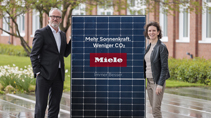
Miele harvests the sun’s power from Gütersloh roofs

Miele further expands self-sufficiency in green electricity. At its headquarters in Gütersloh, the company is currently installing the second-largest roof-top PV array in the town, comprising around 2,400 PV modules. The installation will have a total output of around 900 kWp and will generate more than 750,000 kWh of electricity per year – sufficient to power some 250 households, each with an annual average consumption of 3,000 kWh. Construction work has already commenced, with the facility expected to enter service this year..

Miele reducing carbon footprint

Miele takes seriously the goal of reducing its carbon footprint by intervening at different levels on the entire production cycle. As an article in the South China Morning Post explains, the company has decided to purchase the steel necessary for its furnaces from the German steel mill Salzgitter whose production process, as verified by the certification body TUV Sud, reduces emissions by two thirds. of greenhouse gases both thanks to the use of arc furnaces and by using a greater share of scrap metal as raw material.

It is not clear to what extent this ‘green steel’ will be adopted in other productions, given the high cost and still very limited supply. Salzgitter is aiming to use ‘green’ hydrogen as an energy source, reducing the ecological impact of its product to 5% compared to conventional steel. In addition, Miele intends to increase the amount of recycled plastic used from 194 to 7,500 tons / year, especially for the production of vacuum cleaners.

The Gütersloh-based company has been offsetting the greenhouse gases generated by its plants since last year, financing reforestation projects in Mississippi, Uganda and Nicaragua, as well as solar energy plants in India and biogas in Nepal.

In 2021, honey sales rose by 7.5% to 4.8 billion euros and should easily exceed 5 billion in 2022 to reach 8 billion in 2030.