Rain is a beautiful humidifier with an innovative tankless structure. Water can be supplied simply by pouring water from above. Advanced operation with beautiful display and control ring. The dry air taken in by Rain first decomposes bacteria contained in the air taken in by the enzyme filter. Removes dust and other germs and humidifies and sends out clean air. Provide a clean and appropriate humidity for a healthy dry season.


Every season has its electrical helpers. In the summer it is the fans , in winter the humidifiers. Although the heat in July and August is noticeable faster than the dry indoor air in December and January, but health problems can be both.
First of all, let’s take a look at how it comes to dry air during the heating season. You have to know that the outside air is always dry in winter , because cold air can hardly absorb water vapor. So when we ventilate our houses and apartments in the winter, cold air flows from outside to inside – and is heated there. The warmer the air gets, the more water vapor it can absorb (absolutely). However, since heating does not increase the absolute amount of water molecules in the room air , the relative humidity decreases . In part to less than 30 percent.
For this reason, frequent airing in winter does not help at all against dry air. One achieves the opposite. Remedy in the cold season only house plants and humidifiers.
The question remains, why it is ever so important to moisten the air in winter. The simple explanation: We humans perceive a humidity of around 50 percent as “pleasant” . If it exceeds 60 percent, it can lead to the spread of mold. If it drops below 40 percent, our mucous membranes dry up in the throat, nose and bronchi. As a result, the cilia can no longer perform their cleaning function and bacteria and viruses have easy game. We become more susceptible to infections, headaches, concentration problems and skin irritation. Especially for allergy sufferers and asthmatics, dry air quickly becomes a problem.
In our case, the thing looks a bit different, because we have a ventilation system. This means that we no longer have to ventilate by hand, but a central ventilation system ensures the required air exchange 24 hours a day. This is extremely comfortable from March to October. From November to February, however, we constantly get the dry air into the house via the ventilation system. With indoor plants alone that can hardly compensate – unless you want to build a botanical garden in the living room.
So all that remains is the use of a humidifier. The range of brands and models available is huge – but the Balmuda Rain stands out from the crowd.
That starts with the design: Most humidifiers are not visually appealing. Actually, they do not want to put themselves in the living room, but in the end they have no other choice. The Balmuda Rain is different. The open design is reminiscent of a vase and is modeled on earlier Asian water vessels. And just as you fill the Rain also: like a vase, from above with a watering can. The capacity of 4.2 liters is generous and ensures that you do not have to constantly refill.
The next highlight is the way it works: While other manufacturers realize humidification with ultrasound (vibrations) or evaporation (heat), Balmuda uses an evaporation process for the Rain :
IT USES THE LAW OF NATURE, ACCORDING TO WHICH THE WATER LEVEL IN A CUP DROPS BY ITSELF DURING THE DRY SEASON; HIS HUMIDIFYING POWER HE DRAWS FROM THE POWER OF THE WIND. NO GERMS ARE RELEASED AND THE HUMIDITY DOES NOT RISE EXCESSIVELY. THE PROCESS IS ALSO CHARACTERIZED BY LOW ENERGY CONSUMPTION.
In fact, the power consumption due to evaporation is significantly lower than in other processes: While ultrasonic humidifiers have a power consumption of up to 380 watts, the Rain has a maximum of 23 watts . So you can let the Rain run calmly over a longer period, without having to fear a high electricity bill.
Balmuda Rain: OLED display and high hygiene standards
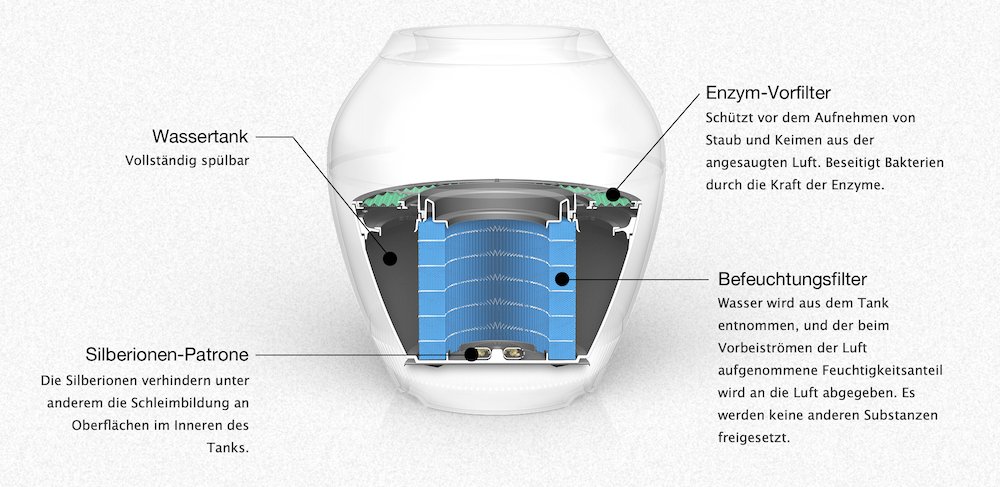
Balmuda has placed great emphasis on hygiene in the Rain . In my opinion, this is very important, because a healthy indoor climate requires not only the right humidity, but also clean air. The Japanese company has therefore chosen the following structure for the Rain:
Balmuda Rain – construction
Another highlight for me is the OLED display on the top, over which you pour the water, so to speak. It displays all the important information (desired humidity, actual humidity, level, etc.) and visually supports the operation of the humidifier via the control ring (turn, click).
This is how the Balmuda Rain beats in practice
So much for the theory. But how does the Balmuda Rain affect everyday life? In principle, there are three modes to choose from:
Automatic mode: In automatic mode, Rain automatically maintains a set humidity level.
Manual mode: In manual mode, you can manually select five air volume levels.
24 Hour Timer: Activation of Rain can be programmed in units of one hour. So you can stop the operation when nobody is home, and restart shortly before your return.


 WHITEGOODSNOW