Bring the Café Home

La Pavoni Unveils the New Cellini Espresso Range
If you’ve been dreaming of taking your morning coffee to the next level, Italian espresso icon La Pavoni has some fantastic news for you.
Unveiled at the World of Coffee event, the legendary brand has officially launched its brand-new Cellini range—a sleek, semi-professional lineup designed specifically for the booming “home barista” movement. Rather than settling for a standard quick brew, more of us are treating coffee making as an art. These gorgeous machines aim to make that professional, high-quality café experience something you can achieve right on your own kitchen counter.
Here is a quick look at the four standout models making up the new lineup:
1. Mini Cellini X
Perfect for tight kitchen spaces, this compact powerhouse features a heat exchanger (HX) and an integrated PID temperature control system. That means you can steam milk and pull a shot at the same time without losing thermal stability. It comes with a professional 58mm portafilter and is available in three stunning finishes: classic polished steel, matte white, and matte black.
2. Cellini EVO PID
Built for reliability and precision, the EVO PID offers incredibly stable temperature management thanks to its advanced PID system and dual-scale pressure gauge. Like the Mini, it’s a heat-exchanger machine available in steel, matte white, or matte black, but with a slightly larger profile designed for those who want effortless consistency cup after cup.
3. Cellini Dual
If you are looking for zero compromises, the Cellini Dual features a double boiler system with independent electronic PID controls. This gives you absolute control over both brewing and steaming temperatures separately. It also integrates a Brew Pressure Profiling Control (BPPC) system so you can manually monitor and manipulate your extraction pressure.
4. Cellini Specialty
The flagship of the range, the Cellini Specialty is designed for the ultimate home coffee enthusiast. It utilizes a dual-boiler configuration paired with dual PIDs to offer commercial-grade thermal stability. Pulling perfect double shots while steaming velvety microfoam for your lattes becomes entirely seamless and highly intuitive.
> “With the Cellini range, we wanted to bring professional technology and extraction standards directly into the home,” says Alessio Pezzoni, CEO of La Pavoni.
>
If you are looking to upgrade your coffee station, these Italian-built beauties perfectly balance high-end commercial tech with gorgeous kitchen aesthetics.

Toy to Table: Why Toy Giant Pop Mart is Building an In-House Home Appliance Division

What happens when a blind-box toy phenomenon decides it wants a permanent spot on your kitchen counter?
According to recent industry hiring spikes, Chinese pop-culture and toy giant Pop Mart is pulling back the curtain on a major strategic pivot. The company has begun aggressively recruiting top-tier talent across small domestic appliance (SDA) research and development (R&D), procurement, and quality control.
While the brand hasn’t dropped an official press release just yet, the industry writing is on the wall: Pop Mart is no longer content with just licensing its characters to third-party appliance brands. They are building their own hardware pipeline.
Beyond the Blind Box: The Search for a Second Growth Curve
For years, Pop Mart’s bread and butter has been the highly addictive, collectible blind box. But collectibility has a ceiling. To sustain long-term growth and transition from a trendy toy brand into a lifestyle staple—much like Disney or Sanrio—Pop Mart needs its intellectual property (IP) embedded in everyday life.
Unlike a collectible figurine that sits passively on a shelf, small appliances offer high-frequency daily interaction. Every time a consumer makes a morning espresso or grabs a cold drink, they interact with the brand. Furthermore, younger consumers are increasingly buying appliances based on aesthetics, emotional resonance, and “vibe” rather than raw technical specifications. This plays directly into Pop Mart’s core strength: emotional design and IP marketing.
The LABUBU Lesson: Why Licensing Failed the Quality Test
Pop Mart isn’t entirely green to the appliance space. They previously dipped their toes in the water via third-party licensing partnerships, resulting in limited-edition LABUBU-branded retro refrigerators, coffee makers, and desktop fans.
The most famous experiment—the LABUBU limited mini-fridge—initially triggered a massive wave of hype. It sold out instantly and saw resale prices skyrocket on the secondary market. However, the bubble burst quickly. Because the product was an OEM (Original Equipment Manufacturer) white-label unit with basic performance but a massive premium price tag, buyers quickly complained about mid-tier build quality and sluggish after-sales support. Resale values plummeted.
The takeaway for Pop Mart was clear: In the white goods and appliance sector, utility is king. You can sell a toy purely on emotional value, but an appliance must work reliably, or the consumer backlash will damage the IP itself.
The Strategy: “IP + Lifestyle” Instead of Technical Warfare
Pop Mart’s recruitment drive for internal R&D signals an attempt to solve this quality control bottleneck. By taking design, procurement, and quality verification in-house, they can tightly control product standards while cutting out the heavy markups associated with third-party licensing.
Industry analysts note that Pop Mart has no intention of competing head-to-head with traditional white goods giants like Midea or Haier on pure performance or scale. Instead, they are carving out a distinct niche: functional, high-aesthetic home goods that prioritize emotional value.
The Verdict for WhiteGoodsNow
The crossover between pop culture and home appliances is getting crowded. Sanrio has mastered licensing, and MINISO has scaled white-label collaborations. Pop Mart’s decision to handle hardware internally is a much riskier, high-capital play.
For the appliance industry, it’s a space worth watching closely. If Pop Mart can successfully balance the emotional allure of its characters with robust product reliability and solid after-sales service, they might just write a brand-new playbook for the premium SDA market.

MIDEA SHOWCASES INNOVATION AND CONNECTIONWITH THE WIRELESS POWER CONSORTIUM

Small Appliances Demonstrate the Capabilities of the Ki Cordless Kitchen Standard

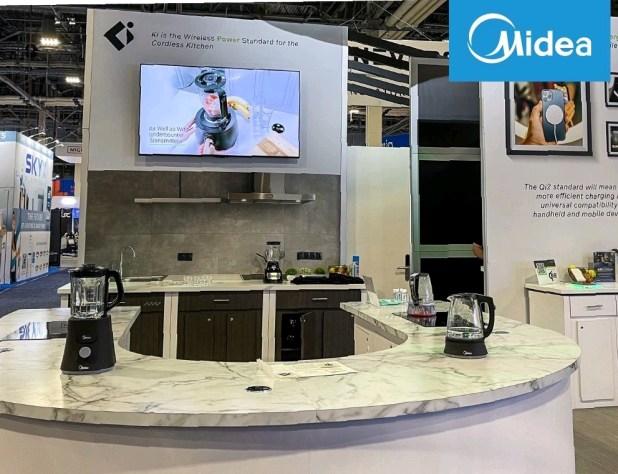
Midea is excited to announce it will exhibit innovative prototype kitchen appliances during the consumer electronics industry’s largest tradeshow – CES 2023, January 5-8, 2023 in Las Vegas, NV. As part of the Wireless Power Consortium’s – a global standard development body for wireless power – booth (Tech West, Venetian Expo #53529), Midea’s prototype appliances, including a blender and electric kettle, will be displayed in the emerging Ki Cordless Kitchen which builds on the success of the Qi standard for wireless charging. The appliances are activated by special transmitters hidden beneath both glass induction cooktops as well as non-metal countertop surfaces to create a convenient, sleek, ultra-modern design for the kitchen. The appliances are then powered by inductive power transfer with no cords to get in the way.

“As the connected world continues to evolve, Midea is proud to be at the forefront of innovating by providing consumers with smart, connected solutions that serve a purpose in people’s everyday lives,” said Kurt Jovais, president of Midea America Corp. “The Wireless Power Consortium supports our mission and is revolutionizing the industry with its Ki Cordless Kitchen. We look forward to working together to elevate the at-home experience with smart technology in our users’ homes.”

This collaboration is built on proven technologies and guided by the Wireless Power Consortium whose members come together from all parts of the industry and all parts of the globe to create worldwide compatibility of all wireless chargers and wireless power sources.

“The Ki Cordless Kitchen standard eli minates the clutter of cords that come with small appliances, creating a more convenient, safer and sleeker designed kitchen,” said Paul Golden, Marketing Director, Wireless Power Consortium. “We’re excited to have Midea as part of our Ki Cordless Kitchen, a company with ground-breaking home appliances that homeowners rely on worldwide.”

The new Ki Cordless Kitchen wireless power standard is currently in development. More information can be found by visiting WirelessPowerConsortium.com/Kitchen. And for additional details on Midea and its entire portfolio of appliances, please visit Midea.com.