According to the Business Research company, the global household laundry equipment market size is expected to grow from $101.43 billion (€96.76bn) in 2021 to $110.84 billion (€105.74bn) in 2022 at a compound annual growth rate (CAGR) of 9.3%.
The growth in the market is mainly due to the companies rearranging their operations and recovering from the COVID-19 impact, which had earlier led to restrictive containment measures involving social distancing, remote working, and the closure of commercial activities that resulted in operational challenges. The household laundry market is expected to reach $150.93 billion (€143.94bn) in 2026 at a CAGR of 8.0%.
Rapid urbanisation is expected to contribute to the growth of the household laundry equipment in the forecast period. Globally, the percentage of population living in urban areas is expected to increase from 56.2% in 2020 and reach 68% by 2050. The growth in the urban population coupled with the rise in disposable incomes and affordability among residents of cities will drive the demand for household laundry equipment.
Laundry
Increasing demand for online on demand laundry services is expected to restrain the market for household laundry equipment in the forecast period. The on-demand laundry services market is expected to be aided by stable economic growth forecast in many developed and developing countries.
The International Monetary Fund (IMF) predicts that the global real GDP growth will be 3.7% over 2019 and 2020, and 3.6% from 2021 to 2023. Additionally, emerging markets are expected to continue to grow slightly faster than the developed markets in the forecast period. For instance, China is forecast to register GDP growth of 6.2% in 2019.
Stable economic growth, increasing internet penetration, and rising disposable income coupled with hectic lifestyle of individuals will lead to an increase in on demand laundry services, thereby limiting the growth of the market for household washing machines.
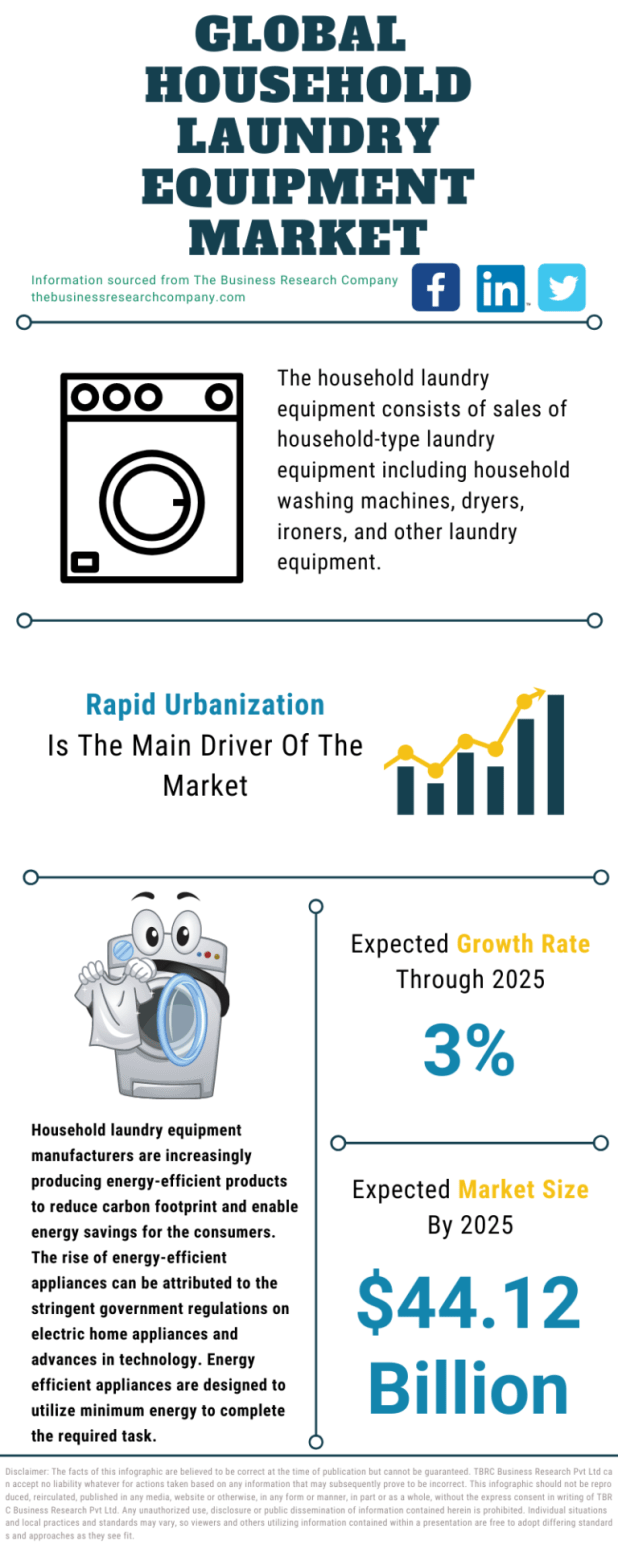
Household laundry equipment manufacturers are increasingly producing energy-efficient products to reduce carbon footprint and enable energy savings for the consumers. The rise of energy-efficient appliances can be attributed to the stringent government regulations on electric home appliances and advances in technology. Energy efficient appliances are designed to utilise minimum energy to complete the required task.Currently, over 80 countries have standards and labels for energy efficient appliances. For example, in the USA, ENERGY STAR certified washing machines use 25% less energy and 33% less water than a standard washing machine.
Major players in the household laundry equipment market are LG Electronics, Whirlpool Corporation, Haier Corporation, Electrolux AB, Panasonic Corporation, BSH Home Appliances Group, Haier Group Corporation, Miele, Siemens AG, Toshiba Corporation, and General Electric Company.
Asia Pacific was the largest region in the household laundry equipment market in 2021. Western Europe was the second-largest region in the household laundry equipment market. The regions covered in the household laundry equipment market are Asia-Pacific, Western Europe, Eastern Europe, North America, South America, Middle East and Africa.
Smart washing machines: APAC has lion’s share
Asia-Pacific has the largest smart washing machine market share globally, accounting for a whopping 59% of the total in 2021. It was followed by Western Europe, and then the other regions. Going forward, the fastest-growing regions in the smart washing machines market will be Africa and the Middle East where growth will be at CAGRs of 14.8% and 10.8% respectively. These will be followed by South America and North America. global smart washing machine market size is expected grow from $14.87 billion (€14.9bn) in 2021 to $15.93 billion (€15.2bn) in 2022 at a compound annual growth rate (CAGR) of 7.1%.
The growth in the market is mainly due to the companies resuming their operations and adapting to the new normal while recovering from the COVID-19 impact, which had earlier led to restrictive containment measures involving social distancing, remote working, and the closure of commercial activities that resulted in operational challenges. The smart washing machine market is expected to reach $20.83 billion (€19.87bn) in 2026 at a CAGR of 6.9%.
Smart Washing Machine Market Trends Hinge On Adoption Of Advanced Technologies
Wi-Fi
Companies in the smart washing machines market are investing in Wi-Fi technology in order to increase processing speed.
Voice-Enabled
Companies in the smart washing machines market are investing in voice-enabled washing machines for market growth.
Internet of Things
Companies in the washing machines market are investing in IoT technologies in washing machines to offer customized solutions. IoT-enabled devices are embedded with sensors, internet connectivity, and other hardware that allows communication via the web.Companies in the smart washing machines market are investing significantly in AI technology. AI can identify data types, find possible connections among datasets, and recognize knowledge using natural language processing. Users will be able to use their smartphones or voice assistants to control these AI powered washing machines.
The global smart washing machines market is highly fragmented, with a large number of players. The top ten competitors in the market made up to 38.6% of the total market in 2021. Haier Smart Home Co., Ltd. was the largest competitor with 9.36% share of the market, followed by LG Electronics, Whirlpool Corporation, AB Electrolux, Panasonic Corporation, Samsung Electronics Co Ltd, Arcelik A.S., Xiaomi Corporation, Robert Bosch GmbH, and Miele.


 WHITEGOODSNOW