
The proposal to expand the EU’s Carbon Border Adjustment Mechanism (CBAM) to include washing machines, refrigerators, and dryers is both timely and essential.
More than 75% of large household appliances produced in Europe are sold within the EU. As a result, manufacturers are directly exposed to rising material and production costs driven by the Emissions Trading System (ETS).
With free ETS allowances being phased out, European producers will face increasing carbon costs—costs that imported finished goods can currently avoid. This widening “carbon gap” risks distorting the market and undermining Europe’s capacity to innovate.
Why extending CBAM matters
Bringing home appliances into the CBAM framework would:
– Level the playing field by ensuring imported goods face equivalent carbon costs
– Encourage global decarbonisation by rewarding low‑carbon manufacturing practices
– Safeguard EU climate ambition by preventing carbon leakage and reinforcing the ETS
To fully achieve CBAM’s objectives, we urge the European Parliament and the Council of the EU to extend coverage to additional home appliance categories that face similar carbon leakage risks.
A comprehensive approach is the only way to protect European industry while staying true to the EU’s climate commitments.
Category Archives: Domestic appliance news,
India Emerges as a Global Growth Engine for Appliance Giants
BSH Home Appliances Group, the company behind Bosch and Siemens appliances, has reported 7% growth in India for FY25, even as its global revenue dipped by around 1.6% year‑on‑year. The contrast is striking, and it underscores a clear trend: India is becoming a critical growth anchor for global white goods players.Dr. Matthias Metz, CEO of BSH, summed it up succinctly:
“BSH Home Appliances India is an extremely important market that demands separate focus.”
Samsung Confirmed as Italy’s Most Preferred Fridge and Washing Machine Brand for 2025
Samsung has once again been named Italy’s favourite brand for refrigerators and washing machines, according to the 2025 Ipsos Brand Attitude survey. The study, conducted in 30 countries, measures brand strength through indicators such as the Most Preferred metric — a spontaneous, single‑answer question asking consumers which brand they favour above all others.
Samsung has held the top spot in both categories since 2018.
“We have been the reference brand in the Refrigerator and Washing Machine categories since 2018,” said Daniele Grassi, Vice President & Head of Home Appliances at Samsung Italy. “Such a long‑lasting result shows that consumers are more than satisfied and recommend us to others.”
Grassi added that Samsung’s leadership reflects a shift among Italian consumers who now view appliances — with lifespans of 7–10 years — as long‑term investments, prioritising performance and quality over price alone.
BSH Reports Stable 2025 Performance With Growth Across Most Regions
BSH Home Appliances Group closed the 2025 fiscal year with €15.0 billion in sales. Adjusted for currency effects, this reflects a slight 1.6% dip, though local‑currency growth reached 2.8%. The company saw positive momentum in North America, Europe, and Emerging Markets, while Greater China remained challenging.
Regional Highlights
North America delivered strong results, with over 5% growth in local currency and continued market‑share gains. Premium brands Gaggenau and Thermador, along with built‑in refrigeration and gas cooktops, drove performance. BSH also strengthened the Bosch brand and its overall competitiveness in the region.
In Europe, sales rose 1.2% despite ongoing price pressure. Built‑in appliances grew 4%, supported by solid demand in Germany, the UK, Spain, the Netherlands, and Italy.
The Emerging Markets region posted 2.3% growth—and an impressive 24% in local currency—across Turkey, Eastern Europe, the Middle East, India, and Africa. BSH also advanced its footprint with a new factory in Cairo. India will become an autonomous region in 2026 due to its scale and strategic importance.
Only Greater China declined, with sales down 7.1% amid persistent market weakness, though BSH maintained its leading position among non‑Chinese manufacturers.
Product Category Trends
Most categories showed resilience in 2025:
– Cooking appliances returned to growth: ovens up 2.0%, hobs and extractor hoods up 2.6%, with rising demand for hobs with integrated ventilation.
– Dishwashers grew 2.1%.
– Small appliances held steady at +0.1%.
– Customer Service revenue edged up 0.3%, reinforcing BSH’s focus on product longevity and customer satisfaction.
Cooling (–4.0%) and laundry (–1.0%) declined, largely due to intense competition in Greater China.
Sabaf Group Reports Solid 2025 Results Amid Deep Sadness for the Loss of CEO Pietro Iotti
Sabaf Group has released its 2025 financial results, but this year’s numbers arrive under the shadow of profound loss. The sudden passing of CEO Pietro Iotti has left the entire organisation grieving, with emotions far outweighing the satisfaction of a positive—though complex—financial performance.
A Year of Stability and Selective Growth
Despite a challenging macroeconomic environment, Sabaf closed 2025 with revenues up 0.8%, reaching €279 million. Profitability also showed resilience:
– EBITDA rose 2.4% to €41 million, representing nearly 15% of total revenues.
– Net profit, however, declined from €16 million to €13 million, reflecting higher costs and a more cautious market.
Even with the dip in net profit, the Board of Directors expressed confidence in the company’s financial health. They intend to maintain the dividend at €0.58 per share, a signal of stability to shareholders and stakeholders alike.
Leadership Transition During a Difficult Moment
In the wake of Iotti’s passing, Sabaf has moved swiftly to ensure continuity and steady governance.
– Gianluca Beschi, previously Chief Financial Officer, will step into the role of CEO.
– Andrea Bonfadelli, Technical Director of the Gas Division and Director of the Supply Chain, has been appointed General Manager.
Both leaders are long-standing figures within the Ospitaletto-based company, and their appointments reflect Sabaf’s commitment to internal expertise and strategic continuity.
Looking Ahead
While the financial results demonstrate resilience, 2025 will be remembered as a year marked by loss. Yet Sabaf’s leadership, operational strength, and long-term vision position the company to move forward with stability and respect for the legacy of Pietro Iotti.
Midea Outlines Strategic Role for Küppersbusch in Its European Expansion
Midea has offered fresh clarity on how Küppersbusch—its German premium appliance brand acquired last year—will fit into the group’s broader European strategy. According to Ralph Kobsik, Managing Director of Midea Europe GmbH, the company intends to keep Küppersbusch operating as an independent, premium‑focused entity.
The move signals Midea’s ambition to strengthen its presence in the high‑end appliance market, an area where Küppersbusch has long held strong brand equity. Rather than folding the brand into Midea’s mainstream portfolio, the company plans to preserve its distinctive identity, design language, and market positioning.
Kobsik confirmed that the initial strategic focus will be on refrigeration and built‑in appliances, two categories where Küppersbusch has historically excelled. New product designs will remain aligned with the brand’s established aesthetic, ensuring continuity for loyal customers and retail partners.
However, one major shift is already underway: production will not return to the former Essen facility, which has now closed. While manufacturing will be relocated, Midea emphasises that the brand’s design DNA and premium positioning will remain intact.
This clarification offers a clearer picture of how Midea plans to balance scale with exclusivity—leveraging Küppersbusch’s heritage while integrating it into a broader European growth strategy.
WhiteGoodsNow will continue tracking developments as Midea refines its premium‑market ambitions.
Cafom Group buyer of the brands belonging to the Brandt Group.
The Nanterre Commercial Court has selected the Cafom Group as the buyer of the brands belonging to the Brandt Group. The deal, valued at €18.6 million, covers four well-known appliance brands—Brandt, Sauter, De Dietrich, and Vedette—along with their associated patents and existing inventory.
Following the acquisition, Cafom has already restarted distribution of these brands in both the French and international markets. The group has also outlined plans to progressively reindustrialize production, with a clear intention to maintain manufacturing activities in France 🇫🇷.
To support this strategy, Cafom has partnered with Arpa, an Alsatian company specializing in cooking appliances. Arpa will notably take charge of induction cooktop production and is expected to create over 50 jobs in the short term, rising to around 130 positions in the longer term as part of a new oven production and assembly line.
At the same time, EverEver, a start-up based in Brittany that had previously submitted its own bid for the brands, has been approached to help develop a new range of washing machines scheduled for launch in the coming months.
Cafom says the project represents a major step in strengthening the French appliance industry.
“We are proud to launch this ambitious project, which will create jobs in France, preserve national industrial heritage, and protect the purchasing power of French consumers,” the group stated. “This initiative also reinforces our position as a leading player in the distribution of home furnishings and household equipment.”
Through this acquisition and its industrial partnerships, Cafom aims to revitalize historic French appliance brands while rebuilding local manufacturing capacity—a move that could bring both economic and industrial benefits in the years ahead.
Hoover reintroduced to Australia, New Zealand and the Pacific Islands.
Tempo and Techtronic Industries (TTi) have entered a new distribution partnership that will see Hoover whitegoods reintroduced to Australia, New Zealand and the Pacific Islands.
Under the agreement, a refreshed Hoover range of major domestic appliances—including laundry, refrigeration and dishwashing—will roll out later this year. The move marks a significant expansion opportunity for the brand, which carries more than a century of heritage in home appliances.
By leveraging Tempo’s established market presence and TTi’s distribution strength, Hoover is set to broaden its footprint across the region and become accessible to a wider base of customers.
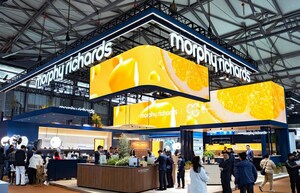
Morphy Richards Celebrates 90 Years of Innovation at AWE 2026
Under the theme “Time Forged, Vision Forward,” Morphy Richards marked its 90th anniversary at AWE 2026 with major product debuts and an AWE Innovation Award for the Kitchen Master 2‑in‑1 Mixing Fryer.
The brand showcased three flagship launches:
– the Fully Automatic Coffee Machine with hot‑and‑cold dual extraction,
– the InfuseChill Flavoured Ice Maker, introducing customizable multi‑flavour ice,
– and the Fully Automatic High‑Speed Blender, offering one‑touch heating, blending, dispensing, and sanitizing.
The award‑winning Kitchen Master impressed with its spatial‑folding design, integrating mixing and frying into a compact, streamlined workflow tailored for modern, space‑conscious kitchens.
Celebrating nine decades of engineering heritage and global growth, Morphy Richards reaffirmed its commitment to More Stylish, Higher Quality, Smarter innovation—continuing to shape the future of everyday living.
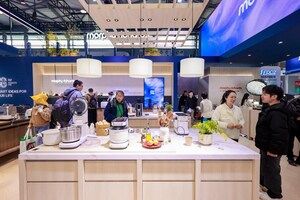
Midea/Teka built-in launch
At the European Trade Conference in Venice, Midea showcased one of its most ambitious product portfolios to date, reinforcing its strategic push into the European market. The brand introduced major innovations across built‑in appliances, refrigeration, laundry care, and small domestic appliances—each designed to meet the evolving needs of consumers and industry professionals.
Built‑In Appliances: Three New Series for Every Kitchen Style
Midea’s built‑in category takes a significant leap forward with the launch of three new lines—Eleva, Ispira, and Essenza—each tailored to a different market segment.
Eleva: Premium Performance Meets Contemporary Design
Positioned at the top of the range, the Eleva series blends advanced technology with refined aesthetics. Key features include:
– TasteXpress®: a high‑temperature grill system for fast, crispy results
– XpressControl™: precise temperature management down to 30°C
– Control On‑the‑Go: remote operation via the SmartHome app
– Modern design with touch UI and a side knob for intuitive control
Eleva is engineered for consumers who want both high‑end performance and a sleek, modern look.
Ispira: Versatility and High Performance
The Ispira line focuses on flexibility and speed, making it ideal for dynamic, everyday cooking. Highlights include:
– XpressFry™: a 360° hot‑air system for crispier textures
– XpressCook: up to 2500 W of power to cut cooking times
– Dedicated pizza function for expanded culinary possibilities
Ispira is designed for households that value performance without compromising versatility.
Essenza: Accessible Quality
For a more budget‑friendly segment, Essenza delivers solid performance with:
– XL cavity capacity for larger dishes
– Even‑Pro Technology ensuring uniform heat distribution
Essenza offers reliable functionality at an accessible price point.
 WHITEGOODSNOW