
For decades, we’ve built major domestic appliances—especially cooktops—as self-contained “boxes.” You buy a cooktop, and the heating elements, UI, and power boards are all crammed together under a single pane of glass.
But what happens when you separate the coils from the brain?
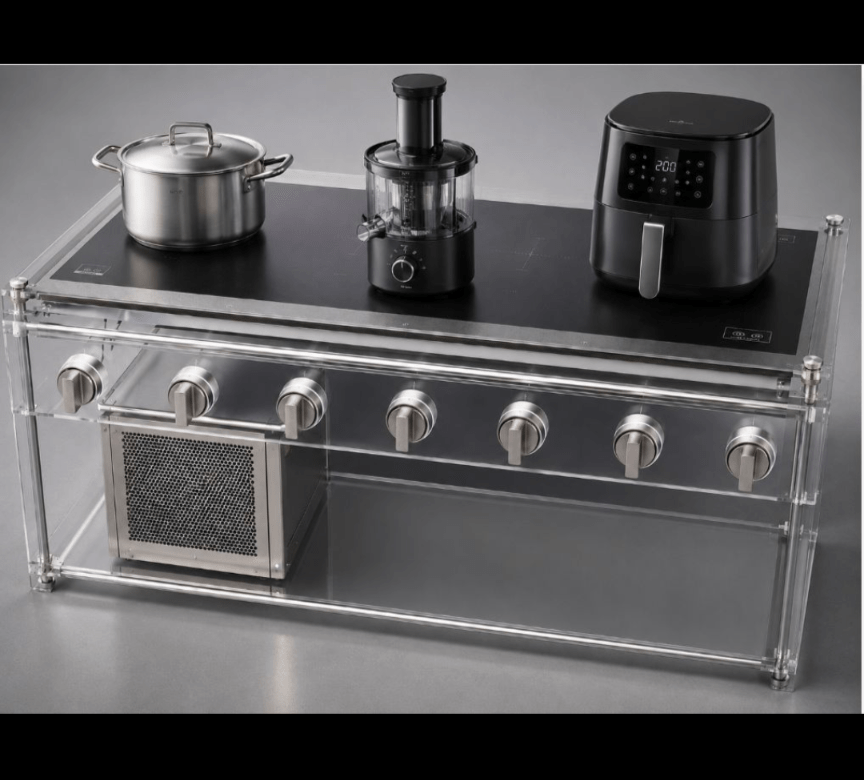
By decoupling the physical induction coils from the heavy-duty power control boards, we are witnessing a massive architectural shift in kitchen design. This modular separation is redefining what “white goods” can actually do.
Novanest is a China-based OEM and ODM manufacturer focused on invisible and full-zone induction cooking solutions.
Why This Architecture is a Game-Changer
1. Ultra-Slim, “Invisible” Aesthetics
When you remove the bulky power boards from beneath the countertop, the space needed directly under the stove is slashed to almost nothing. This allows designers to create paper-thin kitchen islands with fully usable drawer space right beneath the cooking zone.
2. A Giant Leap for Right-to-Repair & Maintenance
Traditionally, if a power board fails, the entire glass cooktop has to be pried out of the counter. Under this new layout, the main electronic units live in an easily accessible side cabinet. Technicians can service or swap the “brain” of the appliance in minutes without ever touching the countertop seal.
3. Infinite Customization (1 to 8+ Zones)
Because the cooking zones are modular, manufacturers aren’t locked into rigid 30-inch or 36-inch footprints. Kitchens can be configured with two zones, six zones, or even irregular layouts spanning across an entire island, scaling effortlessly from high-end residential homes to demanding commercial kitchens.
4. Turning the Countertop into a Wireless Power Grid
The real magic happens when you pair this modular design with wireless power standards. Suddenly, the same glass or stone slab doesn’t just heat pots—it serves as a wireless energy hub. Homeowners can place a blender, cordless kettle, or air fryer directly on the surface, drawing power without a single messy cord in sight.
The Takeaway: The next generation of white goods isn’t about selling standalone appliances. It’s about turning the kitchen island into a unified, flexible energy platform.

