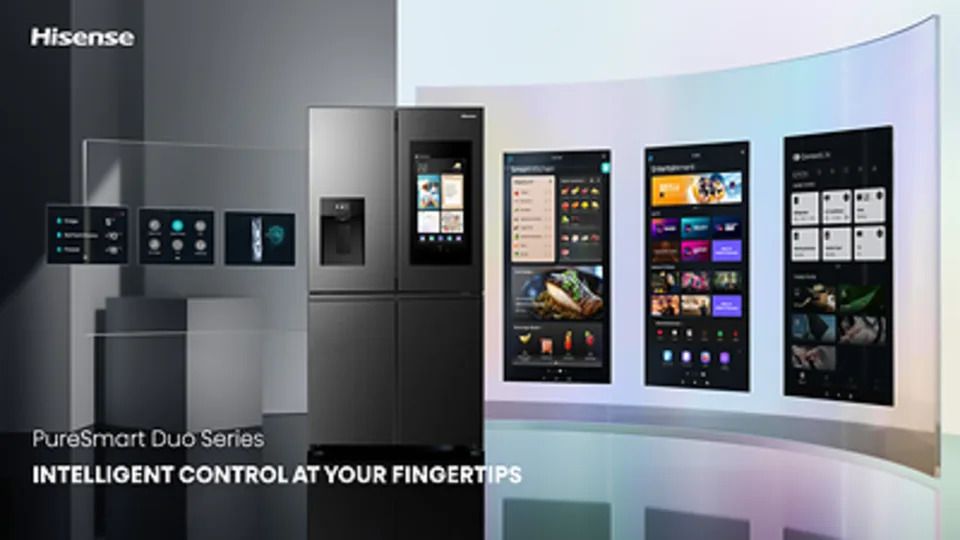
Hisense is expanding its AI Companion Suite with the PureSmart Duo refrigerator series, positioning the kitchen as a connected hub for cooking, entertainment and social interaction. The launch reflects a wider shift in the white goods market towards intelligent appliances designed to simplify everyday routines.
Hisense is taking its vision for the connected home a step further, bringing artificial intelligence into the kitchen with its new PureSmart Duo refrigerator series.
Building on the AI Companion Suite introduced at IFA 2026, the new range aims to transform the refrigerator from a food storage appliance into a central point for meal planning, entertainment and connected living.
The development highlights how manufacturers are increasingly looking beyond traditional appliance functions, using smart technology and connected ecosystems to create more integrated experiences for consumers.
The refrigerator becomes a connected kitchen hub
At the centre of the PureSmart Duo range is a four-door refrigerator offering 611 litres of storage and an integrated 21-inch smart screen.
The display brings together entertainment and practical kitchen functions, with access to streaming content through the VIDAA platform, live TV and music. The aim is to allow users to stay connected and entertained while preparing meals or spending time with family and friends.
The refrigerator also incorporates an ice and water system offering crescent and crushed ice, alongside UV-purified water. Hisense states that the water system delivers a 99.9% sterilisation rate.
Beyond these features, the launch reflects a broader ambition to make the refrigerator an active part of the household’s daily routine, rather than simply a place to store fresh and frozen food.
AI moves beyond individual appliances
The PureSmart Duo launch builds on Hisense’s AI Companion Suite, which connects appliance functions and services through its ConnectLife platform.
The wider ecosystem focuses on three key areas of domestic life: cooking, laundry care, and air and energy management.
In the kitchen, connected appliances are designed to help users explore recipes and coordinate food preparation. By bringing together information about ingredients and food preferences, AI-assisted services can help households decide what to cook and guide them through the process.
In laundry care, intelligent features aim to simplify garment management by identifying fabric requirements and helping coordinate washing and drying programmes.
Meanwhile, connected air and energy solutions are intended to adapt the home environment to changing conditions and user preferences.
Together, these developments illustrate a move towards connected appliance ecosystems in which products work alongside one another, rather than operating as separate smart devices.
Making technology part of everyday life
Hisense is also placing greater emphasis on the social role of the kitchen.
Through its Social Kitchen concept, the company envisages a space where technology supports shared activities, from choosing recipes together to preparing drinks for guests.
The refrigerator’s smart screen and Beverage Master feature are designed to support this experience, allowing users to select drinks and follow preparation instructions.
The proposition is that connected technology can help reduce the effort involved in organising meals and entertaining, leaving more time for the social side of home life.
For manufacturers, this also presents an opportunity to broaden the appeal of premium refrigeration by combining storage capacity and core appliance functionality with digital services and connected features.
What does this mean for the white goods market?
The latest announcement underlines the growing importance of software, connectivity and AI in appliance development.
For the white goods sector, the opportunity lies in making these technologies useful in practical, everyday situations. Consumers may be interested in smart screens and AI-assisted services, but the long-term value will depend on how effectively they improve convenience, simplify tasks and integrate with products already in the home.
Connectivity also creates opportunities for manufacturers to build stronger appliance ecosystems, linking refrigeration, cooking, laundry and climate management through a common platform.
However, the success of these approaches will depend on factors including ease of use, reliability, compatibility, privacy and the ongoing usefulness of connected services. Manufacturers will need to demonstrate that intelligent features deliver meaningful benefits alongside the fundamentals of appliance performance, efficiency and durability.
A more connected future for domestic appliances
With the PureSmart Duo series, Hisense is continuing to develop its vision of AI-assisted living, placing the refrigerator at the centre of a more connected kitchen.
The launch forms part of a wider industry shift towards appliances that can do more than perform a single task, using digital services and connected systems to support everyday household routines.
As the white goods market continues to evolve, the challenge for manufacturers will be to turn these capabilities into tangible consumer benefits. For Hisense, the PureSmart Duo represents another step towards a kitchen where refrigeration, cooking, entertainment and communication come together in one connected experience.